Facultad de Educación y Ciencias Sociales, Universidad Andres Bello, 4030000, Concepción, Chile.
Facultad de Economia y Negocios, Universidad Andres Bello, Fernandez Concha 700, Las Condes, Santiago, Chile.
Sci Rep. 2023 Aug 17;13(1):13386. doi: 10.1038/s41598-023-39843-7.
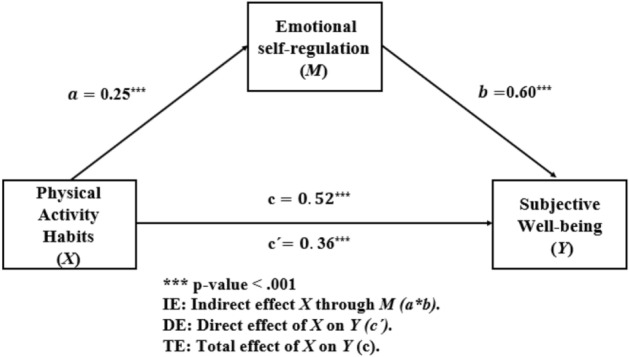
Adolescents' subjective well-being and physical activity have been found to be correlated in previous studies. However, the underlying mechanisms of this relationship, especially the potential contribution of emotional self-regulation, have received little attention. This study aims to investigate the extent to which emotional self-regulation mediates the association between adolescent physical activity habits and their subjective well-being. The study involved 9585 adolescents who completed a cross-sectional survey. Participants were aged between 10 and 19 years old and attended primary and secondary schools in all 16 regions of Chile. The survey utilized a self-report questionnaire to measure physical activity habits, subjective well-being, and emotional self-regulation. Sociodemographic variables, such as age, gender, and socioeconomic level, were also considered in the analysis. The results showed that physical activity habits, emotional regulation, and subjective well-being were positively correlated. Among these factors, the strongest association was found between subjective well-being and emotional self-regulation. The mediation analysis revealed a partial mediation effect of emotional self-regulation between physical activity habits and subjective well-being. In other words, physical activity habits affect subjective well-being to the extent that these habits affect emotional self-regulation. These findings provide valuable insights into the mechanisms underlying the link between physical activity habits and subjective well-being among adolescents. They also offer useful information for the development of public programs and policies aimed at promoting physical activity habits and subjective well-being in young people.
先前的研究发现,青少年的主观幸福感和身体活动之间存在相关性。然而,这种关系的潜在机制,特别是情绪自我调节的潜在贡献,还没有得到太多关注。本研究旨在探讨情绪自我调节在多大程度上介导了青少年身体活动习惯与主观幸福感之间的关联。
该研究涉及 9585 名青少年,他们完成了一项横断面调查。参与者年龄在 10 至 19 岁之间,来自智利所有 16 个地区的小学和中学。该调查采用自陈式问卷来测量身体活动习惯、主观幸福感和情绪自我调节。社会人口变量,如年龄、性别和社会经济水平,也在分析中考虑。
结果表明,身体活动习惯、情绪调节和主观幸福感之间存在正相关。在这些因素中,主观幸福感和情绪自我调节之间的关联最强。中介分析显示,情绪自我调节在身体活动习惯和主观幸福感之间存在部分中介效应。换句话说,身体活动习惯对主观幸福感的影响程度取决于这些习惯对情绪自我调节的影响程度。
这些发现为身体活动习惯和青少年主观幸福感之间的联系提供了有价值的见解。它们还为制定旨在促进年轻人身体活动习惯和主观幸福感的公共计划和政策提供了有用信息。