Chayanun Slila, Chanamuangkon Theerapat, Boonsuth Budsaraporn, Boccaccini Aldo R, Lohwongwatana Boonrat
Biomedical Engineering Program, Faculty of Engineering, Chulalongkorn University, Bangkok, 10330, Thailand.
Biomedical Engineering Research Center, Chulalongkorn University, Bangkok, Thailand.
Mater Today Bio. 2023 Jul 29;22:100754. doi: 10.1016/j.mtbio.2023.100754. eCollection 2023 Oct.
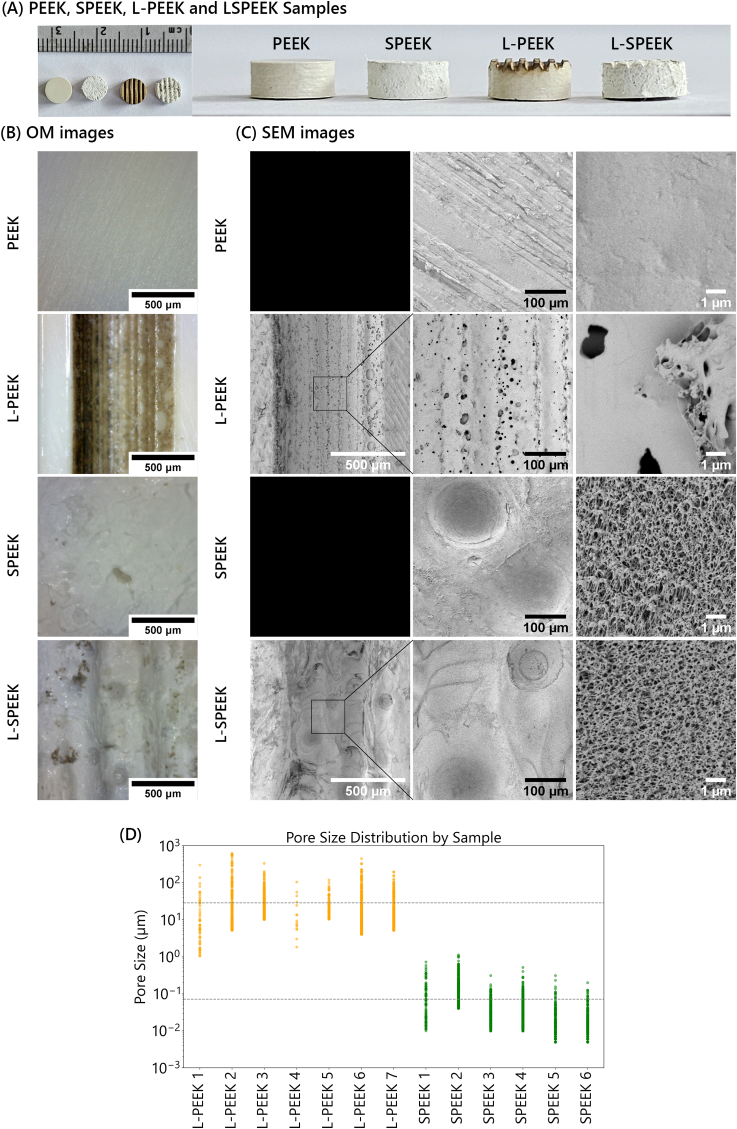
Due to its superior mechanical properties and chemical stability, Polyetheretherketone (PEEK) has emerged as an alternative to conventional metal implants. However, the bio-inertness of PEEK's surface has limited its applications. Ambient sulfonation has been adopted to enhance bioactivity, but its nanoscale topographic changes are insufficient for implant-bone interlock. To further improve bone-implant interlock, this study employs CO laser machining to create sub-millimeter (0.5 mm) grooves on PEEK's surface, aiming to encourage bone ingrowth and strengthen the implant-bone interface. This research investigated the physical and chemical properties and bio-interaction of PEEK surface modified by sulfonation (SPEEK), laser machining (L-PEEK), and combination of both technique (L-SPEEK). X-ray photoelectron spectroscopy (XPS) spectra revealed that sulfonation compensates for the surface chemical shift instigated by laser ablation, aligning the surface chemistry of L-SPEEK with that of SPEEK. Furthermore, L-PEEK surfaces presented pores with sizes ranging from 1 to 600 μm, while SPEEK surfaces exhibited pores between 5 and 700 nm. All tested samples demonstrated non-cytotoxicity, with L-SPEEK exhibiting the highest mineralization and ALP activity as 2 and 2.1 times that of intrinsic PEEK, after 21 days of incubation. Microscopic imaging reveals a notably higher extracellular content on L-SPEEK compared to the other groups. This study underscores the potential of combining sub-millimeter laser machining with sulfonation in enhancing early osteogenic markers, providing a promising pathway for future PEEK-based orthopedic applications.
由于其优异的机械性能和化学稳定性,聚醚醚酮(PEEK)已成为传统金属植入物的替代品。然而,PEEK表面的生物惰性限制了其应用。已采用环境磺化来增强生物活性,但其纳米级地形变化不足以实现植入物与骨的互锁。为了进一步改善骨与植入物的互锁,本研究采用CO激光加工在PEEK表面制造亚毫米(0.5毫米)凹槽,旨在促进骨向内生长并加强植入物与骨的界面。本研究调查了通过磺化(SPEEK)、激光加工(L-PEEK)以及两种技术结合(L-SPEEK)改性的PEEK表面的物理和化学性质以及生物相互作用。X射线光电子能谱(XPS)光谱显示,磺化补偿了激光烧蚀引起的表面化学位移,使L-SPEEK的表面化学与SPEEK的表面化学一致。此外,L-PEEK表面呈现出尺寸范围为1至600μm的孔隙,而SPEEK表面的孔隙在5至700nm之间。所有测试样品均显示无细胞毒性,在孵育21天后,L-SPEEK的矿化和碱性磷酸酶(ALP)活性最高,分别是原始PEEK的2倍和2.1倍。显微镜成像显示,与其他组相比,L-SPEEK上的细胞外物质含量明显更高。本研究强调了亚毫米激光加工与磺化相结合在增强早期成骨标志物方面的潜力,为未来基于PEEK的骨科应用提供了一条有前景的途径。