Institute for Global Health, University College London, London, UK.
UCL Institute of Health Informatics, University College London, London, UK.
Age Ageing. 2023 Aug 1;52(8). doi: 10.1093/ageing/afad141.
Severe acute respiratory syndrome coronavirus 2 (SARS-CoV-2) caused severe disease in unvaccinated long-term care facility (LTCF) residents. Initial booster vaccination following primary vaccination is known to provide strong short-term protection, but data are limited on duration of protection and the protective effect of further booster vaccinations.
To evaluate the effectiveness of third, fourth and fifth dose booster vaccination against SARS-CoV-2 related mortality amongst older residents of LTCFs.
Prospective cohort study.
LTCFs for older people in England participating in the VIVALDI study.
Residents aged >65 years at participating LTCFs were eligible for inclusion if they had at least one polymerase chain reaction or lateral flow device result within the analysis period 1 January 2022 to 31 December 2022. We excluded individuals who had not received at least two vaccine doses before the analysis period. Cox regression was used to estimate relative hazards of SARS-CoV-2 related mortality following 1-3 booster vaccinations compared with primary vaccination, stratified by previous SARS-CoV-2 infection and adjusting for age, sex and LTCF size (total beds).
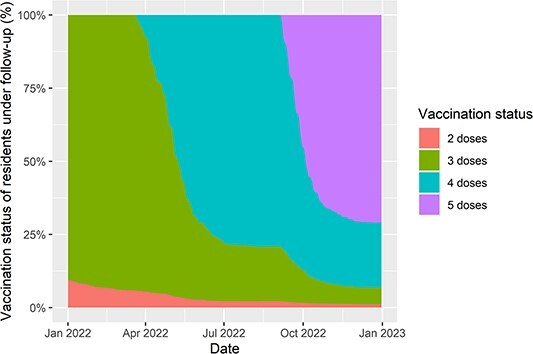
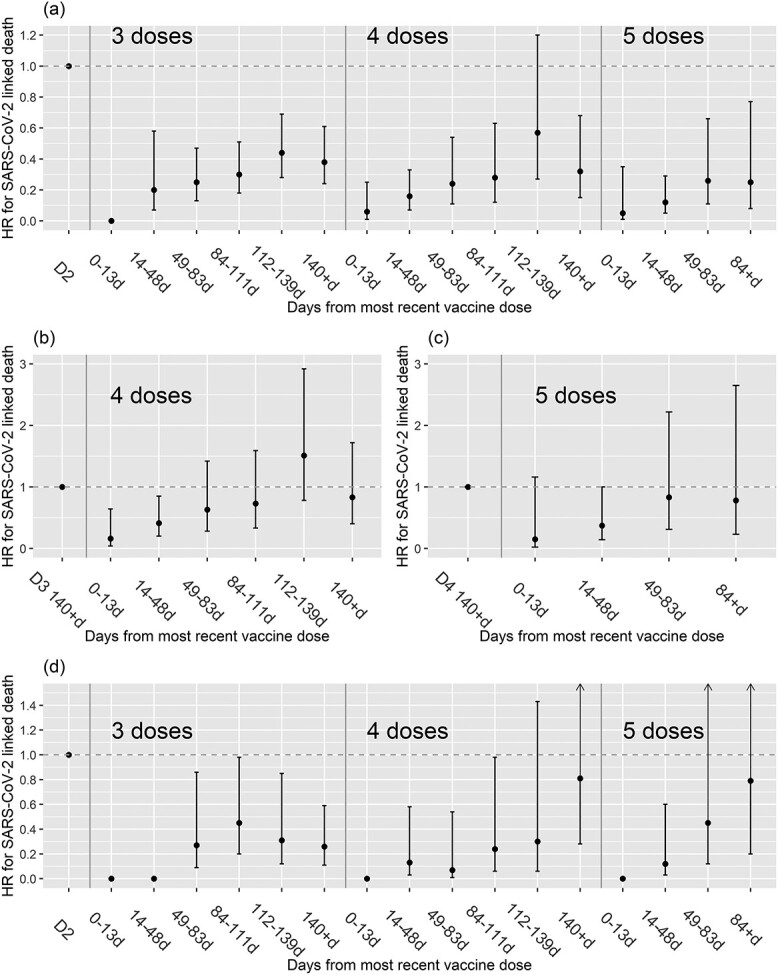
A total of 13,407 residents were included. Our results indicate that third, fourth and fifth dose booster vaccination provide additional short-term protection against SARS-CoV-2 related mortality relative to primary vaccination, with consistent stabilisation beyond 112 days to 45-75% reduction in risk relative to primary vaccination.
Successive booster vaccination doses provide additional short-term protection against SARS-CoV-2 related mortality amongst older LTCF residents. However, we did not find evidence of a longer-term reduction in risk beyond that provided by initial booster vaccination.
严重急性呼吸综合征冠状病毒 2(SARS-CoV-2)可导致未接种疫苗的长期护理机构(LTCF)居民出现重症疾病。已知初级疫苗接种后的初次加强接种可提供强有力的短期保护,但关于保护持续时间和进一步加强接种的保护效果的数据有限。
评估第三次、第四次和第五次 SARS-CoV-2 加强疫苗接种对 LTCF 老年居民与 SARS-CoV-2 相关死亡率的效果。
前瞻性队列研究。
英格兰参与 VIVALDI 研究的老年人 LTCF。
如果参与 LTCF 的年龄 >65 岁的居民在分析期间(2022 年 1 月 1 日至 2022 年 12 月 31 日)至少有一次聚合酶链反应或侧向流动装置结果,则有资格入选。我们排除了在分析期之前未接种至少两剂疫苗的个体。Cox 回归用于估计与初级疫苗接种相比,1-3 次加强接种后与 SARS-CoV-2 相关的死亡率的相对危险度,按以前的 SARS-CoV-2 感染分层,并调整年龄、性别和 LTCF 规模(总床位)。
共有 13407 名居民被纳入研究。结果表明,与初级疫苗接种相比,第三次、第四次和第五次加强疫苗接种可提供针对 SARS-CoV-2 相关死亡率的额外短期保护,在 112 天以上的时间内风险降低 45-75%,且结果稳定。
连续加强疫苗接种剂量可提供针对 LTCF 老年居民与 SARS-CoV-2 相关死亡率的额外短期保护。然而,我们没有发现与初始加强接种相比,风险降低的长期效应。