Singh Chandramani, Verma Savita, Reddy Prabhakar, Diamond Michael S, Curiel David T, Patel Chintan, Jain Manish Kumar, Redkar Sagar Vivek, Bhate Amit Suresh, Gundappa Vivek, Konatham Rambabu, Toppo Leelabati, Joshi Aniket Chandrakant, Kushwaha Jitendra Singh, Singh Ajit Pratap, Bawankule Shilpa, Ella Raches, Prasad Sai, Ganneru Brunda, Chiteti Siddharth Reddy, Kataram Sreenivas, Vadrevu Krishna Mohan
All India Institute of Medical Sciences, Patna, Bihar, India.
Pt. BD Sharma Postgraduate Institute of Medical Sciences (PGIMS), Rohtak, Haryana, India.
NPJ Vaccines. 2023 Aug 18;8(1):125. doi: 10.1038/s41541-023-00717-8.
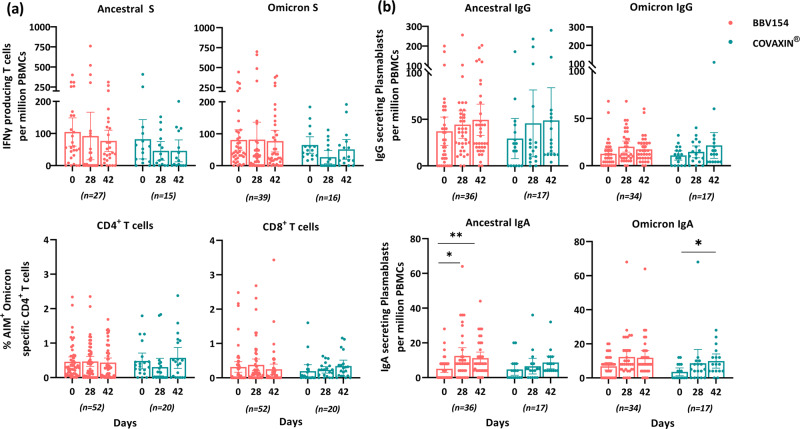
One of the most preferable characteristics for a COVID-19 vaccine candidate is the ability to reduce transmission and infection of SARS-CoV-2, in addition to disease prevention. Unlike intramuscular vaccines, intranasal COVID-19 vaccines may offer this by generating mucosal immunity. In this open-label, randomised, multicentre, phase 3 clinical trial (CTRI/2022/02/40065; ClinicalTrials.gov: NCT05522335), healthy adults were randomised to receive two doses, 28 days apart, of either intranasal adenoviral vectored SARS-CoV-2 vaccine (BBV154) or licensed intramuscular vaccine, Covaxin. Between April 16 and June 4, 2022, we enrolled 3160 subjects of whom, 2971 received 2 doses of BBV154 and 161 received Covaxin. On Day 42, 14 days after the second dose, BBV154 induced significant serum neutralization antibody titers against the ancestral (Wuhan) virus, which met the pre-defined superiority criterion for BBV154 over Covaxin. Further, both vaccines showed cross protection against Omicron BA.5 variant. Salivary IgA titers were found to be higher in BBV154. In addition, extensive evaluation of T cell immunity revealed comparable responses in both cohorts due to prior infection. However, BBV154 showed significantly more ancestral specific IgA-secreting plasmablasts, post vaccination, whereas Covaxin recipients showed significant Omicron specific IgA-secreting plasmablasts only at day 42. Both vaccines were well tolerated. Overall reported solicited reactions were 6.9% and 25.5% and unsolicited reactions were 1.2% and 3.1% in BBV154 and Covaxin participants respectively.
除预防疾病外,新冠疫苗候选产品最理想的特性之一是能够减少严重急性呼吸综合征冠状病毒2(SARS-CoV-2)的传播和感染。与肌肉注射疫苗不同,鼻内新冠疫苗可能通过产生黏膜免疫来实现这一点。在这项开放标签、随机、多中心3期临床试验(CTRI/2022/02/40065;ClinicalTrials.gov:NCT05522335)中,健康成年人被随机分配接受两剂间隔28天的鼻内腺病毒载体SARS-CoV-2疫苗(BBV154)或已获许可的肌肉注射疫苗Covaxin。在2022年4月16日至6月4日期间,我们招募了3160名受试者,其中2971人接受了两剂BBV154,161人接受了Covaxin。在第42天,即第二剂疫苗接种14天后,BBV154诱导产生了针对原始(武汉)病毒的显著血清中和抗体滴度,符合BBV154优于Covaxin的预先设定的优越性标准。此外,两种疫苗均显示出对奥密克戎BA.5变体的交叉保护作用。发现BBV154组的唾液免疫球蛋白A(IgA)滴度更高。此外,对T细胞免疫的广泛评估显示,由于既往感染,两个队列的反应相当。然而,接种疫苗后,BBV154组产生了显著更多的针对原始病毒的分泌IgA的浆母细胞,而Covaxin组的受试者仅在第42天出现了显著的针对奥密克戎的分泌IgA的浆母细胞。两种疫苗的耐受性均良好。总体而言,BBV154组和Covaxin组报告的预期反应分别为6.9%和25.5%,非预期反应分别为1.2%和3.1%。