• 文献检索
  • 文档翻译
  • 深度研究
  • 学术资讯
  • Suppr Zotero 插件Zotero 插件
  • 邀请有礼
  • 套餐&价格
  • 历史记录
应用&插件
Suppr Zotero 插件Zotero 插件浏览器插件Mac 客户端Windows 客户端微信小程序
定价
高级版会员购买积分包购买API积分包
服务
文献检索文档翻译深度研究API 文档MCP 服务
关于我们
关于 Suppr公司介绍联系我们用户协议隐私条款
关注我们

Suppr 超能文献

核心技术专利:CN118964589B侵权必究
粤ICP备2023148730 号-1Suppr @ 2026

文献检索

告别复杂PubMed语法,用中文像聊天一样搜索,搜遍4000万医学文献。AI智能推荐,让科研检索更轻松。

立即免费搜索

文件翻译

保留排版,准确专业,支持PDF/Word/PPT等文件格式,支持 12+语言互译。

免费翻译文档

深度研究

AI帮你快速写综述,25分钟生成高质量综述,智能提取关键信息,辅助科研写作。

立即免费体验

深度伪造与科学知识传播。

Deepfakes and scientific knowledge dissemination.

机构信息

RAND Corporation, Santa Monica, USA.

Carnegie Mellon University, Pittsburgh, USA.

出版信息

Sci Rep. 2023 Aug 18;13(1):13429. doi: 10.1038/s41598-023-39944-3.

DOI:10.1038/s41598-023-39944-3
PMID:37596384
原文链接:https://pmc.ncbi.nlm.nih.gov/articles/PMC10439167/
Abstract

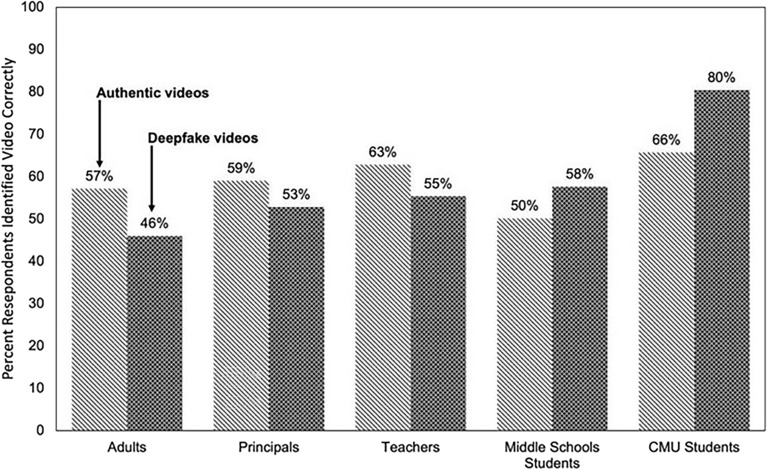
Science misinformation on topics ranging from climate change to vaccines have significant public policy repercussions. Artificial intelligence-based methods of altering videos and photos (deepfakes) lower the barriers to the mass creation and dissemination of realistic, manipulated digital content. The risk of exposure to deepfakes among education stakeholders has increased as learners and educators rely on videos to obtain and share information. We field the first study to understand the vulnerabilities of education stakeholders to science deepfakes and the characteristics that moderate vulnerability. We ground our study in climate change and survey individuals from five populations spanning students, educators, and the adult public. Our sample is nationally representative of three populations. We found that 27-50% of individuals cannot distinguish authentic videos from deepfakes. All populations exhibit vulnerability to deepfakes which increases with age and trust in information sources but has a mixed relationship with political orientation. Adults and educators exhibit greater vulnerability compared to students, indicating that those providing education are especially susceptible. Vulnerability increases with exposure to potential deepfakes, suggesting that deepfakes become more pernicious without interventions. Our results suggest that focusing on the social context in which deepfakes reside is one promising strategy for combatting deepfakes.

摘要

从气候变化到疫苗接种,各种主题的科学错误信息都对公共政策产生重大影响。基于人工智能的修改视频和照片的方法(深度伪造)降低了大规模制作和传播逼真的、受操控的数字内容的门槛。由于学习者和教育者依赖视频来获取和分享信息,教育利益相关者接触深度伪造的风险增加了。我们进行了第一项研究,以了解教育利益相关者对科学深度伪造的脆弱性以及影响脆弱性的特征。我们的研究以气候变化为基础,调查了来自五个群体的个人,涵盖学生、教育工作者和成年公众。我们的样本在三个群体中具有全国代表性。我们发现,27-50%的人无法区分真实视频和深度伪造视频。所有群体都容易受到深度伪造的影响,这种影响随着年龄和对信息源的信任而增加,但与政治倾向的关系较为复杂。成年人和教育工作者比学生更容易受到影响,这表明提供教育的人尤其容易受到影响。随着对潜在深度伪造的接触增加,脆弱性也会增加,这表明如果不采取干预措施,深度伪造会变得更加有害。我们的研究结果表明,关注深度伪造存在的社会背景是对抗深度伪造的一种有前途的策略。
https://cdn.ncbi.nlm.nih.gov/pmc/blobs/78c3/10439167/9357d04daac2/41598_2023_39944_Fig1_HTML.jpg

相似文献

1
Deepfakes and scientific knowledge dissemination.深度伪造与科学知识传播。
Sci Rep. 2023 Aug 18;13(1):13429. doi: 10.1038/s41598-023-39944-3.
2
A Review of Image Processing Techniques for Deepfakes.深度伪造的图像处理技术综述。
Sensors (Basel). 2022 Jun 16;22(12):4556. doi: 10.3390/s22124556.
3
Deepfakes and students' deep learning: A harmonious pair in science?
Science. 2024 Aug 30;385(6712):eadr8354. doi: 10.1126/science.adr8354. Epub 2024 Aug 29.
4
Do deepfake videos undermine our epistemic trust? A thematic analysis of tweets that discuss deepfakes in the Russian invasion of Ukraine.深度伪造视频是否破坏了我们的认知信任?对讨论俄罗斯入侵乌克兰中的深度伪造的推文的主题分析。
PLoS One. 2023 Oct 25;18(10):e0291668. doi: 10.1371/journal.pone.0291668. eCollection 2023.
5
Audio deepfakes: A survey.音频深度伪造:一项调查。
Front Big Data. 2023 Jan 9;5:1001063. doi: 10.3389/fdata.2022.1001063. eCollection 2022.
6
Warning: Humans cannot reliably detect speech deepfakes.警告:人类无法可靠地识别语音深度伪造。
PLoS One. 2023 Aug 2;18(8):e0285333. doi: 10.1371/journal.pone.0285333. eCollection 2023.
7
Fooled twice: People cannot detect deepfakes but think they can.被愚弄两次:人们无法察觉深度伪造,但却认为自己能做到。
iScience. 2021 Oct 29;24(11):103364. doi: 10.1016/j.isci.2021.103364. eCollection 2021 Nov 19.
8
Do Deepfakes Adequately Display Emotions? A Study on Deepfake Facial Emotion Expression.深度伪造能否充分展示情感?一项关于深度伪造面部表情表达的研究。
Comput Intell Neurosci. 2022 Oct 18;2022:1332122. doi: 10.1155/2022/1332122. eCollection 2022.
9
Using deepfakes for experiments in the social sciences - A pilot study.利用深度伪造技术进行社会科学实验——一项试点研究。
Front Sociol. 2022 Nov 29;7:907199. doi: 10.3389/fsoc.2022.907199. eCollection 2022.
10
Prediction of self-efficacy in recognizing deepfakes based on personality traits .基于人格特质预测对深度伪造的自我效能感。
F1000Res. 2023 Oct 12;11:1529. doi: 10.12688/f1000research.128915.3. eCollection 2022.

引用本文的文献

1
Interpretation of AI-Generated vs. Human-Made Images.人工智能生成图像与人工制作图像的解读。
J Imaging. 2025 Jul 7;11(7):227. doi: 10.3390/jimaging11070227.
2
Comparative analysis of public and expert perceptions of electrified vehicles in the European Union.欧盟公众与专家对电动汽车看法的比较分析。
Sci Rep. 2025 Jul 1;15(1):21695. doi: 10.1038/s41598-025-06071-0.
3
False failures, real distrust: the impact of an infrastructure failure deepfake on government trust.虚假失败,真正的不信任:基础设施故障深度伪造对政府信任的影响。

本文引用的文献

1
Deepfake detection by human crowds, machines, and machine-informed crowds.基于人类群体、机器和机器辅助的人类群体的深度伪造检测。
Proc Natl Acad Sci U S A. 2022 Jan 4;119(1). doi: 10.1073/pnas.2110013119.
2
The dangers of blind trust: Examining the interplay among social media news use, misinformation identification, and news trust on conspiracy beliefs.盲目信任的危险:审视社交媒体新闻使用、错误信息识别以及新闻信任对阴谋论信仰的相互作用。
Public Underst Sci. 2021 Nov;30(8):977-992. doi: 10.1177/0963662521998025. Epub 2021 Mar 5.
3
Measuring the impact of COVID-19 vaccine misinformation on vaccination intent in the UK and USA.
Front Psychol. 2025 May 23;16:1574840. doi: 10.3389/fpsyg.2025.1574840. eCollection 2025.
4
Lightweight and hybrid transformer-based solution for quick and reliable deepfake detection.基于轻量级和混合变压器的快速可靠深度伪造检测解决方案。
Front Big Data. 2025 Apr 1;8:1521653. doi: 10.3389/fdata.2025.1521653. eCollection 2025.
5
The public mental representations of deepfake technology: An in-depth qualitative exploration through Quora text data analysis.深度伪造技术的公众心理表征:通过Quora文本数据分析进行的深入定性探索。
PLoS One. 2024 Dec 30;19(12):e0313605. doi: 10.1371/journal.pone.0313605. eCollection 2024.
6
Belief updating when confronted with scientific evidence: Examining the role of trust in science.面对科学证据时的信念更新:检验对科学的信任的作用。
Public Underst Sci. 2024 Apr;33(3):308-324. doi: 10.1177/09636625231203538. Epub 2023 Nov 8.
测量 COVID-19 疫苗错误信息对英国和美国疫苗接种意愿的影响。
Nat Hum Behav. 2021 Mar;5(3):337-348. doi: 10.1038/s41562-021-01056-1. Epub 2021 Feb 5.
4
Aging in an Era of Fake News.假新闻时代的老龄化
Curr Dir Psychol Sci. 2020 Jun;29(3):316-323. doi: 10.1177/0963721420915872. Epub 2020 May 19.
5
Science audiences, misinformation, and fake news.科学受众、错误信息和假新闻。
Proc Natl Acad Sci U S A. 2019 Apr 16;116(16):7662-7669. doi: 10.1073/pnas.1805871115. Epub 2019 Jan 14.
6
Lazy, not biased: Susceptibility to partisan fake news is better explained by lack of reasoning than by motivated reasoning.懒惰而非偏见:党派虚假新闻的易感性可以更好地用缺乏推理来解释,而不是用动机推理来解释。
Cognition. 2019 Jul;188:39-50. doi: 10.1016/j.cognition.2018.06.011. Epub 2018 Jun 20.
7
Face recognition accuracy of forensic examiners, superrecognizers, and face recognition algorithms.法医鉴定人、超级识别者和人脸识别算法的人脸识别准确率。
Proc Natl Acad Sci U S A. 2018 Jun 12;115(24):6171-6176. doi: 10.1073/pnas.1721355115. Epub 2018 May 29.
8
The spreading of misinformation online.网上错误信息的传播。
Proc Natl Acad Sci U S A. 2016 Jan 19;113(3):554-9. doi: 10.1073/pnas.1517441113. Epub 2016 Jan 4.
9
Estimating the reliability of eyewitness identifications from police lineups.评估警方列队辨认中目击证人指认的可靠性。
Proc Natl Acad Sci U S A. 2016 Jan 12;113(2):304-9. doi: 10.1073/pnas.1516814112. Epub 2015 Dec 22.
10
Social media for lifelong learning.用于终身学习的社交媒体。
Int Rev Psychiatry. 2015 Apr;27(2):124-32. doi: 10.3109/09540261.2014.990421.