Department of Endocrinology, The First Affiliated Hospital of Xi'an Jiaotong University, Xi'an, 710061, Shaanxi, People's Republic of China.
Clinical Laboratory, Xi'an NO. 1 Hospital, Xi'an, 710002, Shaanxi, People's Republic of China.
Sci Rep. 2023 Aug 18;13(1):13499. doi: 10.1038/s41598-023-40752-y.
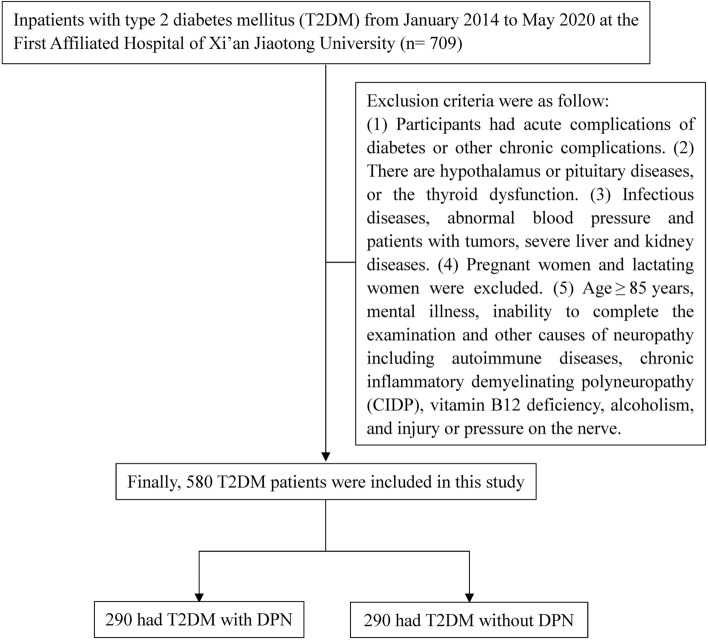
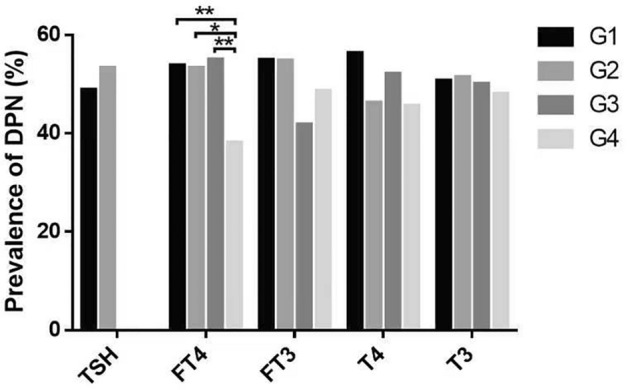
Previous studies disclosed that a high thyroid stimulating hormone level is an independent risk factor for diabetes peripheral neuropathy (DPN) in subclinical hypothyroidism (SCH) patients with type 2 diabetes mellitus (T2DM). However, whether thyroid metabolism has an effect on DPN in euthyroid T2DM patients remains unknown. The aim of this study was to identify the association between thyroid function and DPN in euthyroid T2DM patients. A set of 580 euthyroid T2DM patients was enrolled in the current study and stratified into DPN and Non-DPN groups. Mann-Whitney U test was performed to analyze the continuous variables of biochemical and thyroid metabolism indicators, and the Chi-square test was used to compare the categorical variables. Spearman correlation analysis was performed to analyze the relationship between clinical indicators and free thyroxine (FT4). By using the logistic regression analysis, the prevalence of DPN in different thyroid function indicators were evaluated. T2DM patients with DPN had obviously lower levels of aspartate aminotransferase (AST), alpha-hydroxybutyric dehydrogenase (α-HBDH), superoxide dismutase (SOD), calcium (Ca), creatinine (Cr), uric acid (UA), retinol binding protein (RBP), total protein (TP), albumin (ALB), alanine aminotransferase (ALT) and FT4 than the T2DM patients without DPN (P < 0.05). FT4 was associated with TP, prealbumin (PA), ALB, SOD, anion gap (AG), Ca, chlorine (Cl), UA, RBP, apoprotein A (Apo A), apoprotein B (Apo B), apoprotein E (Apo E), and total cholesterol (TC). According to the FT4 quartile, participants were sequentially divided into four groups to compare the prevalence of DPN between each group. The data suggested that the prevalence of DPN in these four groups was 53.79%, 53.28%, 54.97%, 38.10%, respectively. Moreover, compared with quartile 4, patients in quartile 1, 2, 3 all had a significantly higher risk of DPN (P = 0.007, P = 0.011, P = 0.004). The level of FT4 was negatively correlated with the prevalence of DPN in euthyroid T2DM patients.
先前的研究表明,促甲状腺激素水平升高是亚临床甲状腺功能减退症(SCH)合并 2 型糖尿病(T2DM)患者发生糖尿病周围神经病变(DPN)的独立危险因素。然而,甲状腺代谢对甲状腺功能正常的 T2DM 患者的 DPN 是否有影响尚不清楚。本研究旨在确定甲状腺功能与甲状腺功能正常的 T2DM 患者 DPN 之间的关系。本研究纳入了 580 例甲状腺功能正常的 T2DM 患者,并将其分为 DPN 组和非 DPN 组。采用 Mann-Whitney U 检验分析生化和甲状腺代谢指标的连续变量,采用卡方检验比较分类变量。采用 Spearman 相关分析评估临床指标与游离甲状腺素(FT4)的关系。采用 logistic 回归分析评估不同甲状腺功能指标下 DPN 的患病率。与无 DPN 的 T2DM 患者相比,有 DPN 的 T2DM 患者的天门冬氨酸氨基转移酶(AST)、α-羟丁酸脱氢酶(α-HBDH)、超氧化物歧化酶(SOD)、钙(Ca)、肌酐(Cr)、尿酸(UA)、视黄醇结合蛋白(RBP)、总蛋白(TP)、白蛋白(ALB)、丙氨酸氨基转移酶(ALT)和 FT4 水平明显更低(P<0.05)。FT4 与 TP、前白蛋白(PA)、ALB、SOD、阴离子间隙(AG)、Ca、Cl、UA、RBP、载脂蛋白 A(Apo A)、载脂蛋白 B(Apo B)、载脂蛋白 E(Apo E)和总胆固醇(TC)相关。根据 FT4 四分位数,将参与者依次分为四组,比较每组 DPN 的患病率。结果显示,这四组的 DPN 患病率分别为 53.79%、53.28%、54.97%、38.10%。此外,与 quartile 4 相比,quartile 1、2、3 组的 DPN 发病风险均显著升高(P=0.007、P=0.011、P=0.004)。FT4 水平与甲状腺功能正常的 T2DM 患者 DPN 的患病率呈负相关。