Center for Biomedical Engineering and Technology, University of Maryland School of Medicine, Baltimore, MD 21201, United States of America; Department of Anatomy and Neurobiology, University of Maryland School of Medicine, Baltimore, MD 21201, United States of America.
Lung Biology Research Program and Department of Anesthesiology, University of Maryland School of Medicine, Baltimore, MD 21201, United States of America.
Neurobiol Dis. 2023 Sep;185:106264. doi: 10.1016/j.nbd.2023.106264. Epub 2023 Aug 18.
Impairment of the blood-brain barrier (BBB) is considered to be a common feature among neurodegenerative diseases, including Alzheimer's, Parkinson's and prion diseases. In prion disease, increased BBB permeability was reported 40 years ago, yet the mechanisms behind the loss of BBB integrity have never been explored. Recently, we showed that reactive astrocytes associated with prion diseases are neurotoxic. The current work examines the potential link between astrocyte reactivity and BBB breakdown.
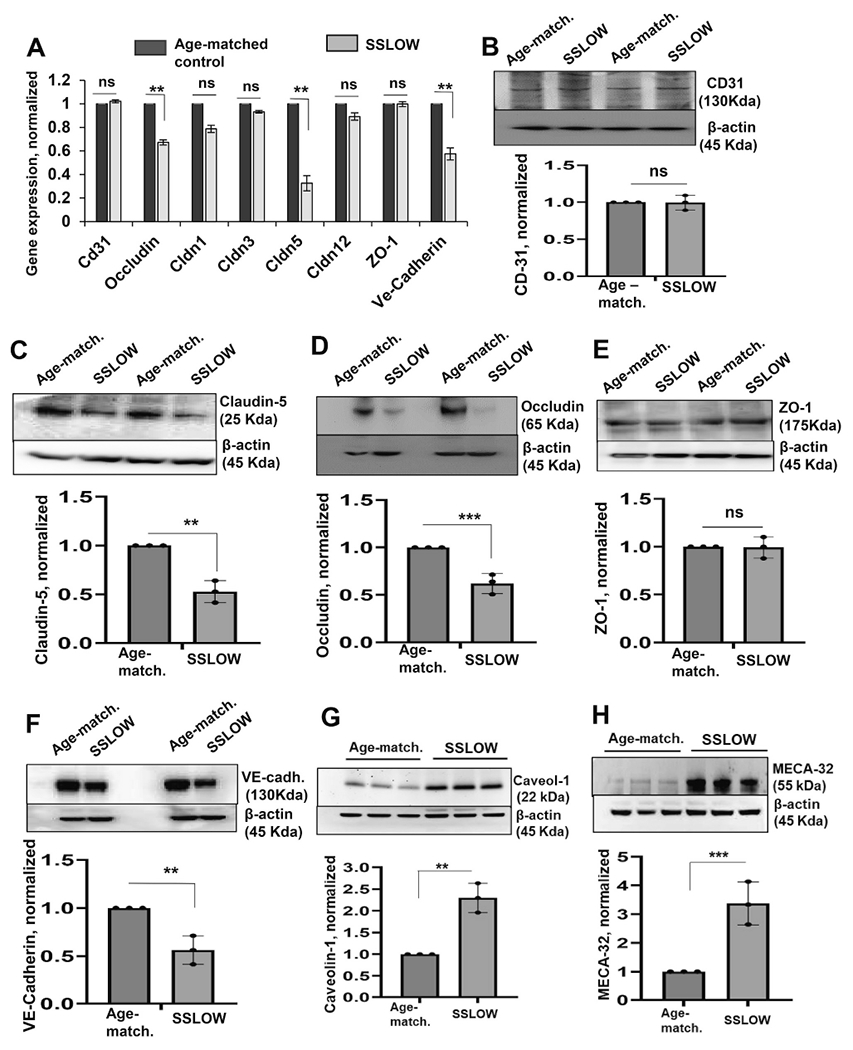
In prion-infected mice, the loss of BBB integrity and aberrant localization of aquaporin 4 (AQP4), a sign of retraction of astrocytic endfeet from blood vessels, were noticeable prior to disease onset. Gaps in cell-to-cell junctions along blood vessels, together with downregulation of Occludin, Claudin-5 and VE-cadherin, which constitute tight and adherens junctions, suggested that loss of BBB integrity is linked with degeneration of vascular endothelial cells. In contrast to cells isolated from non-infected adult mice, endothelial cells originating from prion-infected mice displayed disease-associated changes, including lower levels of Occludin, Claudin-5 and VE-cadherin expression, impaired tight and adherens junctions, and reduced trans-endothelial electrical resistance (TEER). Endothelial cells isolated from non-infected mice, when co-cultured with reactive astrocytes isolated from prion-infected animals or treated with media conditioned by the reactive astrocytes, developed the disease-associated phenotype observed in the endothelial cells from prion-infected mice. Reactive astrocytes were found to produce high levels of secreted IL-6, and treatment of endothelial monolayers originating from non-infected animals with recombinant IL-6 alone reduced their TEER. Remarkably, treatment with extracellular vesicles produced by normal astrocytes partially reversed the disease phenotype of endothelial cells isolated from prion-infected animals.
To our knowledge, the current work is the first to illustrate early BBB breakdown in prion disease and to document that reactive astrocytes associated with prion disease are detrimental to BBB integrity. Moreover, our findings suggest that the harmful effects are linked to proinflammatory factors secreted by reactive astrocytes.
血脑屏障(BBB)的损伤被认为是包括阿尔茨海默病、帕金森病和朊病毒病在内的神经退行性疾病的共同特征。在朊病毒病中,BBB 通透性增加早在 40 年前就有报道,但 BBB 完整性丧失的机制从未被探索过。最近,我们发现与朊病毒病相关的反应性星形胶质细胞具有神经毒性。目前的工作研究了星形胶质细胞反应性与 BBB 破坏之间的潜在联系。
在朊病毒感染的小鼠中,BBB 完整性的丧失和水通道蛋白 4(AQP4)的异常定位(提示星形胶质细胞终足从血管回缩)在疾病发作前就已经明显。血管周围细胞间连接的间隙,以及紧密连接和黏附连接的Occludin、Claudin-5 和 VE-cadherin 的下调,提示 BBB 完整性的丧失与血管内皮细胞的退化有关。与来自非感染成年小鼠的细胞相比,来自朊病毒感染小鼠的内皮细胞表现出与疾病相关的变化,包括 Occludin、Claudin-5 和 VE-cadherin 表达水平降低、紧密连接和黏附连接受损以及跨内皮电阻(TEER)降低。与来自朊病毒感染动物的反应性星形胶质细胞共培养或用反应性星形胶质细胞条件培养基处理的非感染小鼠来源的内皮细胞,表现出与来自朊病毒感染小鼠的内皮细胞相似的疾病相关表型。发现反应性星形胶质细胞产生高水平的分泌型白细胞介素 6(IL-6),单独用重组 IL-6 处理非感染动物的内皮细胞单层,会降低其 TEER。值得注意的是,用正常星形胶质细胞产生的细胞外囊泡处理可部分逆转来自朊病毒感染动物的内皮细胞的疾病表型。
据我们所知,目前的工作首次说明了朊病毒病中早期 BBB 破坏,并证明与朊病毒病相关的反应性星形胶质细胞对 BBB 完整性有害。此外,我们的发现表明,有害影响与反应性星形胶质细胞分泌的促炎因子有关。