Department of Orthopedic Surgery, JPNA Trauma Centre, All India Institute of Medical Sciences, New Delhi, India.
Department of Orthopedic Surgery, JPNA Trauma Centre, All India Institute of Medical Sciences, New Delhi, India.
Chin J Traumatol. 2023 Nov;26(6):363-368. doi: 10.1016/j.cjtee.2023.06.004. Epub 2023 Jun 26.
Hip fractures in elderly have a high mortality. However, there is limited literature on the excess mortality seen in hip fractures compared to the normal population. The purpose of this study was to compare the mortality of hip fractures with that of age and gender matched Indian population.
There are 283 patients with hip fractures aged above 50 years admitted at single centre prospectively enrolled in this study. Patients were followed up for 1 year and the follow-up record was available for 279 patients. Mortality was assessed during the follow-up from chart review and/or by telephonic interview. One-year mortality of Indian population was obtained from public databases. Standardized mortality ratio (SMR) (observed mortality divided by expected mortality) was calculated. Kaplan-Meir analysis was used.
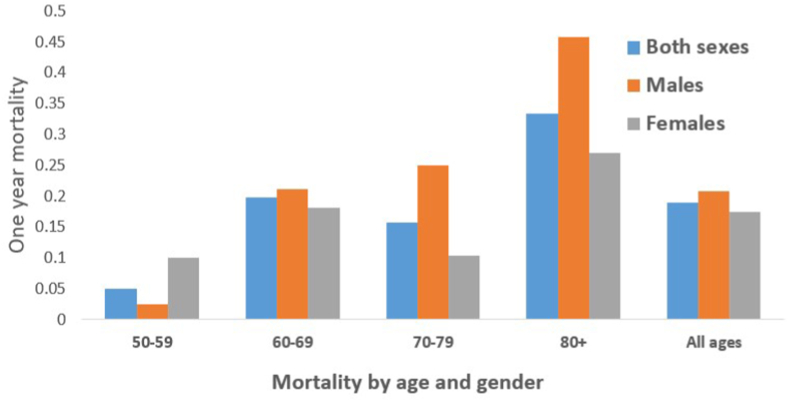
The overall 1-year mortality was 19.0% (53/279). Mortality increased with age (p < 0.001) and the highest mortality was seen in those above 80 years (aged 50 - 59 years: 5.0%, aged 60 - 69 years: 19.7%, aged 70 - 79 years: 15.8%, and aged over 80 years: 33.3%). Expected mortality of Indian population of similar age and gender profile was 3.7%, giving a SMR of 5.5. SMR for different age quintiles were: 3.9 (aged 50 - 59 years), 6.6 (aged 60 - 69 years), 2.2 (aged 70 - 79 years); and 2.0 (aged over 80 years). SMR in males and females were 5.7 and 5.3, respectively.
Indian patients sustaining hip fractures were about 5 times more likely to die than the general population. Although mortality rates increased with age, the highest excess mortality was seen in relatively younger patients. Hip fracture mortality was even higher than that of myocardial infarction, breast cancer, and cervical cancer.
老年人髋部骨折的死亡率较高。然而,与普通人群相比,髋部骨折导致的超额死亡率的相关文献有限。本研究旨在比较髋部骨折患者与年龄和性别相匹配的印度人群的死亡率。
本研究前瞻性纳入了单中心 283 例年龄在 50 岁以上的髋部骨折患者。对患者进行了为期 1 年的随访,其中 279 例患者的随访记录可用。通过病历回顾和/或电话访谈评估随访期间的死亡率。从公共数据库中获得印度人群的 1 年死亡率。计算标准化死亡率比(SMR)(观察死亡率除以预期死亡率)。采用 Kaplan-Meier 分析。
总体 1 年死亡率为 19.0%(53/279)。死亡率随年龄增长而增加(p<0.001),80 岁以上患者死亡率最高(50-59 岁年龄组:5.0%,60-69 岁年龄组:19.7%,70-79 岁年龄组:15.8%,80 岁以上年龄组:33.3%)。具有相似年龄和性别特征的印度人群的预期死亡率为 3.7%,SMR 为 5.5。不同年龄五分位组的 SMR 分别为:3.9(50-59 岁年龄组)、6.6(60-69 岁年龄组)、2.2(70-79 岁年龄组)和 2.0(80 岁以上年龄组)。男性和女性的 SMR 分别为 5.7 和 5.3。
印度髋部骨折患者的死亡风险比普通人群高约 5 倍。尽管死亡率随年龄增长而增加,但相对年轻患者的超额死亡率最高。髋部骨折的死亡率甚至高于心肌梗死、乳腺癌和宫颈癌。