Department of Pediatrics, University of California, San Francisco, CA, United States.
Graduate Program in Human Nutrition, University of Hawai'i Manoa, Honolulu, HI, United States; University of Hawai'i Cancer Center, Honolulu, HI, United States.
Am J Clin Nutr. 2023 Oct;118(4):812-821. doi: 10.1016/j.ajcnut.2023.08.004. Epub 2023 Aug 19.
New recommendations for the assessment of malnutrition and sarcopenia include body composition, specifically reduced muscle mass. Three-dimensional optical imaging (3DO) is a validated, accessible, and affordable alternative to dual X-ray absorptiometry (DXA).
Identify strengths and weaknesses of 3DO for identification of malnutrition in participants with low body mass index (BMI) and eating disorders.
Participants were enrolled in the cross-sectional Shape Up! Adults and Kids studies of body shape, metabolic risk, and functional assessment and had BMI of <20 kg/m in adults or <85% of median BMI (mBMI) in children and adolescents. A subset was referred for eating disorders evaluation. Anthropometrics, scans, strength testing, and questionnaires were completed in clinical research centers. Lin's Concordance Correlation Coefficient (CCC) assessed agreement between 3DO and DXA; multivariate linear regression analysis examined associations between weight history and body composition.
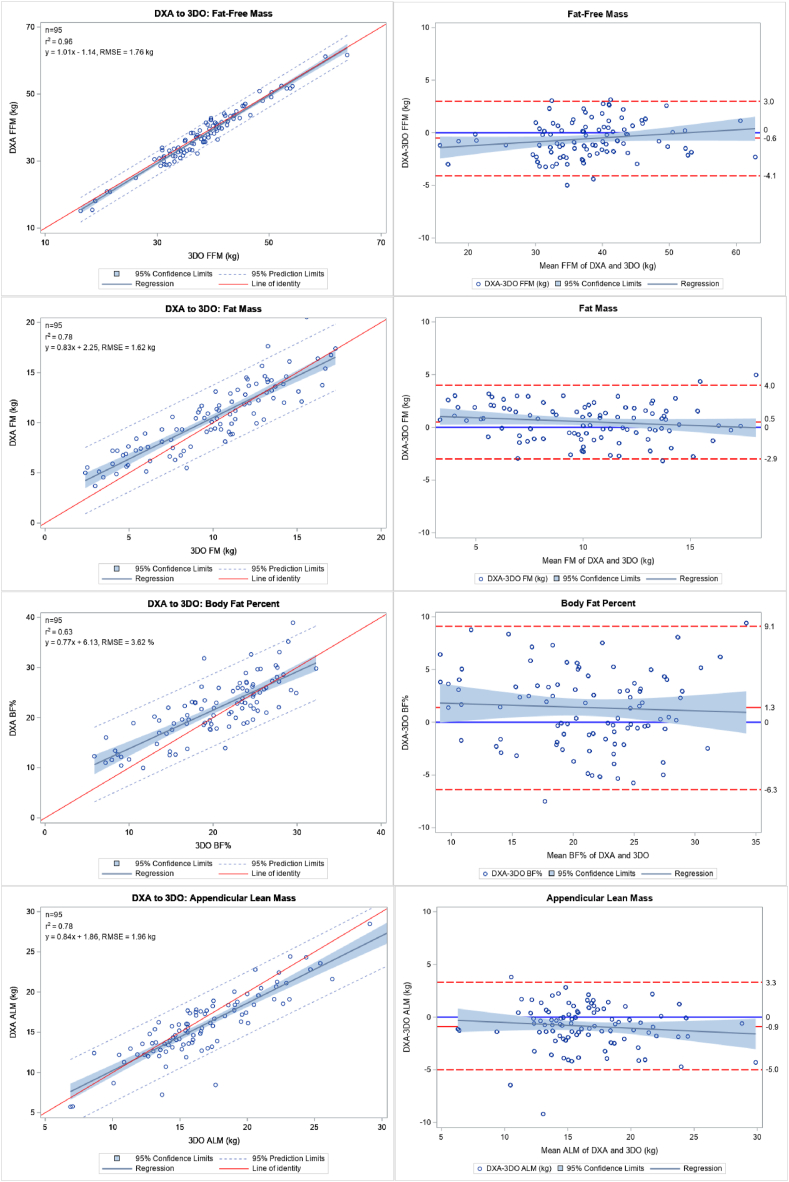
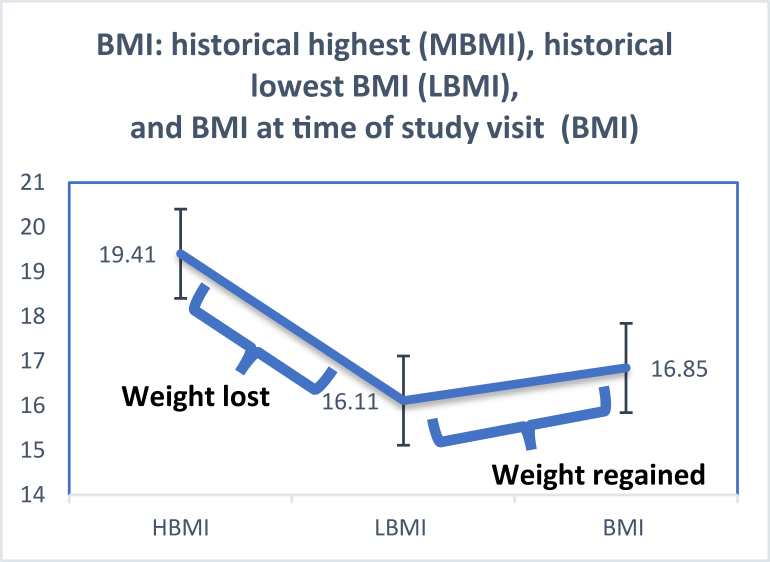
Among 95 participants, mean ± SD BMI was 18.3 ± 1.4 kg/m in adult women (N = 56), 19.0 ± 0.6 in men (N = 14), and 84.2% ± 4.1% mBMI in children (N = 25). Concordance was excellent for fat-free mass (FFM, CCC = 0.97) and strong for appendicular lean mass (ALM, CCC = 0.86) and fat mass (FM, CCC = 0.87). By DXA, 80% of adults met the low FFM index criterion for malnutrition, and 44% met low ALM for sarcopenia; 52% of children and adolescents were <-2 z-score for FM. 3DO identified 95% of these cases. In the subset, greater weight loss predicted lower FFM, FM, and ALM by both methods; a greater percentage of weight regained predicted a higher percentage of body fat.
3DO can accurately estimate body composition in participants with low BMI and identify criteria for malnutrition and sarcopenia. In a subset, 3DO detected changes in body composition expected with weight loss and regain secondary to eating disorders. These findings support the utility of 3DO for body composition assessment in patients with low BMI, including those with eating disorders. This trial was registered at clinicaltrials.gov as NCT03637855.
新的营养不良和肌肉减少症评估建议包括身体成分,特别是肌肉质量减少。三维光学成像(3DO)是一种经过验证、易于获得且价格合理的双能 X 射线吸收法(DXA)替代方法。
确定 3DO 在评估低体重指数(BMI)和饮食障碍患者的营养不良方面的优势和劣势。
参与者被纳入体型、代谢风险和功能评估的横断面 Shape Up!成人和儿童研究,成人的 BMI<20 kg/m,儿童和青少年的 BMI<85%中位数(mBMI)。一部分参与者被转介进行饮食障碍评估。人体测量学、扫描、力量测试和问卷调查在临床研究中心完成。林氏一致性相关系数(CCC)评估 3DO 与 DXA 之间的一致性;多元线性回归分析检查体重史与身体成分之间的关联。
在 95 名参与者中,女性成人(N=56)的平均±SD BMI 为 18.3±1.4 kg/m,男性(N=14)为 19.0±0.6,儿童(N=25)为 84.2%±4.1% mBMI。无脂肪质量(FFM)的一致性极好(CCC=0.97),四肢瘦质量(ALM)和脂肪质量(FM)的一致性较强(CCC=0.86、CCC=0.87)。根据 DXA,80%的成年人符合低 FFM 指数营养不良标准,44%符合低 ALM 肌肉减少症标准;52%的儿童和青少年的 FM<-2 z 分数。3DO 可识别 95%的此类病例。在亚组中,两种方法均显示体重减轻越多,FFM、FM 和 ALM 越低;体重增加的百分比越高,体脂百分比越高。
3DO 可以准确估计低 BMI 参与者的身体成分,并确定营养不良和肌肉减少症的标准。在亚组中,3DO 检测到与饮食障碍相关的体重减轻和恢复引起的身体成分变化。这些发现支持 3DO 在低 BMI 患者的身体成分评估中的应用,包括饮食障碍患者。该试验在 clinicaltrials.gov 注册为 NCT03637855。