Popa-Fotea Nicoleta-Monica, Ferdoschi Corina-Elena, Micheu Miruna-Mihaela
Department 4 Cardio-Thoracic Pathology, University of Medicine and Pharmacy "Carol Davila," Bucharest, Romania.
Cardiology Department, Emergency Clinical Hospital, Bucharest, Romania.
Front Cardiovasc Med. 2023 Aug 3;10:1200341. doi: 10.3389/fcvm.2023.1200341. eCollection 2023.
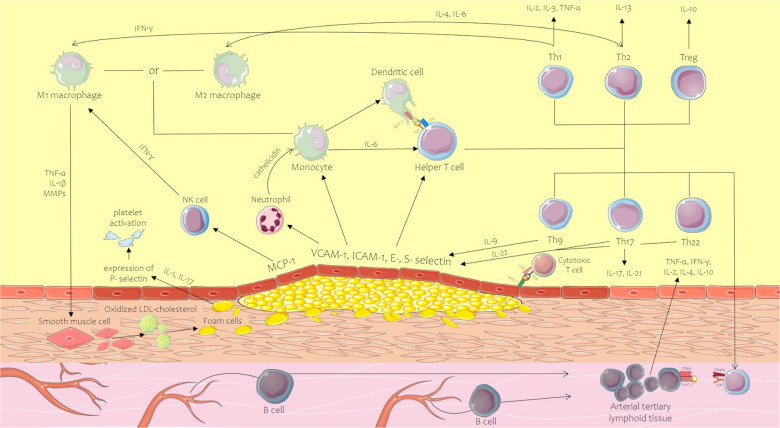
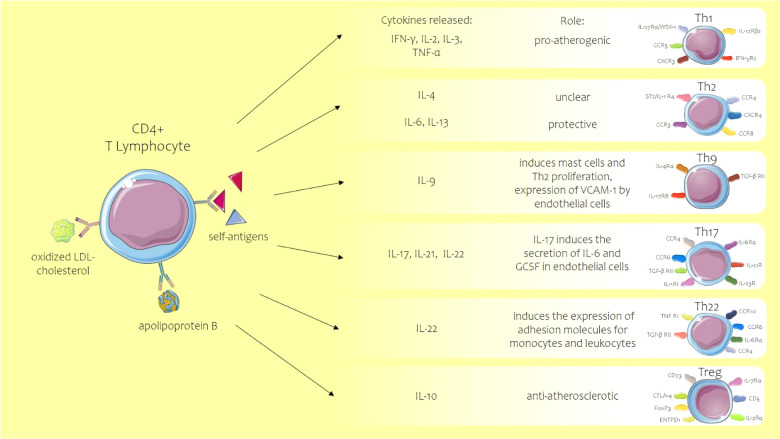
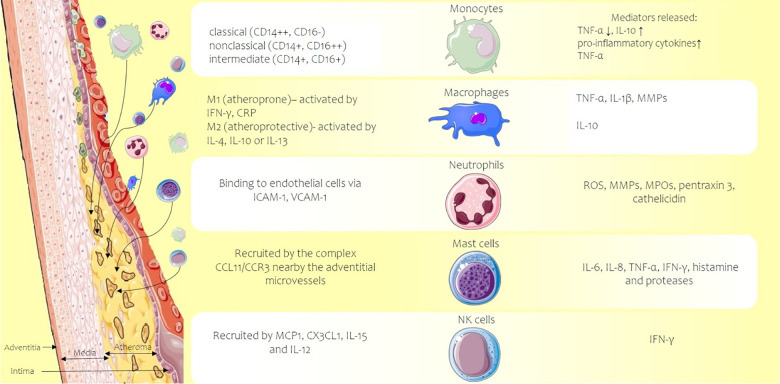
Atherosclerosis and its complications are a major cause of morbidity and mortality worldwide in spite of the improved medical and invasive treatment in terms of revascularization. Atherosclerosis is a dynamic, multi-step process in which inflammation is a ubiquitous component participating in the initiation, development, and entanglements of the atherosclerotic plaque. After activation, the immune system, either native or acquired, is part of the atherosclerotic dynamics enhancing the pro-atherogenic function of immune or non-immune cells, such as endothelial cells, smooth muscle cells, or platelets, through mediators such as cytokines or directly by cell-to-cell interaction. Cytokines are molecules secreted by the activated cells mentioned above that mediate the inflammatory component of atherosclerosis whose function is to stimulate the immune cells and the production of further cytokines. This review provides insights of the cell axis activation and specific mechanisms and pathways through which inflammation actuates atherosclerosis.
尽管在血管重建方面,医学和侵入性治疗有所改善,但动脉粥样硬化及其并发症仍是全球发病和死亡的主要原因。动脉粥样硬化是一个动态的多步骤过程,炎症是参与动脉粥样硬化斑块形成、发展和并发症的普遍存在的成分。激活后,先天或后天免疫系统成为动脉粥样硬化动态变化的一部分,通过细胞因子等介质或直接通过细胞间相互作用,增强免疫或非免疫细胞(如内皮细胞、平滑肌细胞或血小板)的促动脉粥样硬化功能。细胞因子是上述激活细胞分泌的分子,介导动脉粥样硬化的炎症成分,其功能是刺激免疫细胞并产生更多细胞因子。本综述阐述了细胞轴激活以及炎症引发动脉粥样硬化的具体机制和途径。