Tozihi Majid, Shademan Behrouz, Yousefi Hadi, Avci Cigir Biray, Nourazarian Alireza, Dehghan Gholamreza
Department of Biology, Faculty of Natural Sciences, University of Tabriz, Tabriz, Iran.
Stem Cell Research Center, Tabriz University of Medical Sciences, Tabriz, Iran.
Front Aging Neurosci. 2023 Aug 4;15:1227513. doi: 10.3389/fnagi.2023.1227513. eCollection 2023.
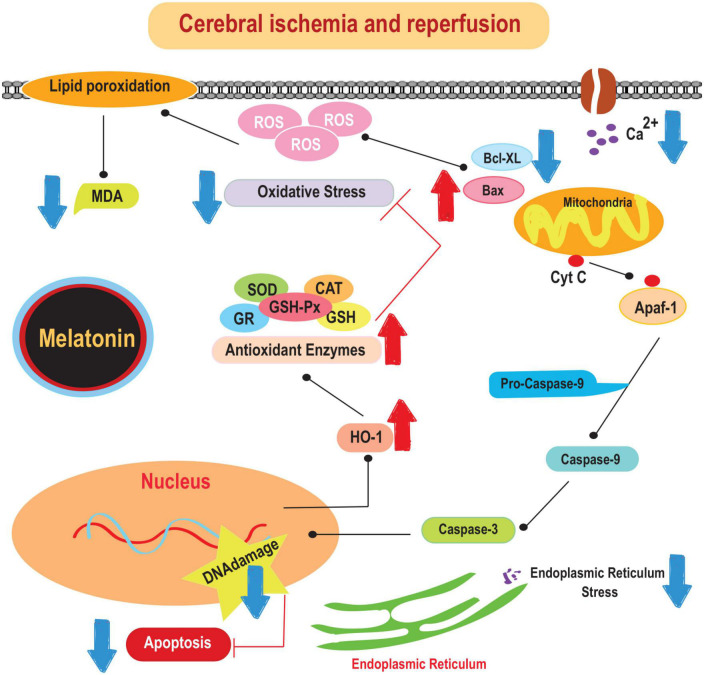
Cerebral ischemia-reperfusion (CIR) injury is initiated by the generation of reactive oxygen species (ROS), which leads to the oxidation of cellular proteins, DNA, and lipids as an initial event. The reperfusion process impairs critical cascades that support cell survival, including mitochondrial biogenesis and antioxidant enzyme activity. Failure to activate prosurvival signals may result in increased neuronal cell death and exacerbation of CIR damage. Melatonin, a hormone produced naturally in the body, has high concentrations in both the cerebrospinal fluid and the brain. However, melatonin production declines significantly with age, which may contribute to the development of age-related neurological disorders due to reduced levels. By activating various signaling pathways, melatonin can affect multiple aspects of human health due to its diverse range of activities. Therefore, understanding the underlying intracellular and molecular mechanisms is crucial before investigating the neuroprotective effects of melatonin in cerebral ischemia-reperfusion injury.
脑缺血再灌注(CIR)损伤由活性氧(ROS)的产生引发,这一过程首先导致细胞蛋白质、DNA和脂质的氧化。再灌注过程会损害支持细胞存活的关键级联反应,包括线粒体生物合成和抗氧化酶活性。未能激活促生存信号可能导致神经元细胞死亡增加和CIR损伤加剧。褪黑素是体内自然产生的一种激素,在脑脊液和大脑中浓度都很高。然而,褪黑素的分泌会随着年龄的增长而显著下降,这可能由于水平降低而导致与年龄相关的神经疾病的发生。通过激活各种信号通路,褪黑素因其多样的活性而能影响人类健康的多个方面。因此,在研究褪黑素对脑缺血再灌注损伤的神经保护作用之前,了解其潜在的细胞内和分子机制至关重要。