Department of Radiation Oncology, Yuan's General Hospital, 162 Cheng Kung 1st Road, Kaohsiung 80249, Taiwan.
Core Laboratory of Neuroscience, Office of R&D, Taipei Medical University, 250 Wu-Hsing Street, Taipei 11031, Taiwan.
Int J Mol Sci. 2020 Apr 21;21(8):2899. doi: 10.3390/ijms21082899.
Stroke is one of the leading causes of death and disability worldwide and places a heavy burden on the economy in our society. Current treatments, such as the use of thrombolytic agents, are often limited by a narrow therapeutic time window. However, the regeneration of the brain after damage is still active days, even weeks, after stroke occurs, which might provide a second window for treatment. Emodin, a traditional Chinese medicinal herb widely used to treat acute hepatitis, has been reported to possess antioxidative capabilities and protective effects against myocardial ischemia/reperfusion injury. However, the underlying mechanisms and neuroprotective functions of Emodin in a rat middle cerebral artery occlusion (MCAO) model of ischemic stroke remain unknown. This study investigates neuroprotective effects of Emodin in ischemia both in vitro and in vivo.
PC12 cells were exposed to oxygen-glucose deprivation to simulate hypoxic injury, and the involved signaling pathways and results of Emodin treatment were evaluated. The therapeutic effects of Emodin in ischemia animals were further investigated.
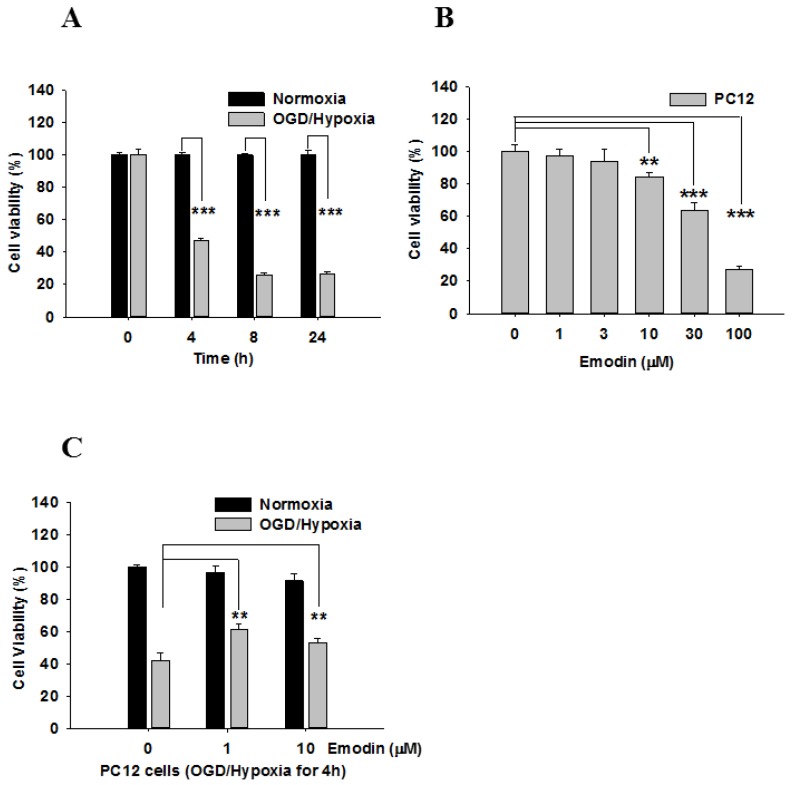
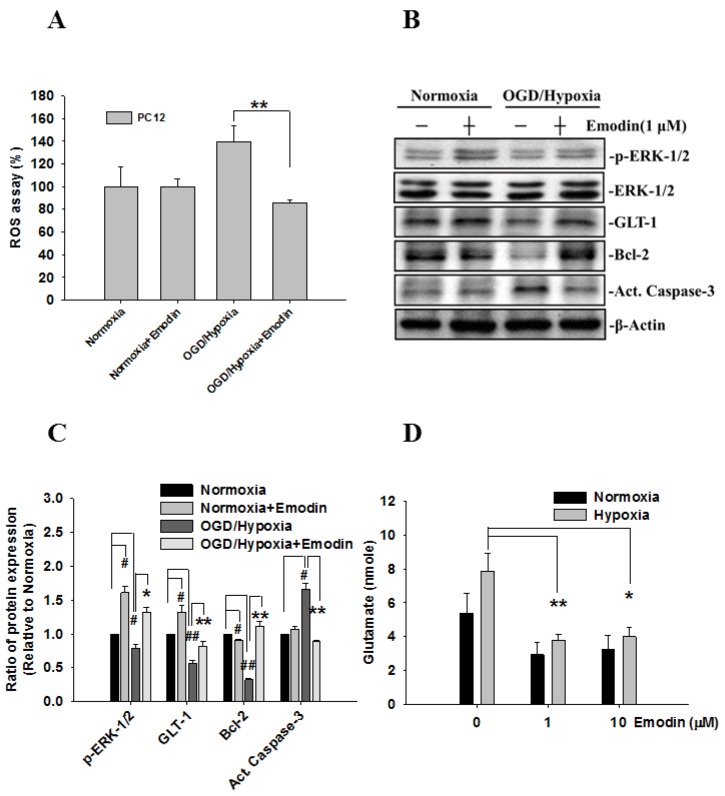
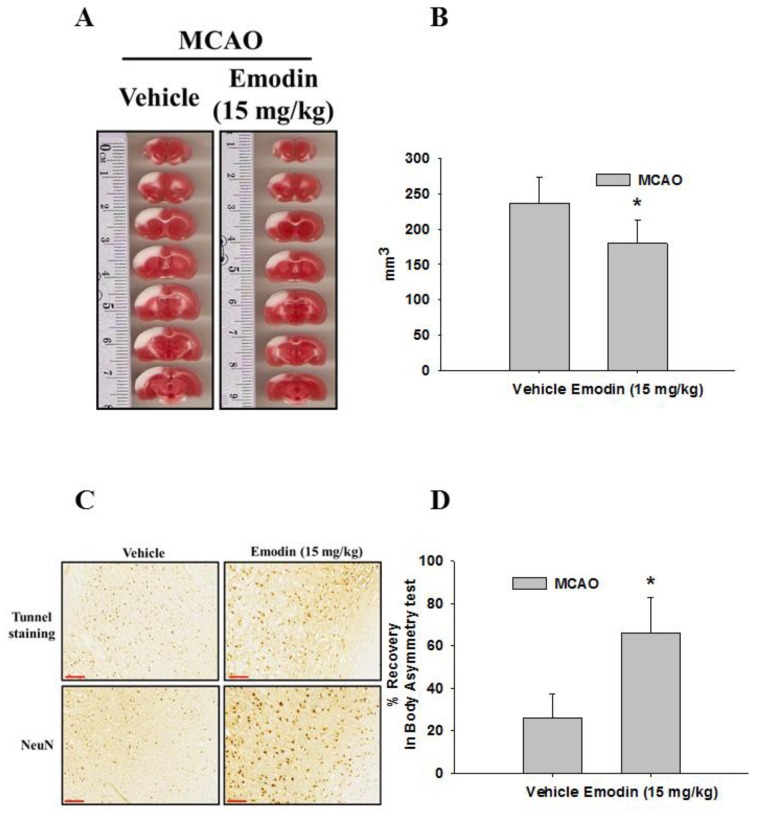
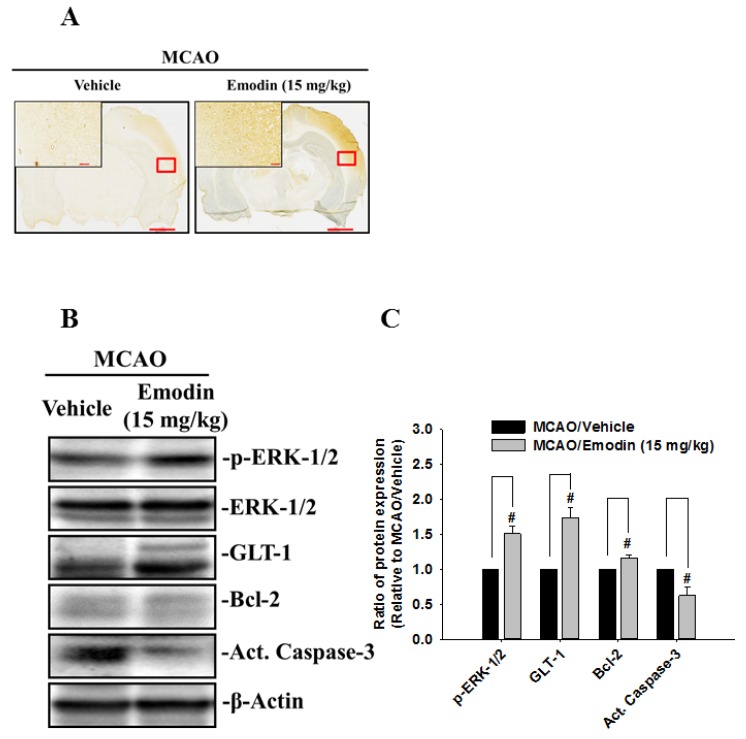
Emodin reduced infarct volume and cell death following focal cerebral ischemia injury. Emodin treatment restored PC12 cell viability and reduced reactive oxygen species (ROS) production and glutamate release under conditions of ischemia/hypoxia. Emodin increased Bcl-2 and glutamate transporter-1 (GLT-l) expression but suppressed activated-caspase 3 levels through activating the extracellular signal-regulated kinase (ERK)-1/2 signaling pathway.
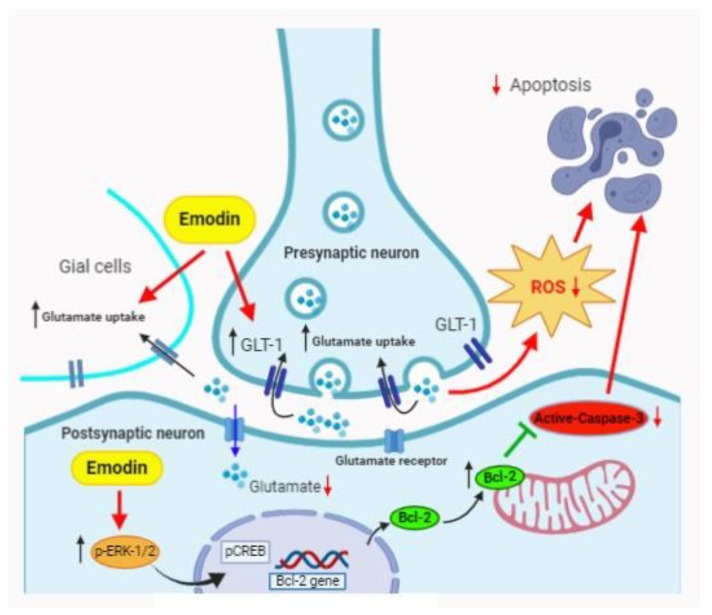
Emodin induced Bcl-2 and GLT-1 expression to inhibit neuronal apoptosis and ROS generation while reducing glutamate toxicity via the ERK-1/2 signaling pathway. Furthermore, Emodin alleviated nerve cell injury following ischemia/reperfusion in a rat MCAO model. Emodin has neuroprotective effects against ischemia/reperfusion injury both in vitro and in vivo, which may be through activating the ERK-1/2 signaling pathway.
中风是全球范围内导致死亡和残疾的主要原因之一,给我们社会的经济带来了沉重负担。目前的治疗方法,如使用溶栓剂,往往受到治疗时间窗狭窄的限制。然而,大脑在受损后仍有几天甚至几周的时间进行再生,这可能为治疗提供第二个窗口。大黄素是一种广泛用于治疗急性肝炎的中药,已被报道具有抗氧化能力和对心肌缺血/再灌注损伤的保护作用。然而,大黄素在大鼠大脑中动脉闭塞(MCAO)缺血性中风模型中的潜在机制和神经保护功能仍不清楚。本研究探讨了大黄素在体外和体内缺血中的神经保护作用。
PC12 细胞暴露于氧葡萄糖剥夺以模拟缺氧损伤,并评估涉及的信号通路和大黄素处理的结果。进一步研究了大黄素在缺血动物中的治疗效果。
大黄素减少了局灶性脑缺血损伤后的梗死体积和细胞死亡。大黄素处理恢复了缺血/缺氧条件下 PC12 细胞的活力,并减少了活性氧(ROS)的产生和谷氨酸的释放。大黄素通过激活细胞外信号调节激酶(ERK)-1/2 信号通路增加了 Bcl-2 和谷氨酸转运体-1(GLT-1)的表达,但抑制了激活的半胱天冬酶 3水平。
大黄素通过激活 ERK-1/2 信号通路诱导 Bcl-2 和 GLT-1 的表达来抑制神经元凋亡和 ROS 的产生,同时减少谷氨酸毒性。此外,大黄素减轻了大鼠 MCAO 模型中缺血/再灌注后的神经细胞损伤。大黄素在体外和体内均具有缺血/再灌注损伤的神经保护作用,这可能是通过激活 ERK-1/2 信号通路实现的。