Bragg Megan G, Rando Juliette, Carroll Kecia N, Eick Stephanie M, Karagas Margaret R, Lin Pi-I, Schmidt Rebecca J, Lyall Kristen
AJ Drexel Autism Institute, Drexel University, Philadelphia, PA, United States.
The Icahn School of Medicine at Mount Sinai, New York, NY, United States.
J Nutr. 2025 Jun;155(6):1938-1951. doi: 10.1016/j.tjnut.2025.02.025. Epub 2025 Mar 17.
Previous research on the role of maternal diet in relation to autism has focused on examining individual nutrient associations. Few studies have examined associations with multiple nutrients using mixtures approaches, which may better reflect true exposure scenarios.
This study aims to examine associations of nutrient mixtures with children's autism diagnosis and trait scores within a large, diverse population.
Participants were drawn from the United States Environmental influences on Child Health Outcomes (ECHO) consortium. Maternal prenatal diet was reported via validated food frequency questionnaires. Children's autism-related traits were measured using the Social Responsiveness Scale (SRS) and autism diagnoses were from parent reports of physician diagnosis. Bayesian kernel machine regression was used to examine the overall mixture effect and interactions between a set of 5 primary nutrients (folate, vitamin D, omega 3 and omega 6 fatty acids, and iron), adjusted for potential confounders, in relationship to child outcomes. Secondary analyses were conducted in a subset of cohorts with an expanded set of 14 nutrients. Traditional linear and logistic regression models were also analyzed for comparison of results to mixture models.
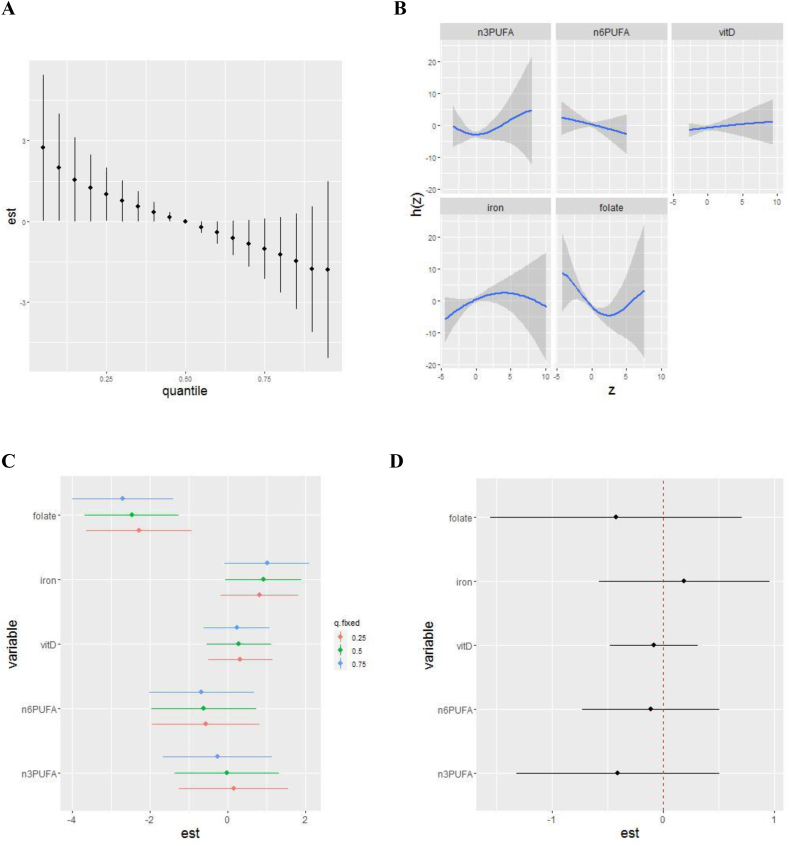
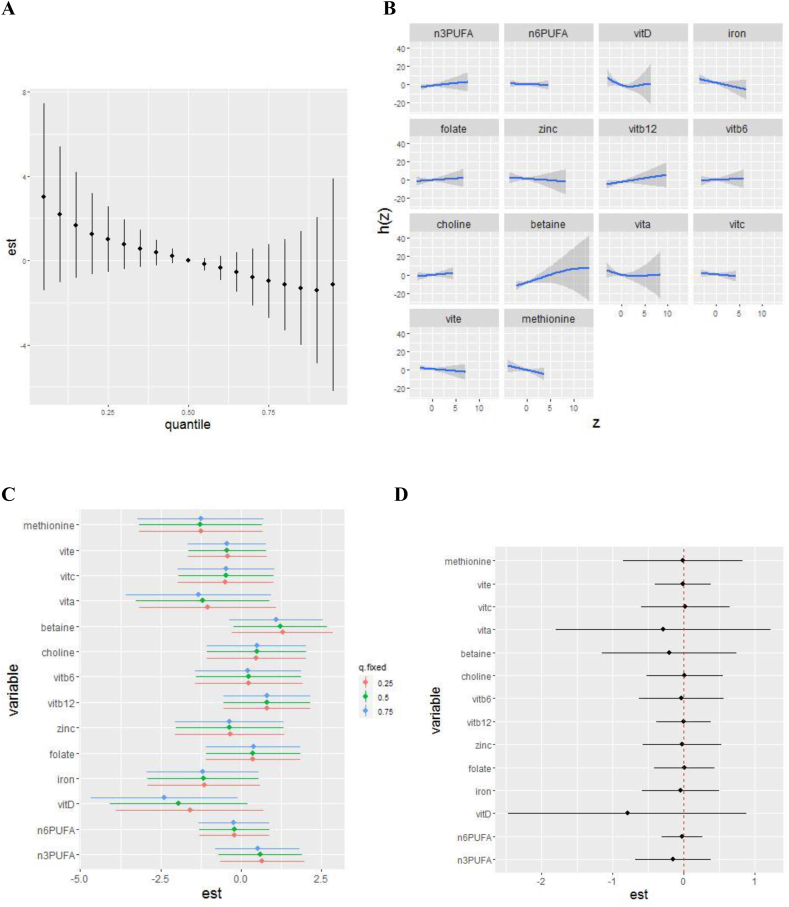
A total of 2614 participants drawn from 7 ECHO cohorts were included in primary analysis. Mixture analyses suggested that increasing the overall 5-nutrient mixture was associated with lower SRS scores. Individual U-shaped associations and bivariate interactions between folate and omega 3 fatty acids were suggested. In the subset included in the secondary analyses of the 14-nutrient mixture, a modest inverse trend remained, but individual nutrient associations were altered, with vitamin D demonstrating higher relative importance than other nutrients. Strong associations with autism diagnosis were not observed.
In this large sample, we found evidence for combined nutrient effects with broader autism-related traits. Because results for individual nutrients were sensitive to mixture components, replication of combined associations between nutrients and autism-related outcomes is needed.
先前关于母亲饮食与自闭症关系的研究主要集中在考察单一营养素的关联。很少有研究使用混合物方法来考察与多种营养素的关联,而这种方法可能更能反映真实的暴露情况。
本研究旨在考察在一个大型多样化人群中,营养素混合物与儿童自闭症诊断及特质得分之间的关联。
参与者来自美国儿童健康结果环境影响(ECHO)联盟。通过经过验证的食物频率问卷报告母亲的产前饮食。使用社会反应量表(SRS)测量儿童与自闭症相关的特质,自闭症诊断来自家长对医生诊断的报告。采用贝叶斯核机器回归来考察一组5种主要营养素(叶酸、维生素D、ω-3和ω-6脂肪酸以及铁)之间的总体混合物效应和相互作用,并针对儿童结局对潜在混杂因素进行了调整。在一个子集队列中对14种营养素的扩展集进行了二次分析。还分析了传统的线性和逻辑回归模型,以便与混合物模型的结果进行比较。
主要分析纳入了来自7个ECHO队列的2614名参与者。混合物分析表明,增加总体5种营养素混合物与较低的SRS得分相关。提示了叶酸和ω-3脂肪酸之间的个体U型关联和双变量相互作用。在14种营养素混合物的二次分析所纳入的子集中,仍存在适度的反向趋势,但个体营养素关联发生了变化,维生素D显示出比其他营养素更高的相对重要性。未观察到与自闭症诊断的强关联。
在这个大样本中,我们发现了营养素综合效应与更广泛的自闭症相关特质之间的证据。由于个体营养素的结果对混合物成分敏感,因此需要对营养素与自闭症相关结局之间的综合关联进行重复研究。