Kaźmierczak Izabela, Zajenkowska Anna, Rajchert Joanna, Jakubowska Adrianna, Abramiuk-Szyszko Agnieszka
Maria Grzegorzewska University, Poland.
Depress Res Treat. 2023 Aug 12;2023:8842805. doi: 10.1155/2023/8842805. eCollection 2023.
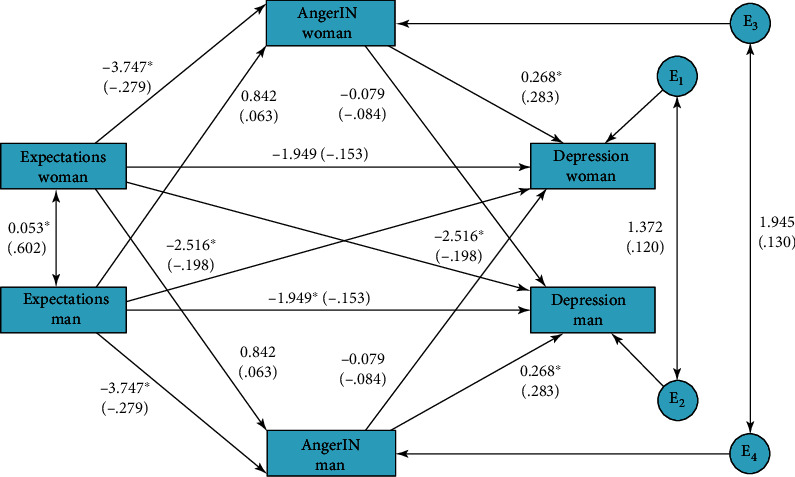
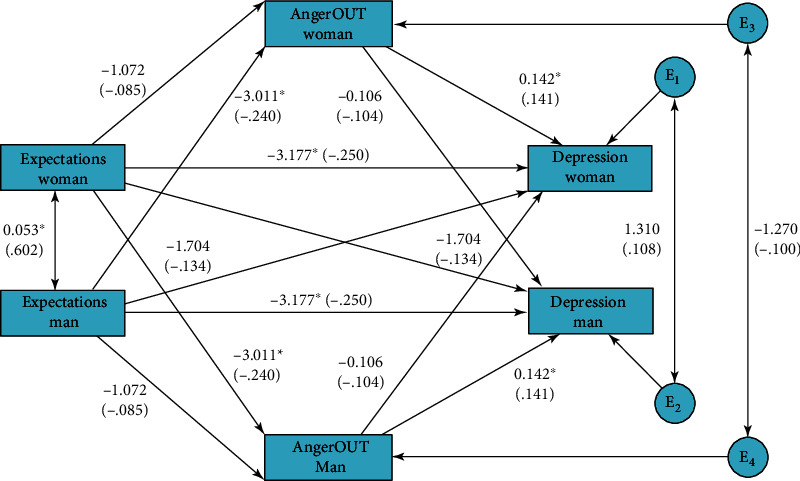
. Depression is associated with unmet relational expectations, but little is known about how both partners experience meeting expectations and how this relates to anger expression and depressive symptoms. The aim of study 1 was to explore the role of anger expression in explaining the link between relational expectations and depression using the actor-partner interdependence mediation model. Additionally, social expectations beyond romantic relationships are associated with societal demands. Study 2 is aimed at investigating the role of anger expression in the relationship between internalized social demands (i.e., outer self-awareness) and depressive symptoms. . Online self-report data were collected from = 194 romantic partners (97 dyads) in study 1 and = 407 individuals in study 2. . In study 1, unmet expectations were associated with both actor and partner effects on depressive symptoms and anger expression. In particular, inwardly directed anger was linked to depressive symptoms in the case of the individual experiencing unmet expectations, whereas outwardly directed anger predicted such symptoms in the case of the partner's unmet expectations. In study 2, there was a positive association between outer self-awareness and directing anger inwards and outwards, which was linked to higher depressive symptoms. Furthermore, while directing anger inwards seemed to be a universal mechanism underlying the association, the interpersonal mechanism (i.e., directing anger outwards) was found to be dependent on gender.
抑郁症与未满足的关系期望有关,但对于双方如何体验期望的满足以及这与愤怒表达和抑郁症状之间的关系却知之甚少。研究1的目的是使用行为者-伴侣相互依赖中介模型,探讨愤怒表达在解释关系期望与抑郁症之间联系中的作用。此外,浪漫关系之外的社会期望与社会需求相关。研究2旨在调查愤怒表达在内在化社会需求(即外在自我意识)与抑郁症状之间关系中的作用。
在研究1中,从194对浪漫伴侣(97个二元组)收集了在线自我报告数据,在研究2中从407名个体收集了数据。
在研究1中,未满足的期望与行为者和伴侣对抑郁症状及愤怒表达的影响均有关联。具体而言,在经历期望未满足的个体中,内向型愤怒与抑郁症状相关,而在伴侣期望未满足的情况下,外向型愤怒预示着此类症状。在研究2中,外在自我意识与内向和外向愤怒表达之间存在正相关,这与更高的抑郁症状有关。此外,虽然内向型愤怒表达似乎是这种关联的普遍机制,但人际机制(即外向型愤怒表达)被发现依赖于性别。