Department of Public Health, Andalusian School of Public Health, Granada, Spain.
Center for Biomedical Research in Epidemiology and Public Health Network, Carlos III Health Institute (ISCIII), Madrid, Spain.
Front Public Health. 2023 Aug 2;11:1217519. doi: 10.3389/fpubh.2023.1217519. eCollection 2023.
The use of health surveys has been key in the scientific community to promptly communicate results about the health impact of COVID-19. But what information was collected, where, when and how, and who was the study population?
To describe the methodological characteristics used in large health surveys conducted in Spain early on in the COVID-19 pandemic.
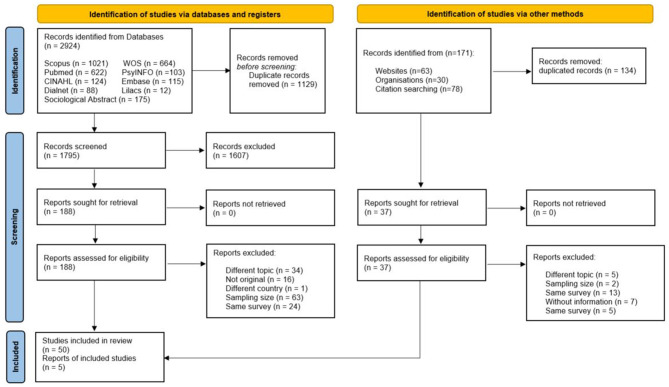
Scoping review. Inclusion criteria: observational studies published between January 2020 and December 2021, with sample sizes of over 2,000 persons resident in Spain. Databases consulted: PubMed, CINAHL, Literatura Latinoamericana y del Caribe en CC de la Salud, Scopus, PsycINFO, Embase, Sociological Abstracts, Dialnet and Web of Science Core Collection. We analyzed the characteristics of the literature references, methodologies and information gathered in the surveys selected. Fifty five studies were included.
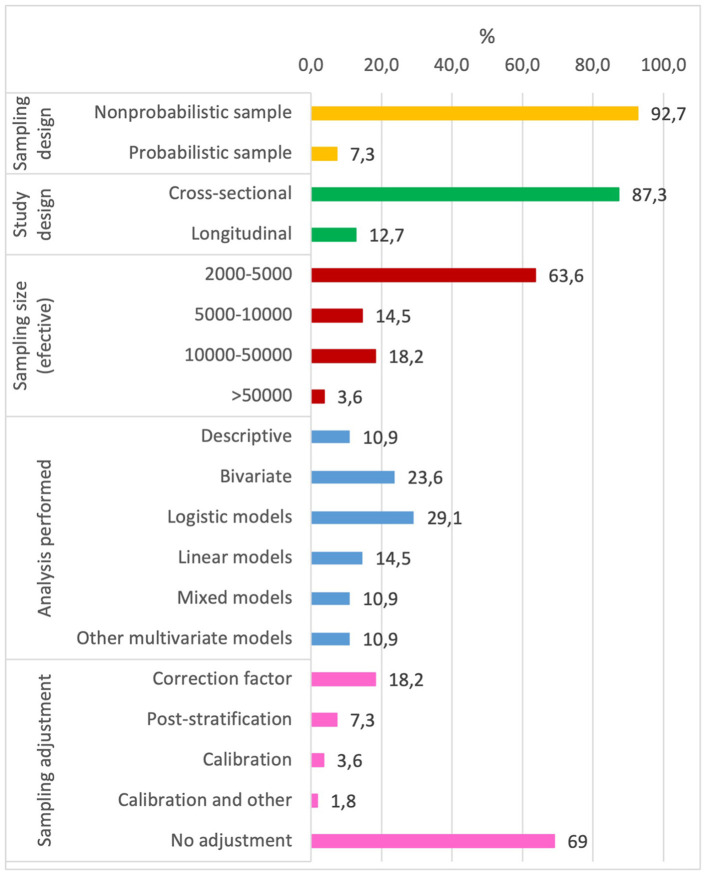
Sixty percentage of the studies included had mental health as their main topic and 75% were conducted on the general adult population. Thirteen percentage had a longitudinal design, 93% used the internet to gather information and the same percentage used non-probability sampling. Thirty percentage made some type of sampling correction to reduce coverage or non-response biases, but not selection biases. Sixty seven percentage did not state the availability of their data.
Consistent with the extensive use of non-probability sampling without any bias correction in the extraordinary setting created by COVID-19, quality population frameworks are required so that probability and representative samples can be extracted quickly to promptly address other health crises, as well as to reduce potential coverage, non-response and particularly selection biases by utilizing reweighting techniques. The low data accessibility despite the huge opportunity that COVID-19 provided for Open Science-based research is striking.
健康调查的使用在科学界中至关重要,能够及时传达 COVID-19 对健康影响的研究结果。但是,收集了哪些信息,在哪里、何时以及如何收集,以及研究人群是谁?
描述 COVID-19 大流行早期在西班牙进行的大型健康调查中使用的方法学特征。
范围综述。纳入标准:发表于 2020 年 1 月至 2021 年 12 月期间、样本量超过 2000 名居住在西班牙的人的观察性研究。检索数据库:PubMed、CINAHL、Literatura Latinoamericana y del Caribe en CC de la Salud、Scopus、PsycINFO、Embase、Sociological Abstracts、Dialnet 和 Web of Science Core Collection。我们分析了所选调查的文献参考、方法学和收集信息的特征。共纳入 55 项研究。
60%的研究将心理健康作为主要主题,75%的研究针对普通成年人群。13%的研究采用纵向设计,93%的研究通过互联网收集信息,相同比例的研究采用非概率抽样。30%的研究对某种类型的抽样进行了校正,以减少覆盖或无应答偏差,但未校正选择偏差。67%的研究未说明其数据的可用性。
在 COVID-19 造成的特殊环境下,广泛使用非概率抽样且未进行任何偏差校正,因此需要有质量的人口框架,以便能够快速提取概率和代表性样本,及时应对其他健康危机,并通过利用重新加权技术减少潜在的覆盖、无应答和特别是选择偏差。尽管 COVID-19 为基于开放科学的研究提供了巨大机会,但数据可访问性低的情况令人震惊。