Zhang Jiqing, Jia Ying, Lv Xiaomeng, Xiong Tiedan, Su Jun, Huang Yuanzheng, Shen Keke
College of Missile Engineering, Rocket Force University of Engineering, Xi'an, China.
School of Marine Science and Technology, Harbin Institute of Technology, Weihai, China.
Front Chem. 2023 Aug 2;11:1207947. doi: 10.3389/fchem.2023.1207947. eCollection 2023.
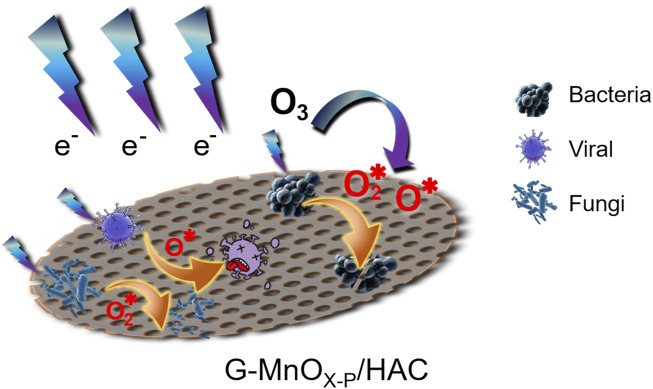
This paper addresses the risk for environmental transmission of pathogenic microorganisms in confined spaces and the serious health hazards for personnel, and research on efficient eradication methods for the pathogenic microorganisms was carried out to provide technical support for ensuring the health of personnel in confined spaces. A series of graphene-MnO2 (G-MnO2) catalytic materials was prepared by hydrothermal and precipitation methods, and processing parameters such as the graphene doping method, the raw material ratio and the plasma action time were optimized. It was shown that G-MnOX-P/HAC prepared by a one-step precipitation method and with a graphene doping ratio of 10% had the best bactericidal effect in a dielectric barrier discharge (DBD) reactor after 4 min of reaction. The eradication rates for (), (), coronavirus and Aspergillus niger were all greater than 99.9%. The characterization techniques TEM, SEM, XRD, XPS, BET and FT-IR showed that the G-MnOX-P samples prepared by the one-step precipitation method had larger specific surface areas with more oxygen vacancies and functional groups on the surfaces, which was conducive to decomposition of the ozone generated by the dissociated plasma and formation of reactive oxygen species (ROS) for the microbial eradication process. Finally, by comparing the ozone-decomposition activity with the plasma co-catalytic performance, it was verified that efficient decomposition of the ozone facilitated the eradication of microorganisms. Based on this, an analysis of the mechanism for efficient eradication was carried out.
本文探讨了密闭空间中病原微生物的环境传播风险以及对人员的严重健康危害,并开展了针对病原微生物的高效根除方法研究,以为保障密闭空间内人员健康提供技术支持。通过水热法和沉淀法制备了一系列石墨烯-二氧化锰(G-MnO₂)催化材料,并对石墨烯掺杂方法、原料比例和等离子体作用时间等工艺参数进行了优化。结果表明,采用一步沉淀法制备、石墨烯掺杂比例为10%的G-MnOX-P/HAC在介质阻挡放电(DBD)反应器中反应4分钟后具有最佳杀菌效果。对大肠杆菌()、金黄色葡萄球菌()、冠状病毒和黑曲霉的根除率均大于99.9%。透射电子显微镜(TEM)、扫描电子显微镜(SEM)、X射线衍射(XRD)、X射线光电子能谱(XPS)、比表面积分析仪(BET)和傅里叶变换红外光谱(FT-IR)等表征技术表明,一步沉淀法制备的G-MnOX-P样品具有更大的比表面积,表面有更多的氧空位和官能团,有利于分解离解等离子体产生的臭氧并形成用于微生物根除过程的活性氧物种(ROS)。最后,通过比较臭氧分解活性和等离子体共催化性能,验证了臭氧的有效分解促进了微生物的根除。在此基础上,对高效根除机制进行了分析。