REMEDY Center for treatment of Rheumatic and Musculoskeletal Diseases, Diakonhjemmet Hospital, Oslo, Norway
REMEDY Center for treatment of Rheumatic and Musculoskeletal Diseases, Diakonhjemmet Hospital, Oslo, Norway.
Ann Rheum Dis. 2023 Nov;82(11):1394-1403. doi: 10.1136/ard-2023-224476. Epub 2023 Aug 22.
Many patients with rheumatoid arthritis (RA) require treatment with tumour necrosis factor inhibitor (TNFi) to reach remission. It is debated whether tapering of TNFi to discontinuation should be considered in sustained remission. The aim of ARCTIC REWIND TNFi was to assess the effect of tapering TNFi to withdrawal compared with stable treatment on the risk of disease activity flares in patients with RA in remission ≥1 year.
This randomised, open-label, non-inferiority trial was undertaken at nine Norwegian rheumatology departments. Patients with RA in remission ≥12 months on stable TNFi therapy were allocated by computer-based block-randomisation to tapering to discontinuation of TNFi or stable TNFi. Conventional synthetic disease-modifying antirheumatic co-medication was unchanged. The primary endpoint was disease flare during the 12-month study period (non-inferiority margin 20%), assessed in the per-protocol population.
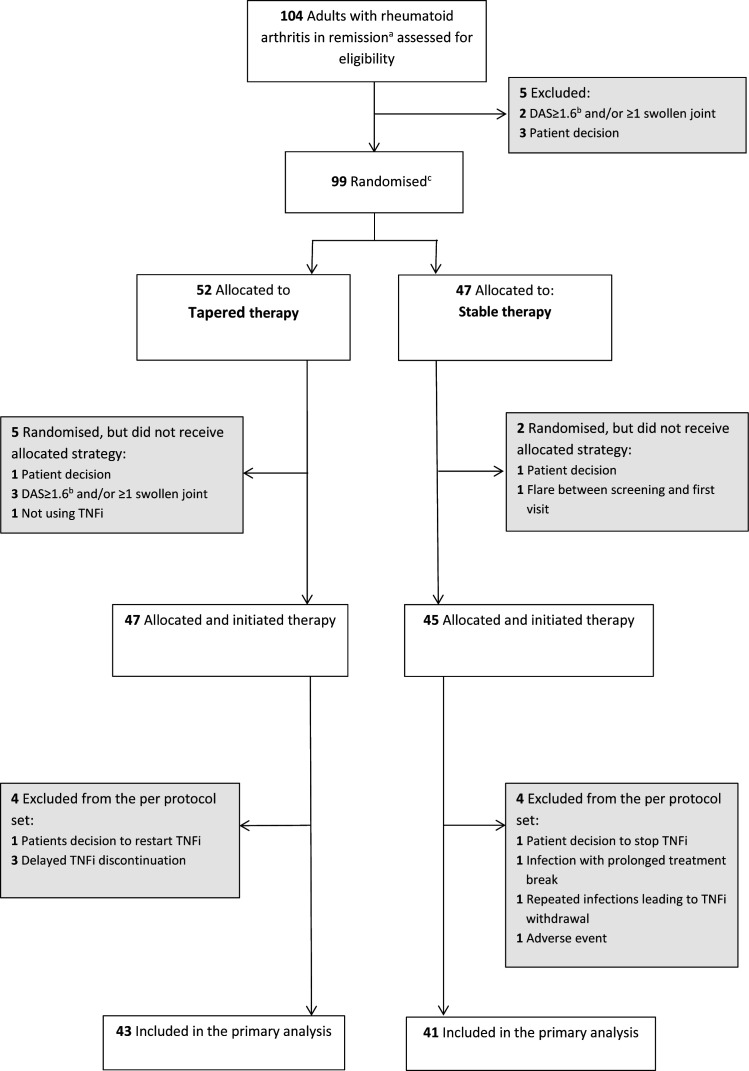
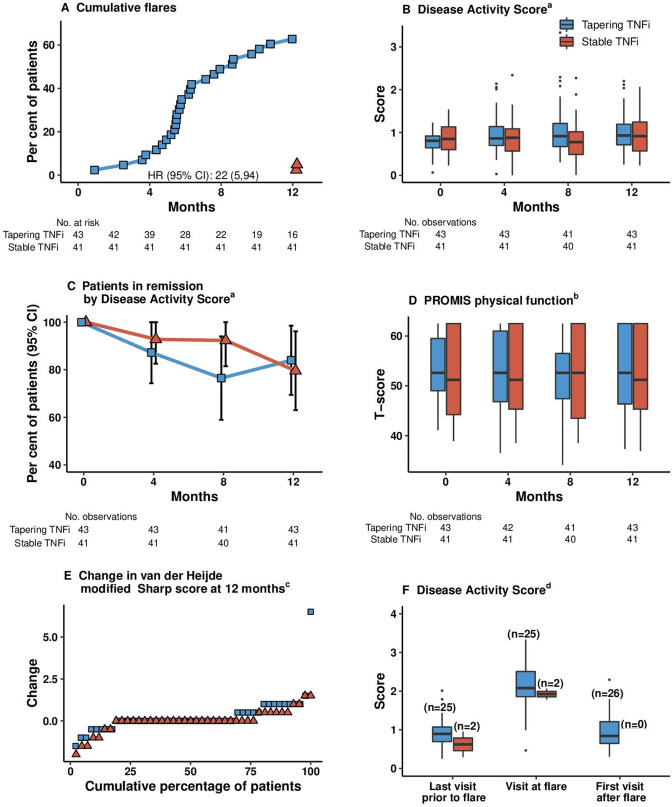
Between June 2013 and January 2019, 99 patients were enrolled and 92 received the allocated treatment strategy. Eighty-four patients were included in the per-protocol population. In the tapering TNFi group, 27/43 (63%) experienced a flare during 12 months, compared with 2/41 (5%) in the stable TNFi group; risk difference (95% CI) 58% (42% to 74%). The tapering strategy was not non-inferior to continued stable treatment. The number of total/serious adverse events was 49/3 in the tapering group, 57/2 in the stable group.
In patients with RA in remission for more than 1 year while using TNFi, an increase in flare rate was reported in those who tapered TNFi to discontinuation. However, most regained remission after reinstatement of full-dose treatment.
EudraCT: 2012-005275-14 and clinicaltrials.gov: NCT01881308.
许多类风湿关节炎(RA)患者需要接受肿瘤坏死因子抑制剂(TNFi)治疗才能达到缓解。关于持续缓解的患者是否应考虑将 TNFi 逐渐减量至停药存在争议。ARCTIC REWIND TNFi 研究的目的是评估在缓解期≥1 年的 RA 患者中,与稳定治疗相比,将 TNFi 逐渐减量至停药对疾病活动复发风险的影响。
这项在挪威 9 个风湿病科进行的随机、开放标签、非劣效性试验,纳入了稳定接受 TNFi 治疗缓解期≥12 个月的 RA 患者,采用计算机分块随机分组,分别接受 TNFi 逐渐减量至停药或稳定 TNFi 治疗。常规的合成改善病情抗风湿药物联合治疗保持不变。主要终点是在 12 个月研究期间的疾病复发(非劣效性边界为 20%),在方案人群中进行评估。
2013 年 6 月至 2019 年 1 月期间,共纳入 99 例患者,92 例接受了分配的治疗策略。84 例患者纳入方案人群。在 TNFi 逐渐减量组中,43 例中有 27 例(63%)在 12 个月时出现复发,41 例中有 2 例(5%)在稳定 TNFi 组中出现复发;风险差异(95%CI)为 58%(42%~74%)。TNFi 逐渐减量策略不比继续稳定治疗差。在逐渐减量组中,共有 49 例/3 例出现全因/严重不良事件,在稳定组中分别为 57 例/2 例。
在缓解期超过 1 年且使用 TNFi 的 RA 患者中,TNFi 逐渐减量至停药组的复发率增加。然而,大多数患者在恢复全剂量治疗后再次缓解。
EudraCT:2012-005275-14;clinicaltrials.gov:NCT01881308。