Wang Liangmin, Xue Weixian
School of Economics and Management, Xi'an University of Technology, Xi'an, 710054, China.
Sci Rep. 2023 Aug 22;13(1):13684. doi: 10.1038/s41598-023-40998-6.
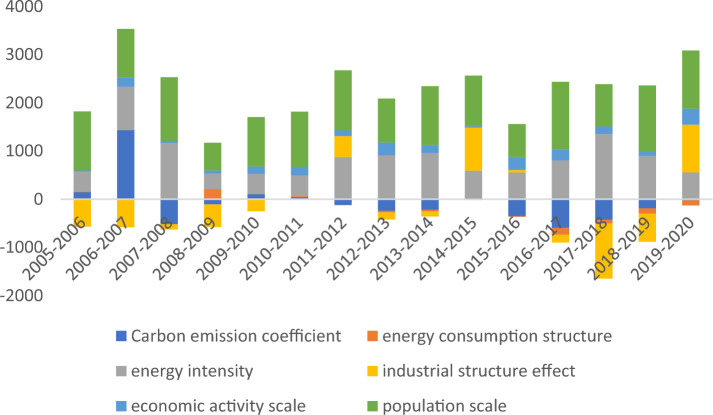
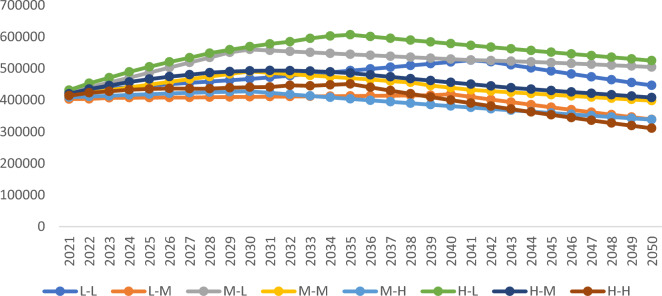
The Yellow River Basin is a key ecological barrier and commercial zone in China, as well as an essential source of energy, chemicals, raw materials, and fundamental industrial foundation, the achievement of its carbon peaking is of great significance for China's high-quality development. Based on this, we decomposed the influencing factors of carbon dioxide emissions in the Yellow River Basin using the LMDI method and predicted the carbon peaking in the Yellow River Basin under different scenarios using the STIRPAT model. The results show that (1) the energy intensity effect, economic activity effect and population effect play a positive role in promoting carbon emissions during 2005-2020. The largest effect on carbon emissions is the population size effect, with a contribution rate of 65.6%. (2) The STIRPAT model predicts that the peak of scenarios "M-L", "M-M" and "M-H" will occur in 2030 at the earliest. The "M-H" scenario is the best model for controlling carbon emissions while economic and social development in the Yellow River Basin. The results of this paper can provide a theoretical basis for the development of a reasonable carbon peak attainment path in the Yellow River Basin and help policy makers to develop a corresponding high-quality development path.
黄河流域是中国重要的生态屏障和经济地带,也是能源、化工、原材料和基础工业的重要基地,其实现碳达峰对中国高质量发展具有重要意义。基于此,本文运用LMDI方法分解了黄河流域二氧化碳排放的影响因素,并运用STIRPAT模型预测了不同情景下黄河流域的碳达峰情况。结果表明:(1)2005—2020年能源强度效应、经济活动效应和人口效应均对碳排放起到正向促进作用,其中人口规模效应的影响最大,贡献率为65.6%。(2)STIRPAT模型预测情景“M-L”“M-M”和“M-H”最早将于2030年达峰,“M-H”情景是黄河流域经济社会发展的同时控制碳排放的最优情景。本文结果可为黄河流域制定合理的碳达峰实现路径提供理论依据,有助于决策者制定相应的高质量发展路径。