China Pharmaceutical University, Nanjing Drum Tower Hospital, Nanjing, 210008, Jiangsu Province, China.
Clinical Medical College, Nanjing University of Chinese Medicine, Nanjing, 210023, Jiangsu, China.
BMC Complement Med Ther. 2023 Aug 22;23(1):295. doi: 10.1186/s12906-023-04108-3.
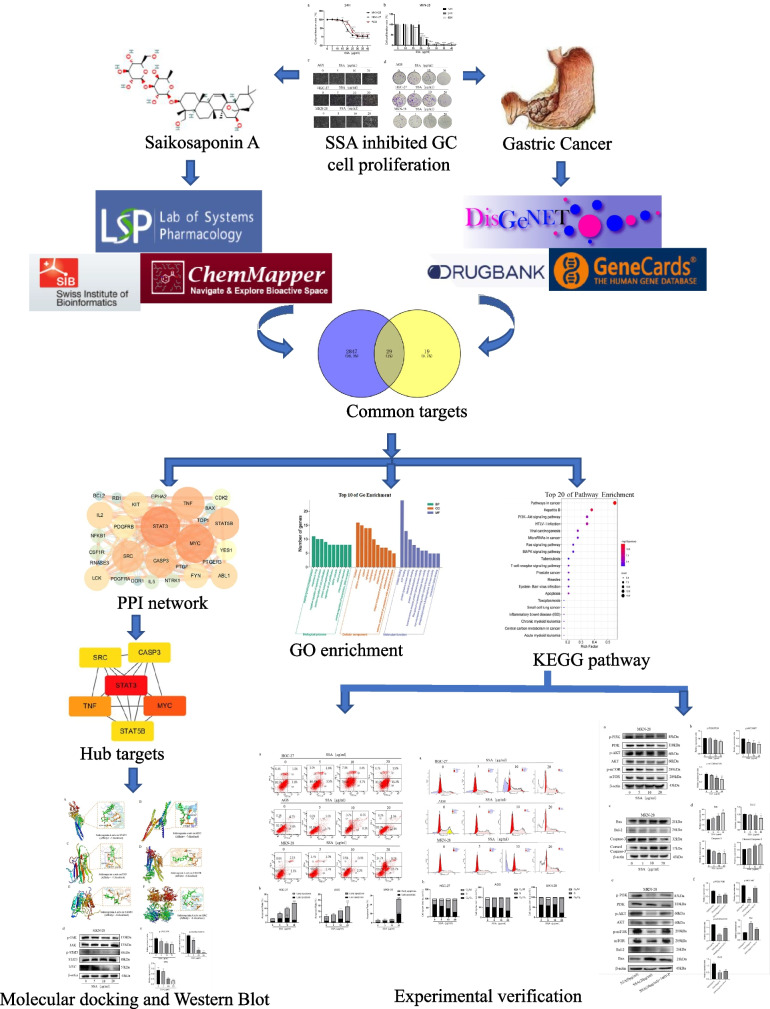
Saikosaponin A (SSA) shows a series of pharmacological activities, such as anti-inflammatory, antioxidant and antitumor. However, there is a lack of comprehensive research or sufficient evidence regarding the efficacy of SSA in treating gastric cancer (GC), and the specific mechanisms by which it inhibits GC growth and progression are still not fully understood.
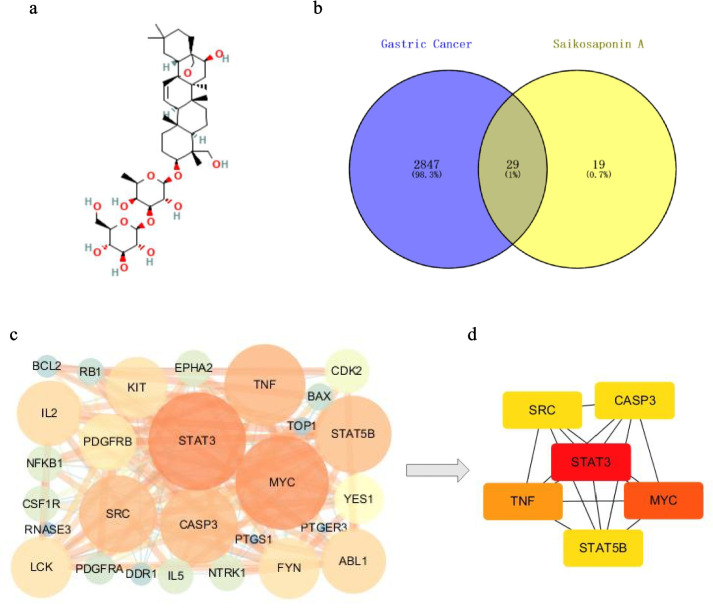
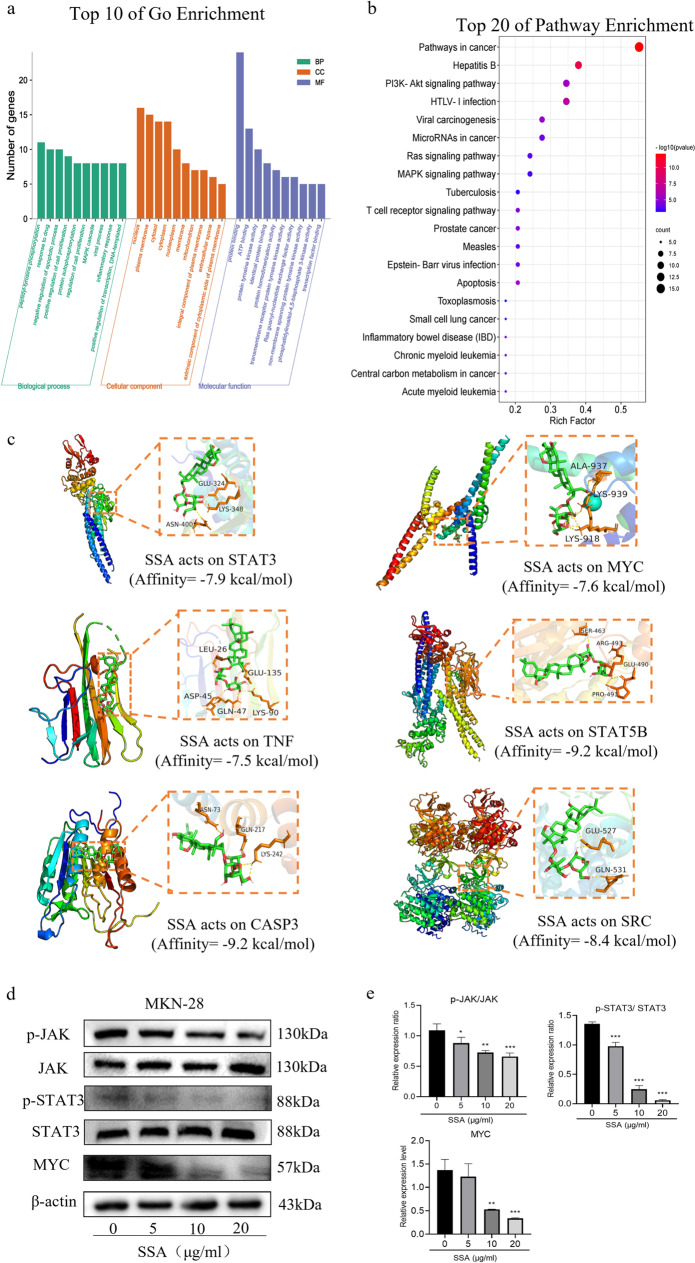
MTT and clonogenic assays were employed to detect the effect of SSA on the proliferation of GC cells. Bioinformatics predicted the SSA targets in the treatment of GC. The core genes and the underlying mechanism of SSA in anti-GC were obtained by analyzing the intersecting targets; molecular docking and Western blot were used to check the reliability of core genes. Flow cytometry was used to analyze apoptosis and cell cycle in GC cells treated with varying concentrations of SSA. Western blot was employed to detect the expression levels of related proteins.
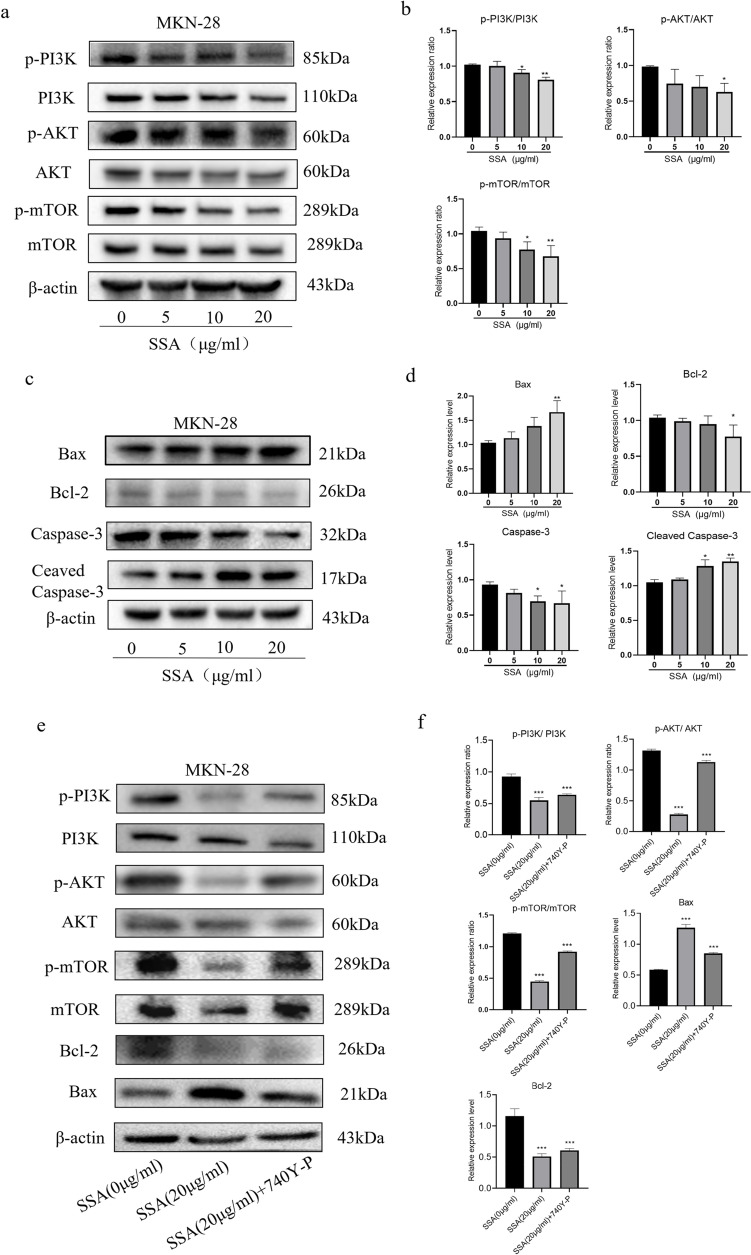
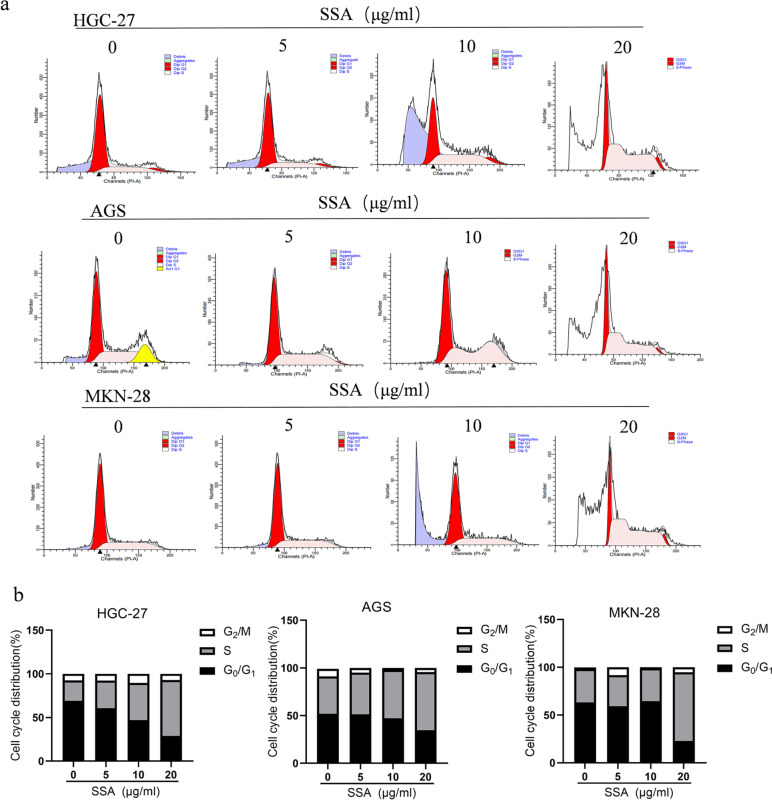
SSA significantly blocked GC cells in the S phase of the cell cycle and induced apoptosis to suppress the proliferation of GC cells. Network pharmacology revealed that the underlying mechanisms through which SSA acts against GC involve the modulation of several signaling pathways, including the PI3K-Akt, MAPK, RAS, and T-cell signaling pathways. Molecular docking showed pivotal target genes with a high affinity to SSA, including STAT3, MYC, TNF, STAT5B, Caspase-3 and SRC. Furthermore, western blot results revealed that SSA significantly increased the protein levels of Bax and Cleaved Caspase-3, whereas decreased the expression levels of p-JAK, p-STAT3, MYC, Bcl-2, p-PI3K, p-AKT and p-mTOR, confirming that the reliability of hub targets and SSA could promote GC cell apoptosis by suppressing PI3K/AKT/mTOR pathway.
The results suggest that SSA has the ability to trigger apoptosis in GC cells by blocking the PI3K/AKT/mTOR pathway. These findings highlight the potential of SSA as a promising natural therapeutic agent for the treatment of GC.
柴胡皂苷 A(SSA)具有一系列药理活性,如抗炎、抗氧化和抗肿瘤。然而,关于 SSA 治疗胃癌(GC)的疗效缺乏全面的研究或充分的证据,其抑制 GC 生长和进展的具体机制仍不完全清楚。
采用 MTT 和集落形成实验检测 SSA 对 GC 细胞增殖的影响。生物信息学预测 SSA 治疗 GC 的靶点。通过分析交集靶点获得 SSA 抗 GC 的核心基因及其作用机制;分子对接和 Western blot 用于检查核心基因的可靠性。用不同浓度的 SSA 处理 GC 细胞,通过流式细胞术分析细胞凋亡和细胞周期。Western blot 用于检测相关蛋白的表达水平。
SSA 能显著阻滞 GC 细胞于细胞周期 S 期,诱导细胞凋亡,从而抑制 GC 细胞的增殖。网络药理学揭示了 SSA 作用于 GC 的潜在机制涉及到几个信号通路的调节,包括 PI3K-Akt、MAPK、RAS 和 T 细胞信号通路。分子对接显示与 SSA 具有高亲和力的关键靶基因,包括 STAT3、MYC、TNF、STAT5B、Caspase-3 和 SRC。此外,Western blot 结果表明 SSA 能显著增加 Bax 和 Cleaved Caspase-3 的蛋白水平,而降低 p-JAK、p-STAT3、MYC、Bcl-2、p-PI3K、p-AKT 和 p-mTOR 的表达水平,证实了枢纽靶基因和 SSA 的可靠性,可通过抑制 PI3K/AKT/mTOR 通路促进 GC 细胞凋亡。
结果表明 SSA 通过阻断 PI3K/AKT/mTOR 通路诱导 GC 细胞凋亡。这些发现突显了 SSA 作为治疗 GC 的有前途的天然治疗剂的潜力。