Vinokurov Michael A, Mironov Konstantin O, Domonova Elvira A, Romanyuk Tatiana N, Popova Anna A, Akimkin Vasiliy G
Central Research Institute of Epidemiology of the Federal Service for Surveillance on Consumer Rights Protection and Human Wellbeing, Moscow, Russia.
Front Oncol. 2023 Aug 8;13:1207935. doi: 10.3389/fonc.2023.1207935. eCollection 2023.
Cervical cancer (CC) is a prevalent malignancy affecting women globally. The primary causative factor of CC is the high-risk oncogenic human papillomavirus (HR-HPV). However, it is noteworthy that not all women infected with HR-HPV develop cancer, indicating the potential involvement of genetic predisposition in the development of CC. This study aims to identify genetic risks and their distribution in groups of women with different epidemiological features of HR-HPV.
A comparison was conducted among four groups of women, comprising 218 HPV-negative women, 120 HPV-positive women, 191 women diagnosed with cervical intraepithelial neoplasia (CIN) grade 2 or 3, and 124 women diagnosed with CC. The analysis focused on four single nucleotide polymorphisms (SNPs): in , in , in , and in .
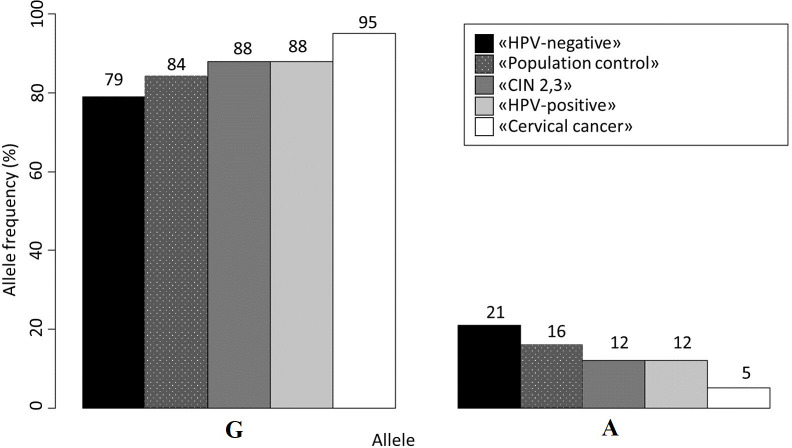
The rs55986091-A allele exhibited a protective effect within the "CC" group when compared to the "HPV-Negative" group (OR = 0.4, 95% CI= 0.25-0.65) using a log-additive model. Additionally, similar protective effects were observed in the "CIN 2/3" group compared to the "HPV-Negative" group (OR = 0.47, 95% CI = 0.28-0.79).
The data obtained emphasize the importance of developing PCR-based diagnostic kits for the identification of SNP alleles, particularly for rs55986091, among HR-HPV-positive women within the Russian population.
宫颈癌(CC)是一种在全球范围内影响女性的常见恶性肿瘤。宫颈癌的主要致病因素是高危致癌性人乳头瘤病毒(HR-HPV)。然而,值得注意的是,并非所有感染HR-HPV的女性都会患癌,这表明遗传易感性可能参与了宫颈癌的发生发展。本研究旨在确定不同HR-HPV流行病学特征女性群体中的遗传风险及其分布情况。
对四组女性进行了比较,包括218名HPV阴性女性、120名HPV阳性女性、191名被诊断为宫颈上皮内瘤变(CIN)2级或3级的女性以及124名被诊断为宫颈癌的女性。分析聚焦于四个单核苷酸多态性(SNP):位于[具体基因1]的[具体SNP名称1]、位于[具体基因2]的[具体SNP名称2]、位于[具体基因3]的[具体SNP名称3]和位于[具体基因4]的[具体SNP名称4]。
使用对数相加模型比较“宫颈癌”组和“HPV阴性”组时,rs55986091-A等位基因在“宫颈癌”组中显示出保护作用(OR = 0.4,95% CI = 0.25 - 0.65)。此外,与“HPV阴性”组相比,在“CIN 2/3”组中也观察到了类似的保护作用(OR = 0.47,95% CI = 0.28 - 0.79)。
所获得的数据强调了开发基于PCR的诊断试剂盒以识别SNP等位基因的重要性,特别是对于俄罗斯人群中HR-HPV阳性女性的rs55986091。