Asif Muhammad Zaka, Benveniste Maci C, Chism Kyra D, Levin Ari L, Lanier Deanna, Watkins Rockford E, Taujale Rahil, Tucker Niyelle, Edison Arthur S
Department of Biochemistry & Molecular Biology, University of Georgia, Athens, Georgia, United States.
Complex Carbohydrate Research Center, University of Georgia, Athens, Georgia, United States.
MicroPubl Biol. 2023 Aug 7;2023. doi: 10.17912/micropub.biology.000819. eCollection 2023.
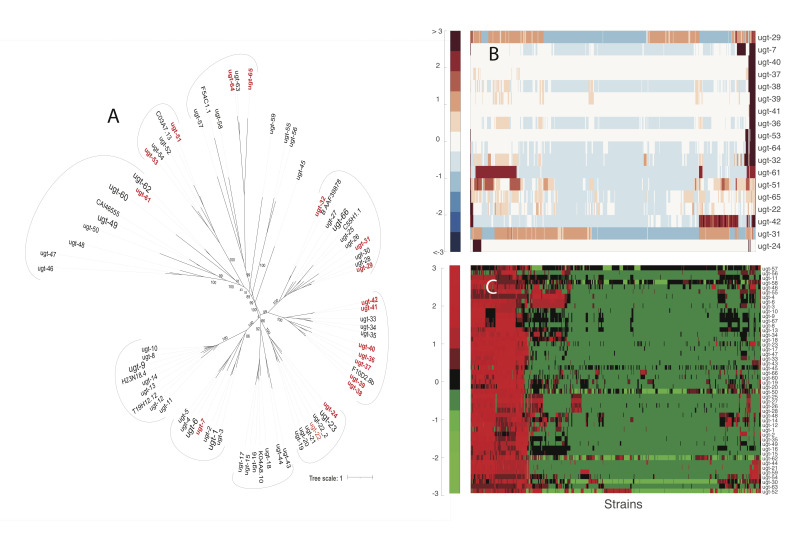
are free-living nematodes with a relatively short life cycle and a wealth of genomic information across multiple databases. Uridine diphosphate-glycosyltransferases (UGTs) are a family of enzymes involved in Phase II modification of xenobiotics in , which is the addition of a sizeable water-soluble molecule to a xenobiotic to allow for its excretion out of a cell. Little is known about the variation in UGTs across wild isolates and how that might affect their innate immune response. We analyzed the diversity in genes across isolates from different geographical locations from the Natural Diversity Resource (CaeNDR) database. This was accomplished using whole genome data and data identifying genome regions as hyper-divergent for each isotype. We implemented three steps to identify genes and make inferences based on their variation. First, we created a catalog of UGTs in the N2 reference strain and used them to create a phylogenetic tree that depicts the relationships between the UGT protein sequences. We then quantified variation using the strains from the CaeNDR database and used their data to remove hyper-divergent genes. The third step was to catalog the occurrence of minor allele frequency (MAF) > 0.05 for all the to compare how that aligned with genes classified as hyper-divergent by CaeNDR. Of the 67 genes analyzed, 18 were hyper-divergent. This research will help improve our understanding of variation in .
是自由生活的线虫,具有相对较短的生命周期,并且在多个数据库中拥有丰富的基因组信息。尿苷二磷酸糖基转移酶(UGTs)是一类参与异生素II相修饰的酶,即在异生素上添加一个相当大的水溶性分子,使其能够排出细胞。关于野生分离株中UGTs的变异以及这可能如何影响它们的先天免疫反应,人们知之甚少。我们分析了来自秀丽隐杆线虫自然多样性资源(CaeNDR)数据库中不同地理位置的67个分离株的UGT基因多样性。这是通过全基因组数据以及识别每个同种型超发散基因组区域的数据来完成的。我们实施了三个步骤来识别UGT基因并根据它们的变异进行推断。首先,我们在N2参考菌株中创建了UGT目录,并使用它们创建了一个系统发育树,描绘了UGT蛋白序列之间的关系。然后,我们使用CaeNDR数据库中的菌株量化UGT变异,并使用它们的数据去除超发散的UGT基因。第三步是对所有UGT的次要等位基因频率(MAF)> 0.05的情况进行编目,以比较其与CaeNDR分类为超发散的基因的一致性。在分析的67个UGT基因中,有18个是超发散基因。这项研究将有助于提高我们对秀丽隐杆线虫中UGT变异的理解。