Todorovic Jovana, Stamenkovic Zeljka, Stevanovic Aleksandar, Terzic Natasa, Kissimova-Skarbek Katarzyna, Tozija Fimka, Mechili Enkeleint A, Devleesschauwer Brecht, Terzic-Supic Zorica, Vasic Milena, Bjegovic-Mikanovic Vesna, Santric-Milicevic Milena
Faculty of Medicine, Institute of Social Medicine, School of Public Health and Health Management, University of Belgrade, Dr Subotica 15, Belgrade, 11000, Serbia.
Institute of Public Health of Montenegro, Podgorica, Montenegro.
Arch Public Health. 2023 Aug 24;81(1):156. doi: 10.1186/s13690-023-01137-9.
Despite effective prevention and control strategies, in countries of the Balkan region, cancers are the second leading cause of mortality, closely following circulatory system diseases.
To describe trends in the burden of breast, cervical, and colon and rectum cancer in the Balkan region and per country between 1990 and 2019, including a forecast to 2030.
We described the 2019 Global Burden of Disease (GBD) estimates for breast, cervical, and colon and rectum cancers in eleven Balkan countries over the period 1990-2019, including incidence, years lived with disability (YLD), years of life lost (YLL), and disability-adjusted life years (DALYs) rates per 100,000 population and accompanied 95% uncertainty interval. With the Autoregressive Integrated Moving Average, we forecasted these rates per country up to 2030.
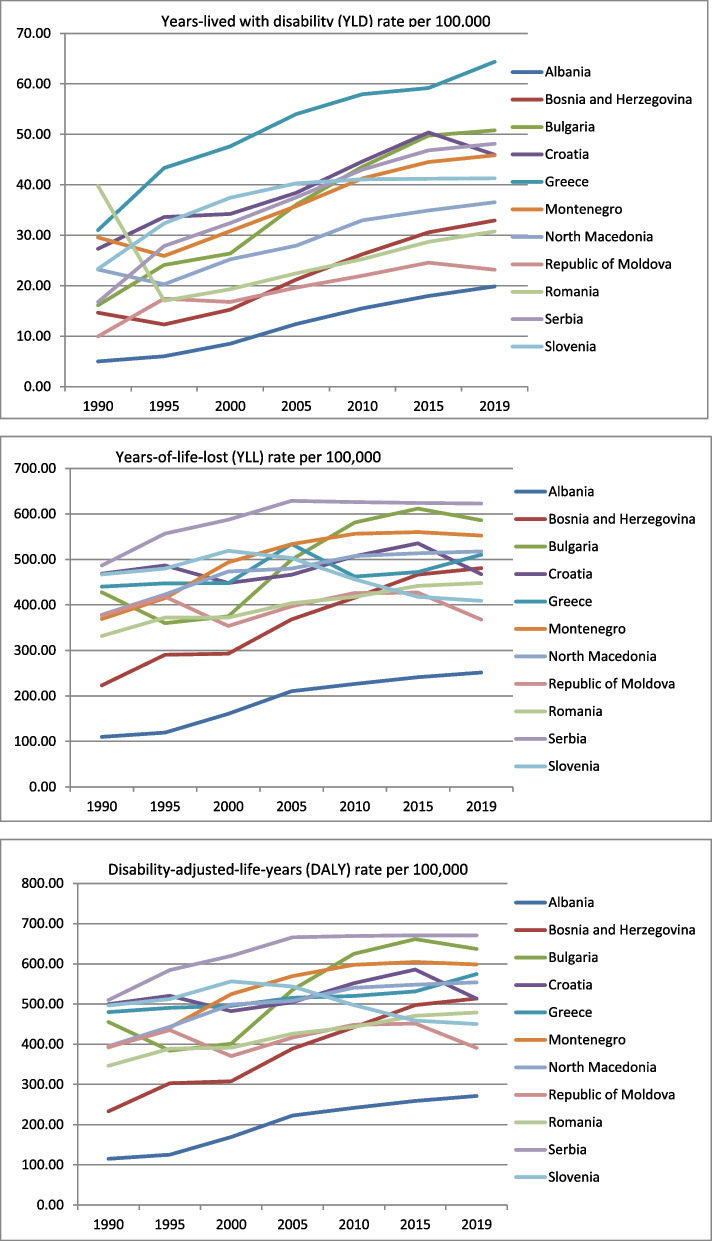
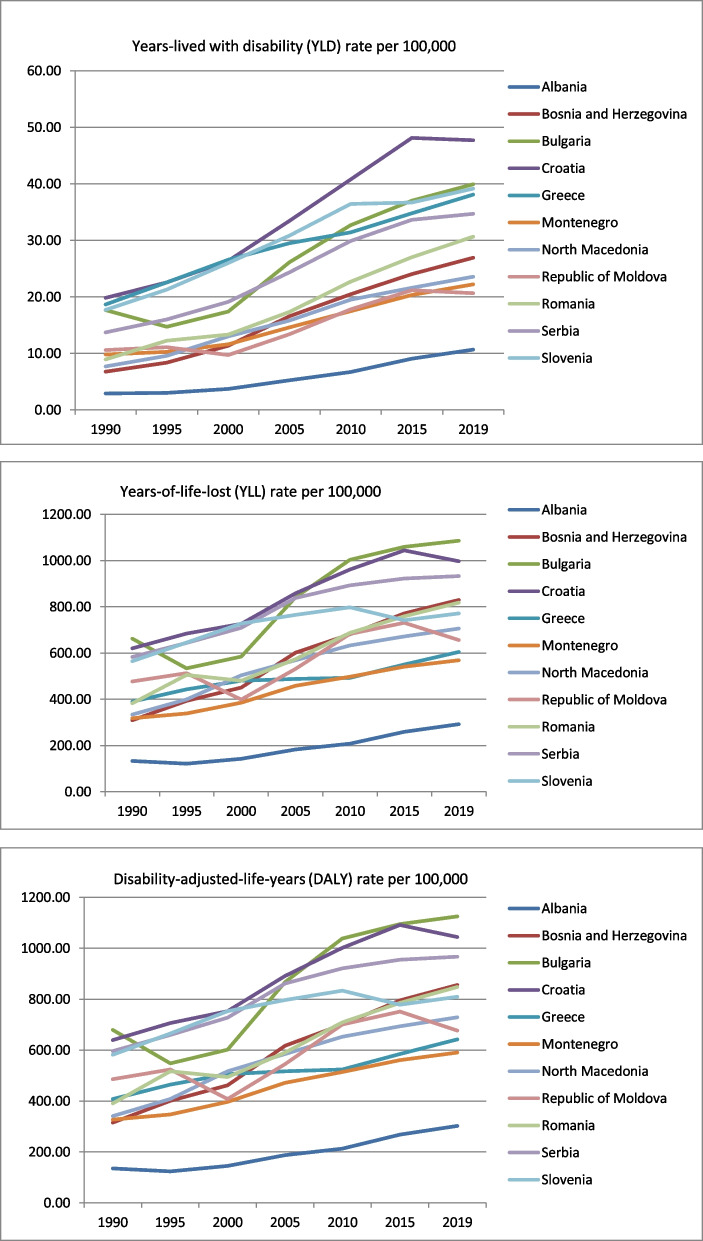
In the Balkan region, the highest incidence and DALYs rates in the study period were for colon and rectum, and breast cancers. Over the study period, the DALYs rates for breast cancer per 100,000 population were the highest in Serbia (reaching 670.84 in 2019) but the lowest in Albania (reaching 271.24 in 2019). In 2019, the highest incidence of breast cancer (85 /100,000) and highest YLD rate (64 /100,000) were observed in Greece. Romania had the highest incidence rates, YLD rates, DALY rates, and YLL rates of cervical cancer, with respective 20.59%, 23.39% 4.00%, and 3.47% increases for the 1990/2019 period, and the highest forecasted burden for cervical cancer in 2030. The highest incidence rates, YLD rates and DALY rates of colon and rectum cancers were continuously recorded in Croatia (an increase of 130.75%, 48.23%, and 63.28%, respectively), while the highest YLL rates were in Bulgaria (an increase of 63.85%). The YLL rates due to colon and rectum cancers are forecasted to progress by 2030 in all Balkan countries.
As most of the DALYs burden for breast, cervical, and colon and rectum cancer is due to premature mortality, the numerous country-specific barriers to cancer early detection and quality and care continuum should be a public priority of multi-stakeholder collaboration in the Balkan region.
尽管有有效的预防和控制策略,但在巴尔干地区国家,癌症是仅次于循环系统疾病的第二大死亡原因。
描述1990年至2019年巴尔干地区及各国乳腺癌、宫颈癌以及结肠癌和直肠癌的负担趋势,包括对2030年的预测。
我们描述了1990 - 2019年期间11个巴尔干国家乳腺癌、宫颈癌以及结肠癌和直肠癌的2019年全球疾病负担(GBD)估计值,包括发病率、伤残调整生命年(YLD)、生命损失年数(YLL)以及每10万人口的伤残调整生命年(DALY)率,并伴有95%的不确定区间。利用自回归积分滑动平均法,我们预测了各国到2030年的这些比率。
在巴尔干地区,研究期间发病率和DALY率最高的是结肠癌和直肠癌以及乳腺癌。在研究期间,塞尔维亚每10万人口中乳腺癌的DALY率最高(2019年达到670.84),而阿尔巴尼亚最低(2019年达到271.24)。2019年,希腊观察到乳腺癌的发病率最高(85/10万)和YLD率最高(64/10万)。罗马尼亚宫颈癌的发病率、YLD率、DALY率和YLL率最高,1990/2019年期间分别增长了20.59%、23.39%、4.00%和3.47%,且预计2030年宫颈癌负担最高。克罗地亚持续记录到结肠癌和直肠癌的发病率、YLD率和DALY率最高(分别增长了130.75%、48.23%和63.28%),而保加利亚的YLL率最高(增长了63.85%)。预计到2030年,所有巴尔干国家因结肠癌和直肠癌导致的YLL率都将上升。
由于乳腺癌、宫颈癌以及结肠癌和直肠癌的大部分DALY负担是由于过早死亡,巴尔干地区各国在癌症早期检测以及质量和连续护理方面存在众多障碍,这应成为多方利益相关者合作的公共优先事项。