Department of Medical Oncology, National Clinical Research Center for Cancer/Cancer Hospital, National Cancer Center, Chinese Academy of Medical Sciences & Peking Union Medical College, No. 17 Panjiayuan Nanli, Chaoyang District, Beijing, 100021, China.
Department of Medical Oncology, Beijing Chao yang District San huan Cancer Hospital, Beijing, 100122, China.
BMC Med Genomics. 2023 Aug 24;16(1):200. doi: 10.1186/s12920-023-01634-4.
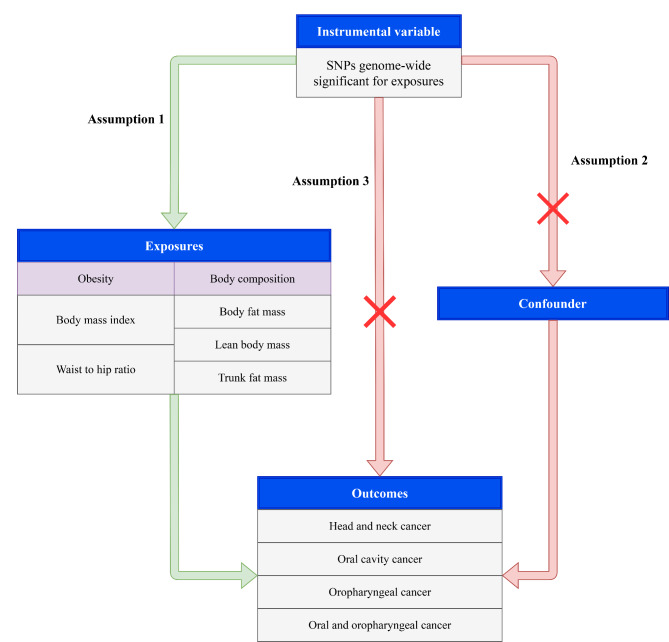
Observational studies have reported controversial results on the association between obesity and head and neck cancer risk. This study aimed to perform a two-sample Mendelian randomization (MR) analysis to assess the causal association between obesity and head and neck cancer risk using publicly available genome-wide association studies (GWAS) summary statistics.
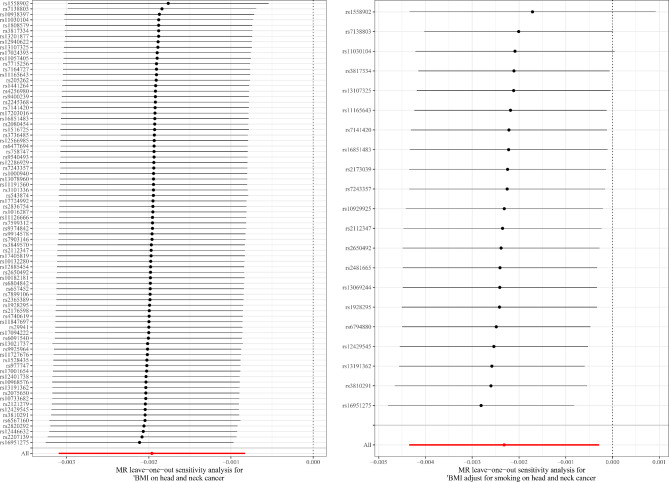
Single-nucleotide polymorphisms (SNPs) for obesity [body mass index (BMI), waist-to-hip ratio (WHR), whole body fat mass, lean body mass, and trunk fat mass] and head and neck cancer (total head and neck cancer, oral cavity cancer, oropharyngeal cancer, and oral cavity and oropharyngeal cancer) were retrieved from published GWASs and used as genetic instrumental variables. Five methods including inverse-variance-weighted (IVW), weighted-median, MR-Egger, weighted mode, and MR-PRESSO were used to obtain reliable results, and odds ratio with 95% confidence interval (CI) were calculated. Tests for horizontal pleiotropy, heterogeneity, and sensitivity were performed separately.
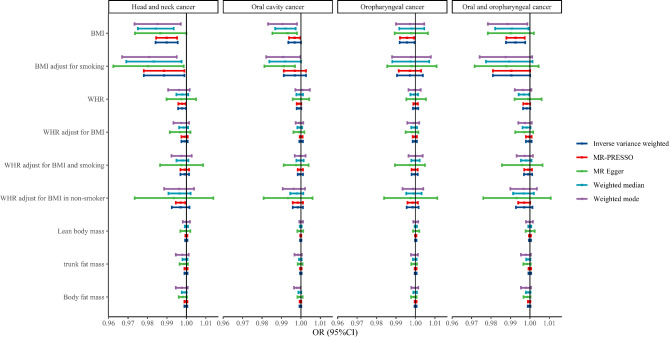
Genetically predicted BMI was negatively associated with the risk of total head and neck cancer, which was significant in the IVW [OR (95%CI), 0.990 (0.984-0.996), P = 0.0005], weighted-median [OR (95%CI), 0.984 (0.975-0.993), P = 0.0009], and MR-PRESSO [OR (95%CI), 0.990 (0.984-0.995), P = 0.0004] analyses, but suggestive significant in the MR-Egger [OR (95%CI), 0.9980 (0.9968-0.9991), P < 0.001] and weighted mode [OR (95%CI), 0.9980 (0.9968-0.9991), P < 0.001] analyses. Similar, genetically predicted BMI adjust for smoking may also be negatively associated with the risk of total head and neck cancer (P < 0.05). Genetically predicted BMI may be negatively related to the risk of oral cavity cancer, oropharyngeal cancer, and oral cavity and oropharyngeal cancer (P < 0.05), but no causal association was observed for BMI adjust for smoking (P > 0.05). In addition, no causal associations were observed for other exposures and outcomes (all P > 0.05).
This MR analysis supported the causal association of BMI-related obesity with decreased risk of total head and neck cancer. However, the effect estimates from the MR analysis were close to 1, suggesting a slight protective effect of BMI-related obesity on head and neck cancer risk.
观察性研究报告称肥胖与头颈部癌症风险之间的关联存在争议。本研究旨在使用公开的全基因组关联研究(GWAS)汇总统计数据,通过两样本孟德尔随机化(MR)分析来评估肥胖与头颈部癌症风险之间的因果关联。
从已发表的 GWAS 中检索到肥胖[体重指数(BMI)、腰臀比(WHR)、全身脂肪量、瘦体重和躯干脂肪量]和头颈部癌症(总头颈部癌症、口腔癌、口咽癌和口腔与口咽癌)的单核苷酸多态性(SNP),并将其用作遗传工具变量。使用了五种方法,包括逆方差加权(IVW)、加权中位数、MR-Egger、加权模式和 MR-PRESSO,以获得可靠的结果,并计算了比值比及其 95%置信区间(CI)。分别进行了水平异质性、异质性和敏感性检验。
遗传预测的 BMI 与总头颈部癌症的风险呈负相关,在 IVW [比值比(95%CI),0.990(0.984-0.996),P=0.0005]、加权中位数 [比值比(95%CI),0.984(0.975-0.993),P=0.0009]和 MR-PRESSO [比值比(95%CI),0.990(0.984-0.995),P=0.0004]分析中具有统计学意义,但在 MR-Egger [比值比(95%CI),0.9980(0.9968-0.9991),P<0.001]和加权模式 [比值比(95%CI),0.9980(0.9968-0.9991),P<0.001]分析中具有提示性统计学意义。类似地,遗传预测的 BMI 调整吸烟因素后也可能与总头颈部癌症的风险呈负相关(P<0.05)。遗传预测的 BMI 可能与口腔癌、口咽癌和口腔与口咽癌的风险呈负相关(P<0.05),但调整吸烟因素后的 BMI 与风险无因果关联(P>0.05)。此外,其他暴露因素和结局均无因果关联(均 P>0.05)。
本 MR 分析支持 BMI 相关肥胖与总头颈部癌症风险降低之间的因果关联。然而,MR 分析的效应估计值接近 1,提示 BMI 相关肥胖对头颈部癌症风险有轻微的保护作用。