Zheng Can, Ling Shuai, Cho Dongmin
Department of Design and Manufacturing Engineering, Jeonbuk National University, Jeonju 54896, Republic of Korea.
Department of Industrial Design, Jeonbuk National University, Jeonju 54896, Republic of Korea.
Behav Sci (Basel). 2023 Aug 9;13(8):664. doi: 10.3390/bs13080664.
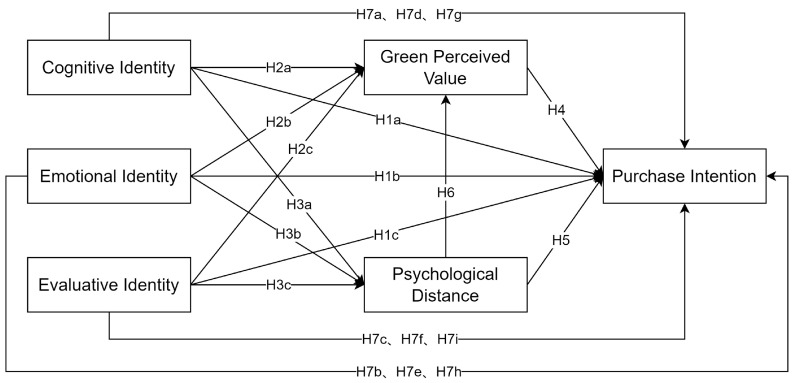
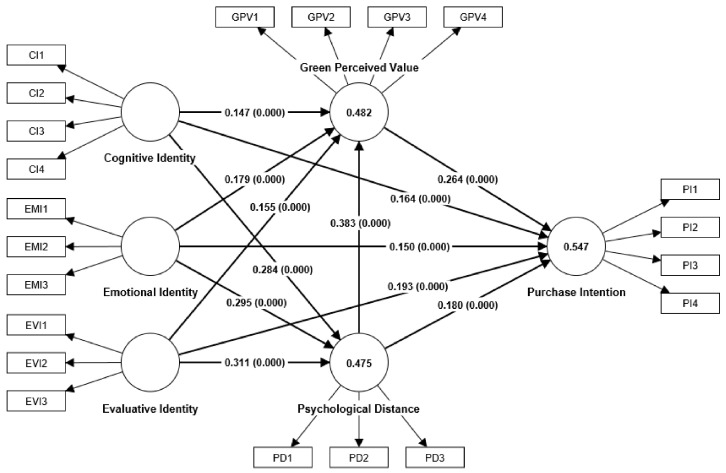
As the global population continues to grow, the impact of environmental damage and resource depletion has been severely increased. In this context, green food gains tremendous potential as a sustainable solution. This study establishes a model framework around social identity, psychological distance, green perceived value, and purchase intention from the perspective of social identity to explore the impact the social group has on individual green food purchase intention. Data from 497 questionnaires collected in China were validated using SPSS26 and SmartPLS4. The results demonstrated that the model exhibited excellent explanatory power for psychological distance (R = 47.5%), green perceived value (R = 48.2%), and purchase intention of green food (R = 54.7%). Path analysis showed that social identity, psychological distance, and green perceived value significantly positively affected green food purchase intention. The results also show that social identity significantly positively affected psychological distance and green perceived value, while psychological distance has a significant positive influence on green perceived value. Additionally, it is concluded that psychological distance and green perceived value have significant mediating and serial mediating effects on social identity and green food purchase intention. These findings bridge the research gap concerning consumers' green food purchase intention from a group perspective, thereby offering great insights for the formulation of sustainable policies. Furthermore, the study provides both theoretical and practical implications for the expansion of the green food consumption market.
随着全球人口持续增长,环境破坏和资源枯竭的影响已大幅加剧。在此背景下,绿色食品作为一种可持续解决方案具有巨大潜力。本研究从社会认同的角度围绕社会认同、心理距离、绿色感知价值和购买意愿建立了一个模型框架,以探讨社会群体对个体绿色食品购买意愿的影响。使用SPSS26和SmartPLS4对在中国收集的497份问卷数据进行了验证。结果表明,该模型对心理距离(R = 47.5%)、绿色感知价值(R = 48.2%)和绿色食品购买意愿(R = 54.7%)具有出色的解释力。路径分析表明,社会认同、心理距离和绿色感知价值对绿色食品购买意愿有显著的正向影响。结果还表明,社会认同对心理距离和绿色感知价值有显著的正向影响,而心理距离对绿色感知价值有显著的正向影响。此外,研究得出心理距离和绿色感知价值在社会认同和绿色食品购买意愿之间具有显著的中介和序列中介作用。这些发现从群体角度弥合了关于消费者绿色食品购买意愿的研究差距,从而为可持续政策的制定提供了深刻见解。此外,该研究为绿色食品消费市场的拓展提供了理论和实践意义。