Yin Yize, Mu Chaohui, Wang Jiahui, Wang Yixuan, Hu Wenmin, Zhu Wenjing, Yu Xinjuan, Hao Wanming, Zheng Yuxin, Li Qinghai, Han Wei
Department of Pulmonary and Critical Care Medicine, Qingdao Municipal Hospital, School of Public Health, Qingdao University, Qingdao 266071, China.
Department of Pulmonary and Critical Care Medicine, Qingdao Municipal Hospital, School of Medicine, Qingdao University, Qingdao 266071, China.
Toxics. 2023 Jul 26;11(8):646. doi: 10.3390/toxics11080646.
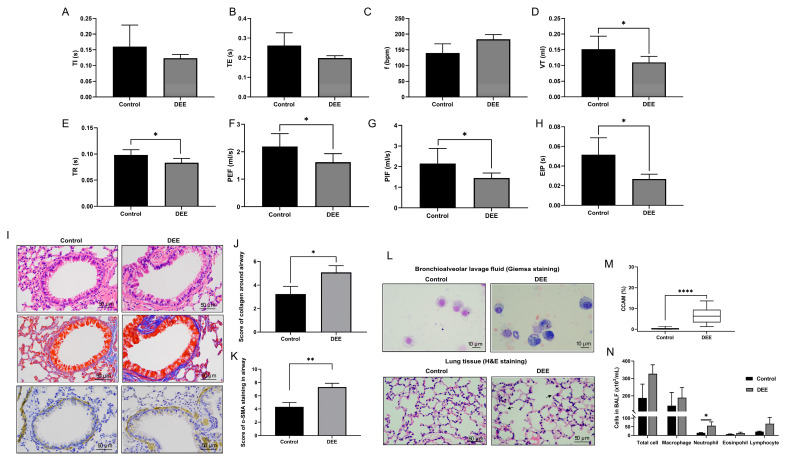
Exposure to diesel exhaust emissions (DEE) is strongly linked to innate immune injury and lung injury, but the role of macrophage chemoattractant CXCL17 in the lung damage caused by DEE exposure remains unclear. In this study, whole-body plethysmography (WBP), inflammatory cell differential count, and histopathological analysis were performed to assess respiratory parameters, airway inflammation, and airway injury in C57BL/6 male mice exposed to DEE for 3 months. qRT-PCR, IHC (immunohistochemistry), and ELISA were performed to measure the CXCL17 expression in airway epithelium or BALF (bronchoalveolar lavage fluid) following DEE/Diesel exhaust particle (DEP) exposure. Respiratory parameters, airway inflammation, and airway injury were assessed in CXCL17-overexpressing mice through adeno-associated virus vector Type 5 (AAV5) infection. Additionally, an in vitro THP-1 and HBE co-culture system was constructed. Transwell assay was carried out to evaluate the effect of rh-CXCL17 (recombinant human protein-CXCL17) on THP-1 cell migration. Flow cytometry and qRT-PCR were conducted to assess the impacts of rh-CXCL17 on apoptosis and inflammation/remodeling of HBE cells. We found that the mice exposed to DEE showed abnormal respiratory parameters, accompanied by airway injury and remodeling (ciliary injury in airway epithelium, airway smooth muscle hyperplasia, and increased collagen deposition). Carbon content in airway macrophages (CCAM), but not the number of macrophages in BALF, increased significantly. CXCL17 expression significantly decreased in mice airways and HBE after DEE/DEP exposure. AAV5-CXCL17 enhanced macrophage recruitment and clearance of DEE in the lungs of mice, and it improved respiratory parameters, airway injury, and airway remodeling. In the THP-1/HBE co-culture system, rh-CXCL17 increased THP-1 cell migration while attenuating HBE cell apoptosis and inflammation/remodeling. Therefore, CXCL17 might attenuate DEE-induced lung damage by recruiting and activating pulmonary macrophages, which is expected to be a novel therapeutic target for DEE-associated lung diseases.
接触柴油尾气排放物(DEE)与先天性免疫损伤和肺损伤密切相关,但巨噬细胞趋化因子CXCL17在DEE暴露引起的肺损伤中的作用仍不清楚。在本研究中,对暴露于DEE 3个月的C57BL/6雄性小鼠进行全身体积描记法(WBP)、炎性细胞分类计数和组织病理学分析,以评估呼吸参数、气道炎症和气道损伤。进行qRT-PCR、免疫组织化学(IHC)和酶联免疫吸附测定(ELISA),以测量DEE/柴油尾气颗粒(DEP)暴露后气道上皮或支气管肺泡灌洗液(BALF)中CXCL17的表达。通过5型腺相关病毒载体(AAV5)感染,在CXCL17过表达小鼠中评估呼吸参数、气道炎症和气道损伤。此外,构建了体外THP-1和HBE共培养系统。进行Transwell试验以评估重组人蛋白-CXCL17(rh-CXCL17)对THP-1细胞迁移的影响。进行流式细胞术和qRT-PCR以评估rh-CXCL17对HBE细胞凋亡和炎症/重塑的影响。我们发现,暴露于DEE的小鼠表现出异常呼吸参数,伴有气道损伤和重塑(气道上皮中的纤毛损伤、气道平滑肌增生和胶原沉积增加)。气道巨噬细胞中的碳含量(CCAM)显著增加,但BALF中的巨噬细胞数量未增加。DEE/DEP暴露后,小鼠气道和HBE中CXCL17表达显著降低。AAV5-CXCL17增强了小鼠肺中巨噬细胞的募集和DEE的清除,并改善了呼吸参数、气道损伤和气道重塑。在THP-1/HBE共培养系统中,rh-CXCL17增加了THP-1细胞迁移,同时减轻了HBE细胞凋亡和炎症/重塑。因此,CXCL17可能通过募集和激活肺巨噬细胞减轻DEE诱导的肺损伤,有望成为DEE相关肺部疾病的新型治疗靶点。