Department of Physiology and Brain Science Institute, Johns Hopkins University School of Medicine, Baltimore, MD, 21205, USA.
The Solomon H. Snyder Department of Neuroscience, Johns Hopkins University School of Medicine, Baltimore, MD, 21205, USA.
Mol Neurodegener. 2023 Aug 25;18(1):58. doi: 10.1186/s13024-023-00642-3.
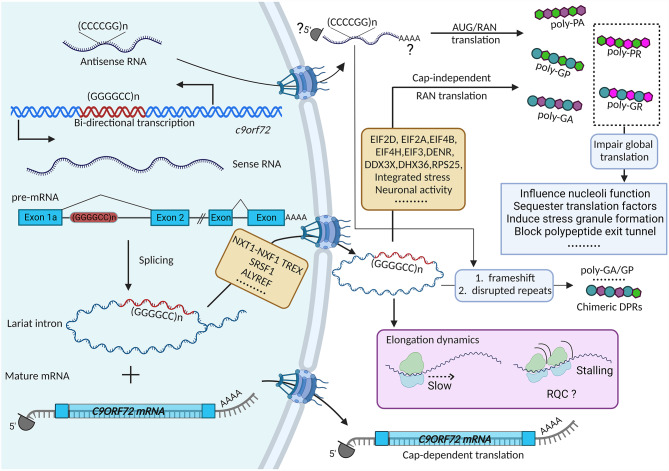
RNA translation is tightly controlled in eukaryotic cells to regulate gene expression and maintain proteome homeostasis. RNA binding proteins, translation factors, and cell signaling pathways all modulate the translation process. Defective translation is involved in multiple neurological diseases including amyotrophic lateral sclerosis (ALS). ALS is a progressive neurodegenerative disorder and poses a major public health challenge worldwide. Over the past few years, tremendous advances have been made in the understanding of the genetics and pathogenesis of ALS. Dysfunction of RNA metabolisms, including RNA translation, has been closely associated with ALS. Here, we first introduce the general mechanisms of translational regulation under physiological and stress conditions and review well-known examples of translation defects in neurodegenerative diseases. We then focus on ALS-linked genes and discuss the recent progress on how translation is affected by various mutant genes and the repeat expansion-mediated non-canonical translation in ALS.
RNA 翻译在真核细胞中受到严格调控,以调节基因表达并维持蛋白质组平衡。RNA 结合蛋白、翻译因子和细胞信号通路都调节翻译过程。翻译缺陷与多种神经疾病有关,包括肌萎缩侧索硬化症(ALS)。ALS 是一种进行性神经退行性疾病,是全球主要的公共卫生挑战。在过去的几年中,人们在理解 ALS 的遗传学和发病机制方面取得了巨大进展。RNA 代谢包括 RNA 翻译的功能障碍与 ALS 密切相关。在这里,我们首先介绍了在生理和应激条件下翻译调控的一般机制,并回顾了神经退行性疾病中翻译缺陷的著名例子。然后,我们专注于 ALS 相关基因,并讨论了最近关于各种突变基因如何影响翻译以及 ALS 中重复扩展介导的非规范翻译的进展。