Qiu Jiewen, Wei Lijian, Su Yilin, Tang Yuting, Peng Guoyou, Wu Yimin, He Yan, Liu Hanqun, Guo Wenyuan, Wu Zhuohu, Xu Pingyi, Mo Mingshu
Department of Neurology, The First Affiliated Hospital of Guangzhou Medical University, Guangzhou 510120, China.
Department of General Medicine, Fengxian Community Health Service Center, Shanghai 210499, China.
Brain Sci. 2023 Aug 4;13(8):1166. doi: 10.3390/brainsci13081166.
Abnormal accumulation of lipids is found in dopamine neurons and resident microglia in the substantia nigra of patients with Parkinson's disease (PD). The accumulation of lipids is an important risk factor for PD. Previous studies have mainly focussed on lipid metabolism in peripheral blood, but little attention has been given to cerebrospinal fluid (CSF). We drew the lipidomic signature in CSF from PD patients and evaluated the role of lipids in CSF as biomarkers for PD diagnosis.
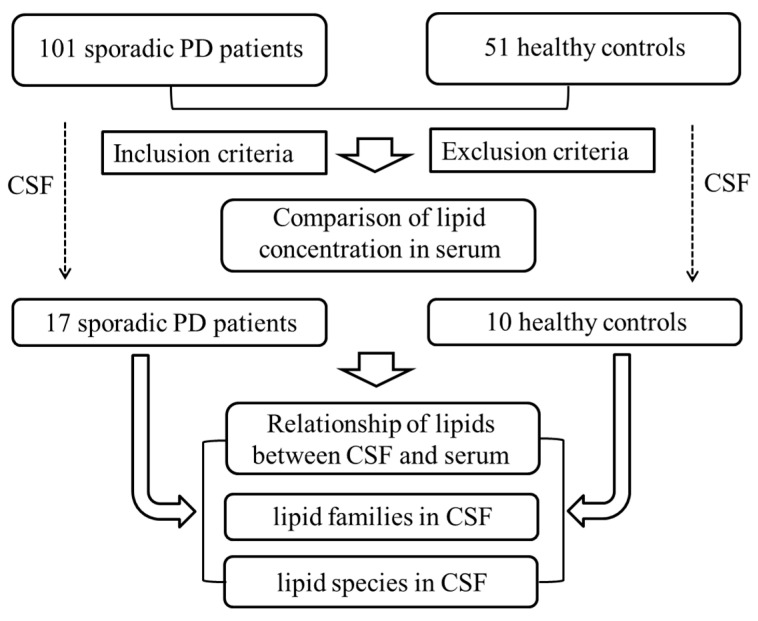
Based on lipidomic approaches, we investigated and compared lipid metabolism in CSF from PD patients and healthy controls without dyslipidaemia in peripheral blood and explored the relationship of lipids between CSF and serum by Pearson correlation analysis.
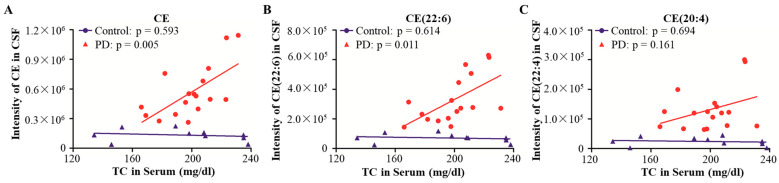
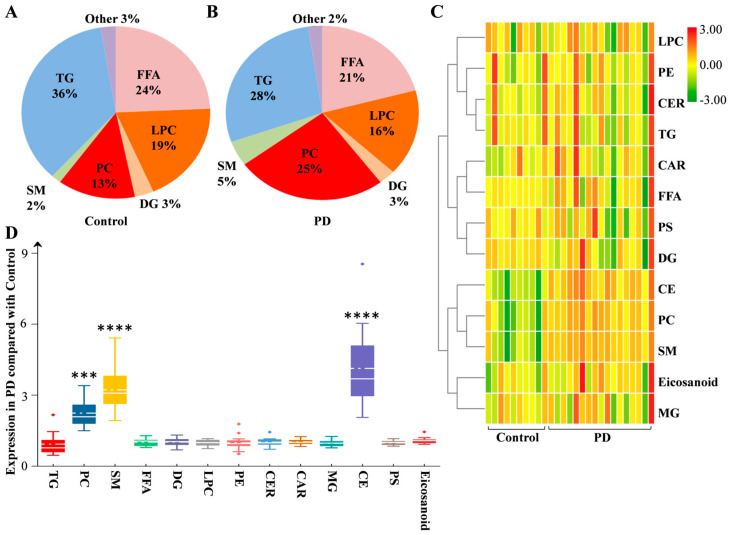
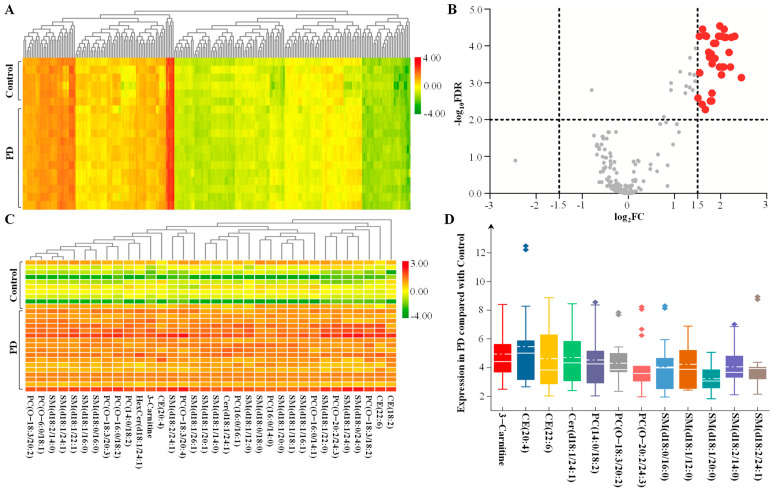
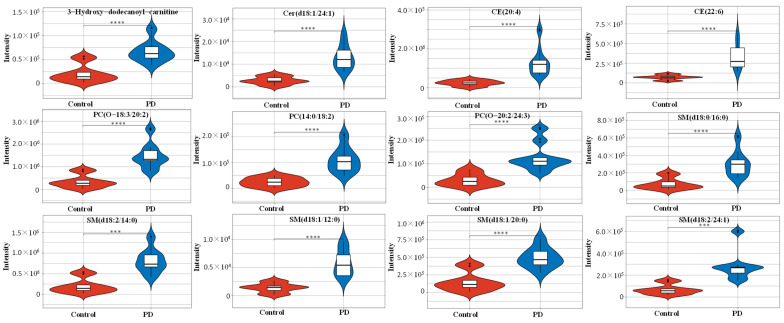
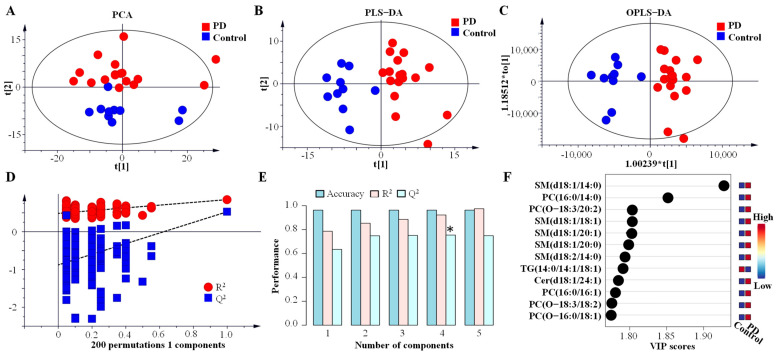
A total of 231 lipid species were detected and classified into 13 families in the CSF. The lipid families, including phosphatidylcholine (PC), sphingomyelin (SM) and cholesterol ester (CE), had significantly increased expression compared with the control. Hierarchical clustering was performed to distinguish PD patients based on the significantly changed expression of 34 lipid species. Unsupervised and supervised methods were used to refine this classification. A total of 12 lipid species, including 3-hydroxy-dodecanoyl-carnitine, Cer(d18:1/24:1), CE(20:4), CE(22:6), PC(14:0/18:2), PC(O-18:3/20:2), PC(O-20:2/24:3), SM(d18:0/16:0), SM(d18:2/14:0), SM(d18:2/24:1), SM(d18:1/20:1) and SM(d18:1/12:0), were selected to draw the lipidomic signature of PD. Correlation analysis was performed and showed that the CE family and CE (22:6) in CSF had a positive association with total cholesterol in the peripheral blood from PD patients but not from healthy controls.
Our results revealed that the lipidomic signature in CSF may be considered a potential biomarker for PD diagnosis, and increased CE, PC and SM in CSF may reveal pathological changes in PD patients, such as blood-brain barrier leakage.
在帕金森病(PD)患者的黑质中,多巴胺能神经元和常驻小胶质细胞内发现脂质异常蓄积。脂质蓄积是PD的一个重要危险因素。既往研究主要聚焦于外周血中的脂质代谢,而对脑脊液(CSF)关注较少。我们绘制了PD患者脑脊液中的脂质组学特征图谱,并评估了脑脊液中脂质作为PD诊断生物标志物的作用。
基于脂质组学方法,我们研究并比较了PD患者和外周血无血脂异常的健康对照者脑脊液中的脂质代谢情况,并通过Pearson相关分析探讨了脑脊液与血清中脂质的关系。
在脑脊液中共检测到231种脂质,并分为13个家族。与对照组相比,包括磷脂酰胆碱(PC)、鞘磷脂(SM)和胆固醇酯(CE)在内的脂质家族表达显著增加。基于34种脂质显著变化的表达进行层次聚类以区分PD患者。使用无监督和有监督方法对该分类进行优化。共选择了12种脂质,包括3-羟基-十二烷酰肉碱、神经酰胺(d18:1/24:1)、胆固醇酯(20:4)、胆固醇酯(22:6)、磷脂酰胆碱(14:0/18:2)、磷脂酰胆碱(O-18:3/20:2)、磷脂酰胆碱(O-20:2/24:3)、鞘磷脂(d18:0/16:0)、鞘磷脂(d18:2/14:0)、鞘磷脂(d18:2/24:1)、鞘磷脂(d18:1/20:1)和鞘磷脂(d18:1/12:0),以绘制PD的脂质组学特征图谱。进行相关分析,结果显示脑脊液中的胆固醇酯家族和胆固醇酯(22:6)与PD患者外周血中的总胆固醇呈正相关,而与健康对照者外周血中的总胆固醇无正相关。
我们的结果表明,脑脊液中的脂质组学特征图谱可能被视为PD诊断的潜在生物标志物,脑脊液中胆固醇酯、磷脂酰胆碱和鞘磷脂的增加可能揭示PD患者的病理变化,如血脑屏障渗漏。