Zhang Yifan, Yan Yuexin, Kong Xiangxu, Zhang Haijun, Su Shengyuan
Department of Intensive Care Medicine, Shenzhen Baoan People's Hospital, Shenzhen, China.
Department of Neurology, Shenzhen Baoan People's Hospital, Shenzhen, China.
Front Aging Neurosci. 2025 May 30;17:1582362. doi: 10.3389/fnagi.2025.1582362. eCollection 2025.
To identify key cerebrospinal fluid (CSF) metabolomic biomarkers associated with Parkinson's disease (PD) and prodromal PD, providing insights for intervention strategy development.
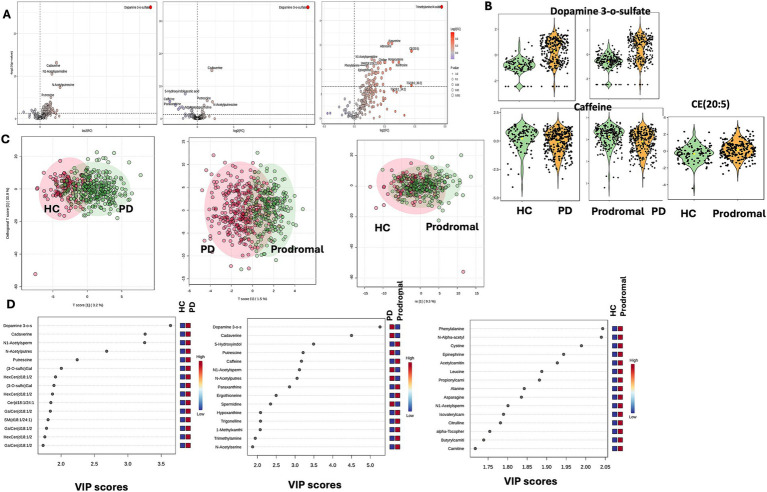
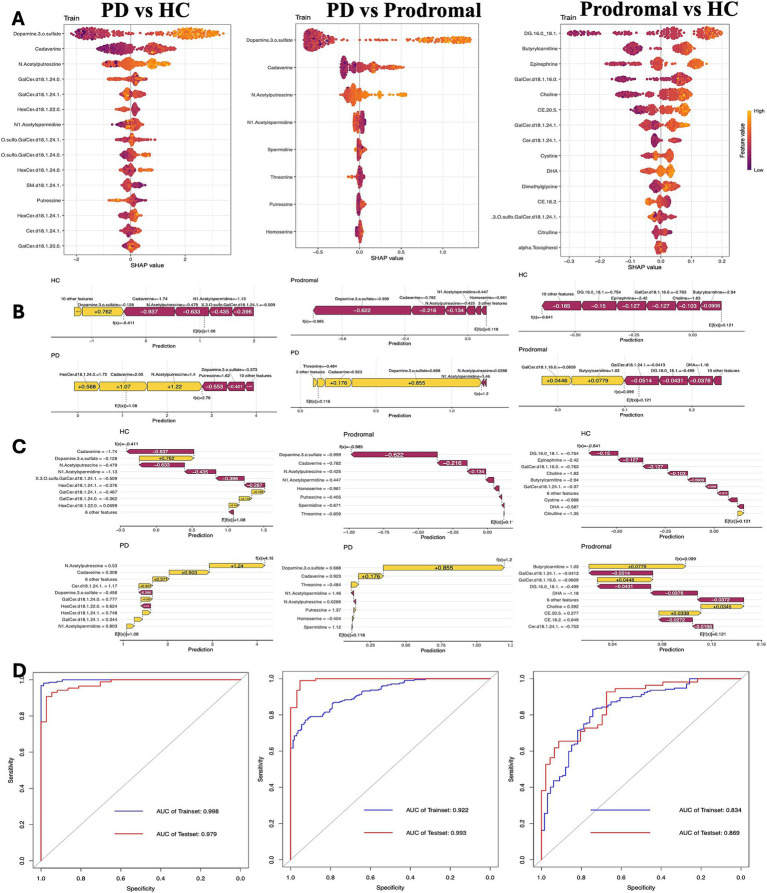
Six hundred and thirty-nine participants from the Parkinson's Progression Markers Initiative (PPMI) cohort were included: 300 PD patients, 112 healthy controls (HC), and 227 prodromal PD patients. Regression analysis and OPLS-DA identified metabolic biomarkers, while pathway analysis examined their relationship to clinical features. An XGBoost-based early prediction model was developed to assess the distinction between PD, prodromal PD, and HC. A two-sample bidirectional Mendelian randomization analysis was performed to examine the association between differential metabolites and Parkinson's disease.
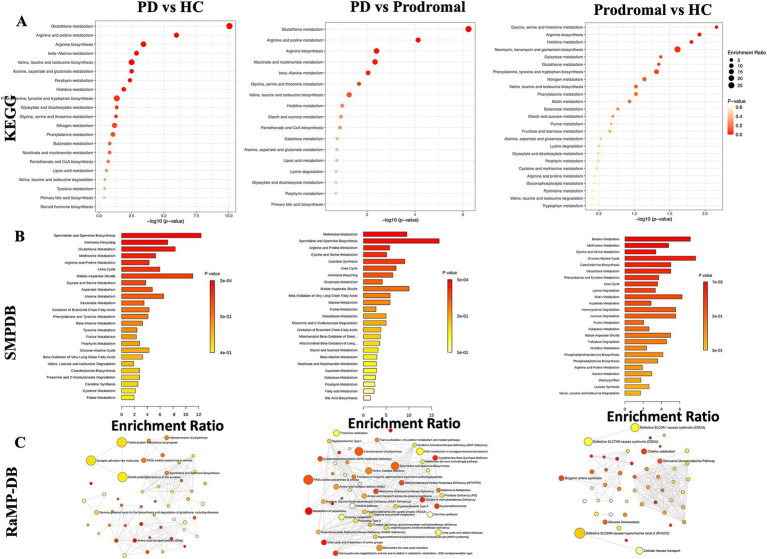
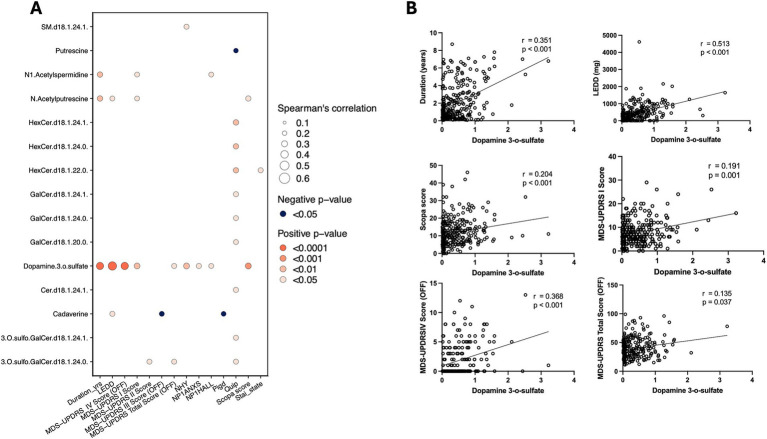
Sixty-four metabolites were significantly altered in PD patients compared to HC, with 58 elevated and 6 reduced. In prodromal PD, 19 metabolites were increased, and 34 were decreased. Key metabolic pathways involved glutathione and amino acid metabolism. Dopamine 3-O-sulfate correlated with PD progression, levodopa-equivalent dose, and non-motor symptoms. The XGBoost model demonstrated high specificity in predicting the onset of PD. The MR analysis results showed a positive correlation between higher genetic predictions of dopamine 3-O-sulfate levels and the risk of Parkinson's disease. In contrast, the reverse MR analysis found that Parkinson's disease susceptibility significantly increased dopamine 3-O-sulfate levels.
The differential expression of CSF metabolites reveals early cellular metabolic changes, providing insights for early diagnosis and monitoring PD progression. A bidirectional causal relationship exists between genetically determined PD susceptibility and metabolites.
识别与帕金森病(PD)及其前驱期相关的关键脑脊液(CSF)代谢组学生物标志物,为干预策略的制定提供依据。
纳入帕金森病进展标志物倡议(PPMI)队列中的639名参与者:300例PD患者、112名健康对照(HC)和227例前驱期PD患者。通过回归分析和正交偏最小二乘法判别分析(OPLS-DA)确定代谢生物标志物,同时通过通路分析研究它们与临床特征的关系。开发了一种基于XGBoost的早期预测模型,以评估PD、前驱期PD和HC之间的差异。进行了两样本双向孟德尔随机化分析,以检验差异代谢物与帕金森病之间的关联。
与HC相比,PD患者中有64种代谢物发生显著变化,其中58种升高,6种降低。在前驱期PD中,19种代谢物增加,34种减少。关键代谢途径涉及谷胱甘肽和氨基酸代谢。3-O-硫酸多巴胺与PD进展、左旋多巴等效剂量和非运动症状相关。XGBoost模型在预测PD发病方面具有高特异性。孟德尔随机化分析结果显示,较高的3-O-硫酸多巴胺水平的遗传预测值与帕金森病风险呈正相关。相反,反向孟德尔随机化分析发现,帕金森病易感性显著增加3-O-硫酸多巴胺水平。
CSF代谢物的差异表达揭示了早期细胞代谢变化,为PD的早期诊断和病情监测提供了依据。遗传决定的PD易感性与代谢物之间存在双向因果关系。