Sun Shiquan, Hong Yang, Guo Jinhao, Zhang Ning, Zhang Minghai
College of Wildlife and Protected Area, Northeast Forestry University, Harbin 150040, China.
Feline Research Center of National Forestry and Grassland Administration, Harbin 150040, China.
Biology (Basel). 2023 Aug 11;12(8):1122. doi: 10.3390/biology12081122.
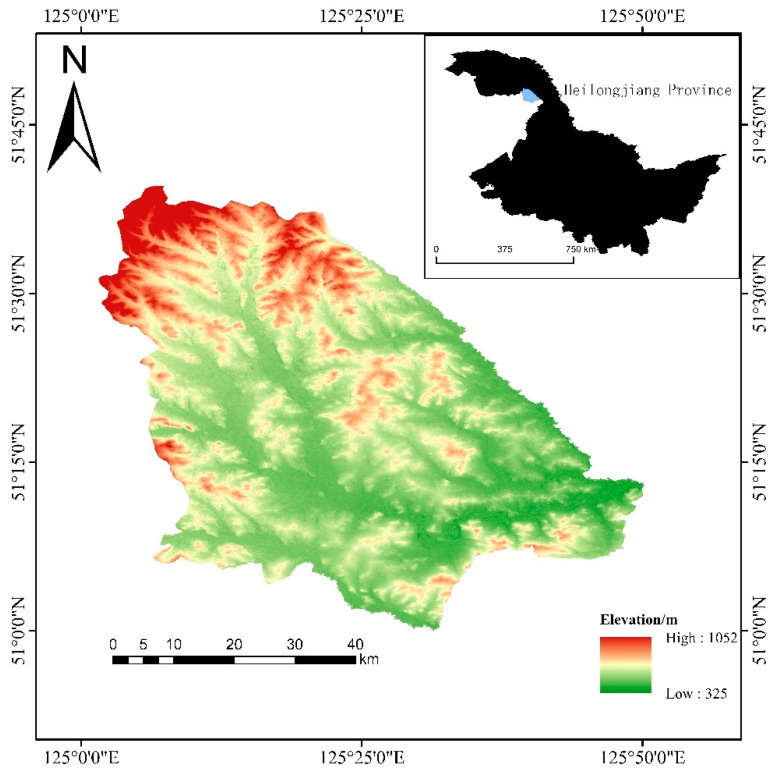
The change in habitat pattern is one of the key factors affecting the survival of the moose population. The study of the habitat landscape pattern is the key to protecting the Chinese cold-temperate forest moose population and monitoring the global distribution of moose. Through the ecological risk assessment of the moose habitat landscape pattern in a cold-temperate forest, we hope to assess the strength of habitat resistance under stress factors. This study provides a theoretical basis for the protection of the moose population in the cold-temperate forest in China and the establishment of the cold-temperate forest national park. In the study, the MaxEnt model, landscape index calculation and ecological risk assessment model construction were used to analyze the field survey and infrared camera monitoring data from April 2014 to January 2023. The habitat suitability layer of the moose population in the Nanwenghe National Nature Reserve of the Great Khingan Mountains was calculated, and the range of the moose habitat was divided based on the logical threshold of the model. The landscape pattern index of the moose habitat was calculated by Fragstats software and a landscape ecological risk assessment model was established to analyze the landscape pattern and ecological risk dynamic changes of the moose habitat in 2015 and 2020. The results showed that under the premise of global warming, the habitat landscape contagion index decreased by 4.53 and the split index increased by 4.86 from 2015 to 2020. In terms of ecological risk: the area of low ecological risk areas increased by 0.88%; the area of medium ecological risk areas decreased by 1.11%; and the area of high ecological risk areas increased by 0.23%. The fragmentation risk of the landscape pattern of the moose habitat tends to increase, the preferred patch type is dispersed, the degree of aggregation is low, and the risk of patch type transformation increases. The middle and high ecological risk areas are mainly concentrated in the river area and its nearby forests, showing a fine and scattered distribution. Under the interference of global warming and human activities, the fragmentation trend of the moose habitat in the study area is increasing, and the habitat quality is declining, which is likely to cause moose population migration. For this reason, the author believes that the whole cold temperate forest is likely to face the risk of increasing the transformation trend of dominant patch types in the cold-temperate coniferous forest region mainly caused by global warming, resulting in an increase in the risk of habitat fragmentation. While the distribution range of moose is reduced, it has a significant impact on the diversity and ecological integrity of the whole cold-temperate forest ecosystem. This study provides theoretical references for further research on the impact of climate warming on global species distribution and related studies. It is also helpful for humans to strengthen their protection awareness of forest and river areas and formulate reasonable protection and sustainable development planning of cold-temperate forests. Finally, it provides theoretical references for effective monitoring and protection of cold-temperate forests and moose population dynamics.
栖息地格局变化是影响驼鹿种群生存的关键因素之一。对栖息地景观格局的研究是保护中国寒温带森林驼鹿种群及监测驼鹿全球分布的关键。通过对寒温带森林中驼鹿栖息地景观格局进行生态风险评估,我们希望评估胁迫因素下栖息地抗性的强度。本研究为中国寒温带森林驼鹿种群的保护及寒温带森林国家公园的建立提供了理论依据。研究中,利用MaxEnt模型、景观指数计算及生态风险评估模型构建,分析了2014年4月至2023年1月的实地调查和红外相机监测数据。计算了大兴安岭南瓮河国家级自然保护区驼鹿种群的栖息地适宜性图层,并基于模型的逻辑阈值划分了驼鹿栖息地范围。利用Fragstats软件计算了驼鹿栖息地的景观格局指数,并建立了景观生态风险评估模型,分析了2015年和2020年驼鹿栖息地的景观格局及生态风险动态变化。结果表明,在全球变暖的前提下,2015年至2020年栖息地景观蔓延度指数下降了4.53,分离度指数增加了4.86。在生态风险方面:低生态风险区面积增加了0.88%;中生态风险区面积减少了1.11%;高生态风险区面积增加了0.23%。驼鹿栖息地景观格局的破碎化风险趋于增加,偏好的斑块类型分散,聚集程度低,斑块类型转变风险增加。中高生态风险区主要集中在河流区域及其附近森林,呈细碎化分布。在全球变暖和人类活动的干扰下,研究区域内驼鹿栖息地的破碎化趋势加剧,栖息地质量下降,这可能导致驼鹿种群迁移。为此,作者认为整个寒温带森林可能面临因全球变暖导致寒温带针叶林区域优势斑块类型转变趋势增加、栖息地破碎化风险上升的风险。在驼鹿分布范围缩小的同时,对整个寒温带森林生态系统的多样性和生态完整性产生重大影响。本研究为进一步研究气候变暖对全球物种分布的影响及相关研究提供了理论参考。也有助于人类增强对森林和河流区域的保护意识,制定寒温带森林合理的保护及可持续发展规划。最后,为有效监测和保护寒温带森林及驼鹿种群动态提供了理论参考。


