School of Health Sciences, Purdue University, West Lafayette, IN 47907, USA.
Exponent Inc., Alexandria, VA 22314, USA.
Biomolecules. 2023 Aug 8;13(8):1229. doi: 10.3390/biom13081229.
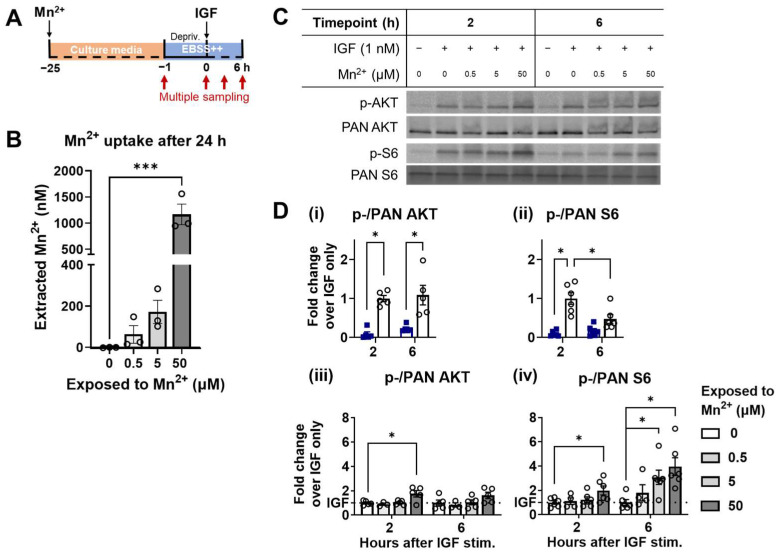
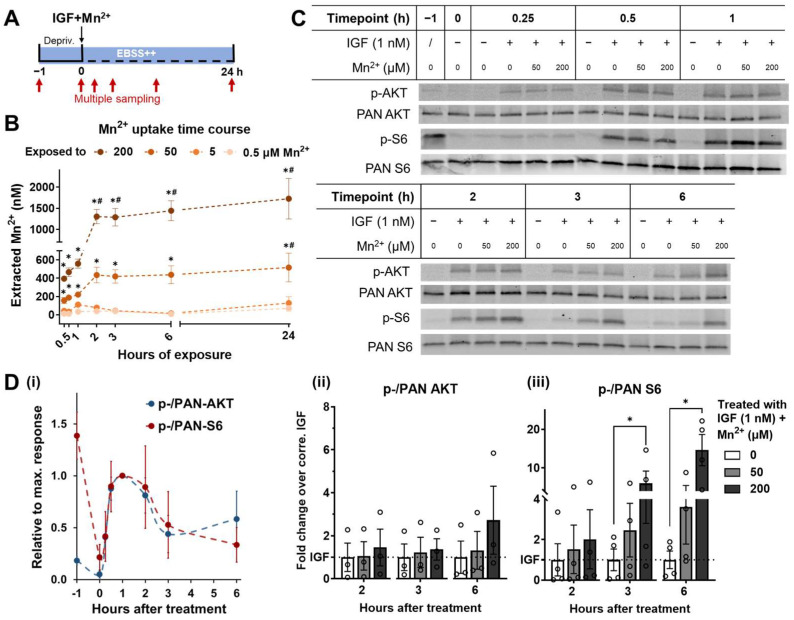
The insulin-like growth factor (IGF)/insulin signaling (IIS) pathway is involved in cellular responses against intracellular divalent manganese ion (Mn) accumulation. As a pathway where multiple nodes utilize Mn as a metallic co-factor, how the IIS signaling patterns are affected by Mn overload is unresolved. In our prior studies, acute Mn exposure potentiated IIS kinase activity upon physiological-level stimulation, indicated by elevated phosphorylation of protein kinase B (PKB, also known as AKT). AKT phosphorylation is associated with IIS activity; and provides direct signaling transduction input for the mammalian target of rapamycin complex 1 (mTORC1) and its downstream target ribosomal protein S6 (S6). Here, to better define the impact of Mn exposure on IIS function, Mn-induced IIS activation was evaluated with serial concentrations and temporal endpoints. In the wild-type murine striatal neuronal line ST, the acute treatment of Mn with IGF induced a Mn concentration-sensitive phosphorylation of S6 at Ser235/236 to as low as 5 μM extracellular Mn. This effect required both the essential amino acids and insulin receptor (IR)/IGF receptor (IGFR) signaling input. Similar to simultaneous stimulation of Mn and IGF, when a steady-state elevation of Mn was established via a 24-h pre-exposure, phosphorylation of S6 also displayed higher sensitivity to sub-cytotoxic Mn when compared to AKT phosphorylation at Ser473. This indicates a synergistic effect of sub-cytotoxic Mn on IIS and mTORC1 signaling. Furthermore, elevated intracellular Mn, with both durations, led to a prolonged activation in AKT and S6 upon stimulation. Our data demonstrate that the downstream regulator S6 is a highly sensitive target of elevated Mn and is well below the established acute cytotoxicity thresholds (<50 μM). These findings indicate that the IIS/mTORC1 pathways, in which Mn normally serves as an essential co-factor, are dually responsible for the cellular changes in exposures to real-world Mn concentrations.
胰岛素样生长因子(IGF)/胰岛素信号(IIS)通路参与细胞对细胞内二价锰离子(Mn)积累的反应。作为一个利用 Mn 作为金属辅因子的多个节点的通路,IIS 信号模式如何受到 Mn 过载的影响尚未解决。在我们之前的研究中,急性 Mn 暴露在生理水平的刺激下增强了 IIS 激酶活性,表现为蛋白激酶 B(PKB,也称为 AKT)的磷酸化水平升高。AKT 磷酸化与 IIS 活性相关;并为雷帕霉素复合物 1(mTORC1)及其下游靶标核糖体蛋白 S6(S6)提供直接的信号转导输入。在这里,为了更好地定义 Mn 暴露对 IIS 功能的影响,我们评估了 Mn 诱导的 IIS 激活与连续浓度和时间终点的关系。在野生型小鼠纹状体神经元系 ST 中,IGF 急性处理 Mn 会导致 S6 在 Ser235/236 上发生 Mn 浓度敏感的磷酸化,其最低 Mn 浓度低至 5 μM 细胞外 Mn。这种效应需要必需氨基酸和胰岛素受体(IR)/胰岛素样生长因子受体(IGFR)信号输入。与同时刺激 Mn 和 IGF 类似,当通过 24 小时预暴露建立稳定的 Mn 升高时,与 Ser473 处的 AKT 磷酸化相比,S6 的磷酸化对亚细胞毒性 Mn 也显示出更高的敏感性。这表明亚细胞毒性 Mn 对 IIS 和 mTORC1 信号具有协同作用。此外,无论持续时间长短,升高的细胞内 Mn 都会导致刺激后 AKT 和 S6 的持续激活。我们的数据表明,下游调节剂 S6 是升高的 Mn 的高度敏感靶标,远低于既定的急性细胞毒性阈值(<50 μM)。这些发现表明,IIS/mTORC1 通路通常将 Mn 作为必需的辅因子,在暴露于实际 Mn 浓度时,对细胞变化具有双重责任。