Soler Lara, Moreno Yolanda, Moreno-Mesonero Laura, Amorós Inmaculada, Alonso José Luís, Ferrús María Antonia
Research Institute of Water and Environmental Engineering (IIAMA), Universitat Politècnica de València, Camino de Vera s/n, 46022 Valencia, Spain.
Biotechnology Department, Universitat Politècnica de València, Camino de Vera s/n, 46022 Valencia, Spain.
Foods. 2023 Aug 18;12(16):3102. doi: 10.3390/foods12163102.
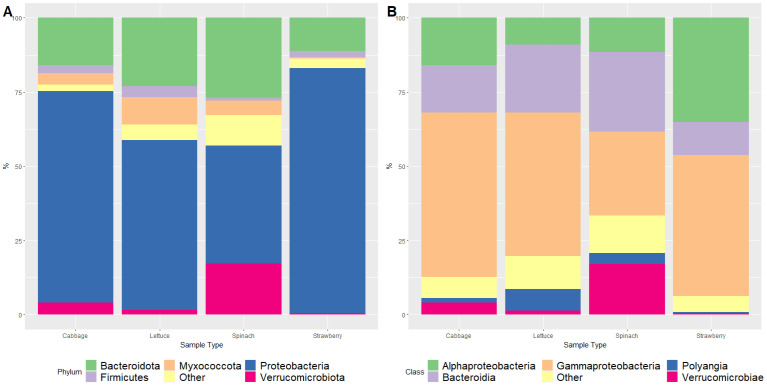
In response to growing global interest in organic agriculture, this study delves into the microbial landscape of organically grown raw produce with a focus on food safety. Vegetables that are consumed raw are potential vehicles for the transmission of any type of microorganism capable of causing human disease. Free-living amoebae (FLA) are ubiquitous protozoa found in many ecosystems and can serve as hosts to pathogenic bacteria. So far, data regarding the FLA bacterial microbiome in fresh produce remain scarce and are non-existent for those of organic origin. Thus, the aim of this preliminary work is to characterize the microbiome of FLA in commonly consumed raw vegetables to know their possible implications for consumers. A total of 40 organic cabbage, lettuce, spinach, and strawberry samples were analyzed. FLA were found in all samples, and their bacterial microbiome was obtained via amplicon sequencing using the Illumina MiSeq platform and pair-end protocol. spp. and were identified via qPCR in 65.0% and 25.0% of the samples, respectively. Regarding the bacterial microbiome of FLA, the most abundant genera were (1.8-17.8%) and (1.7-12.6%). Bacteria not previously related to FLA, such as or , are described in this work. Importantly, several bacterial genera found within the FLA microbiome were identified as potential human pathogens, including , , , , , and . This is the first work in which FLA microbiome isolated from organic products has been characterized, underscoring the significance of understanding FLA's role as carriers of pathogenic bacteria in the context of organic food safety.
针对全球对有机农业日益增长的兴趣,本研究深入探讨了有机种植的生鲜农产品的微生物状况,重点关注食品安全。生食蔬菜是任何能够导致人类疾病的微生物传播的潜在载体。自由生活阿米巴(FLA)是在许多生态系统中普遍存在的原生动物,可作为病原菌的宿主。到目前为止,关于新鲜农产品中FLA细菌微生物组的数据仍然很少,而对于有机来源的农产品则不存在相关数据。因此,这项初步工作的目的是对常见生食蔬菜中FLA的微生物组进行表征,以了解它们对消费者可能产生的影响。总共分析了40个有机卷心菜、生菜、菠菜和草莓样本。在所有样本中都发现了FLA,并使用Illumina MiSeq平台和双端协议通过扩增子测序获得了它们的细菌微生物组。分别在65.0%和25.0%的样本中通过qPCR鉴定出了 spp. 和 。关于FLA的细菌微生物组,最丰富的属是 (1.8 - 17.8%)和 (1.7 - 12.6%)。这项工作描述了一些以前与FLA无关的细菌,如 或 。重要的是,在FLA微生物组中发现的几个细菌属被鉴定为潜在的人类病原体,包括 、 、 、 、 、 和 。这是第一项对从有机产品中分离出的FLA微生物组进行表征的工作,强调了在有机食品安全背景下理解FLA作为病原菌载体作用的重要性。