Lacan Ioana, Moldovan Marioara, Sarosi Codruta, Cuc Stanca, Pastrav Mihaela, Petean Ioan, Ene Razvan
Department of Physics and Chemistry, Technical University of Cluj-Napoca, 400114 Cluj-Napoca, Romania.
Department of Polymer Composites, Raluca Ripan Institute for Research in Chemistry, Babeș-Bolyai University, 30 Fantanele Street, 400294 Cluj-Napoca, Romania.
Materials (Basel). 2023 Aug 17;16(16):5653. doi: 10.3390/ma16165653.
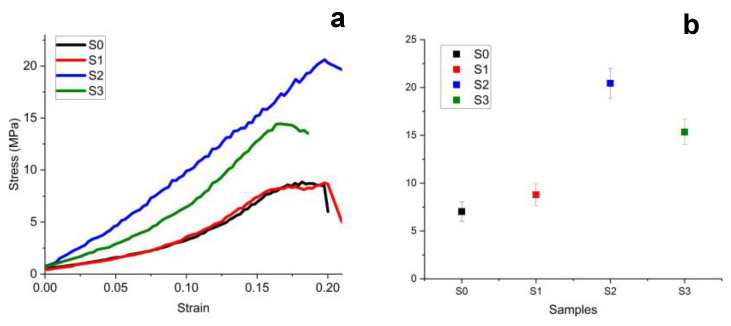
Calcium phosphate cements present increased biocompatibility due to their chemical composition being similar to that of the hydroxyapatite in the hard tissues of the living body. It has certain limitations due to its poor mechanical properties, such as low tensile strength and increased brittleness. Thus, the optimal way to improve properties is through the design of novel composite cements. The purpose was fulfilled using a 25% hydroxyethyl methacrylate (HEMA) mixed with 3% urethane dimethacrzlate (UDMA) base matrix with various ratios of polyethylene glycol (PEG 400) and polycaprolactone (PCL). Mineral filler is based on tricalcium phosphate (TCP) with different chitosan ratio used as bio-response enhancer additive. Four mixtures were prepared: S0-unfilled polymer matrix; S1 with 50% TCP filler; S2 with 50% chitosan + TCP filler; and S3 with 17.5% chitosan + TCP mixed with 17.5% nano hydroxyapatite (HA). The mechanical properties testing revealed that the best compressive strength was obtained by S2, followed by S3, and the worst value was obtained for the unfilled matrix. The same tendency was observed for tensile and flexural strength. These results show that the novel filler system increases the mechanical resistance of the TCP composite cements. Liquid exposure investigation reveals a relative constant solubility of the used filler systems during 21 days of exposure: the most soluble fillers being S3 and S2 revealing that the additivated TCP is more soluble than without additives ones. Thus, the filler embedding mode into the polymer matrix plays a key role in the liquid absorption. It was observed that additive filler enhances the hydrophobicity of UDMA monomer, with the matrix resulting in the lowest liquid absorption values, while the non-additivated samples are more absorbent due to the prevalence of hydrolytic aliphatic groups within PEG 400. The higher liquid absorption was obtained on the first day of immersion, and it progressively decreased with exposure time due to the relative swelling of the surface microstructural features. The obtained results are confirmed by the microstructural changes monitored by SEM microscopy. S3 and S2 present a very uniform and compact filler distribution, while S1 presents local clustering of the TCP powder at the contact with the polymer matrix. The liquid exposure revealed significant pore formation in S0 and S1 samples, while S3 and S2 proved to be more resistant against superficial erosion, proving the best resistance against liquid penetration.
磷酸钙骨水泥因其化学成分与生物活体硬组织中的羟基磷灰石相似而具有更高的生物相容性。由于其机械性能较差,如拉伸强度低和脆性增加,存在一定局限性。因此,改善性能的最佳方法是设计新型复合骨水泥。通过将25%的甲基丙烯酸羟乙酯(HEMA)与3%的聚氨酯二甲基丙烯酸酯(UDMA)基础基质与不同比例的聚乙二醇(PEG 400)和聚己内酯(PCL)混合来实现这一目的。矿物填料基于磷酸三钙(TCP),使用不同比例的壳聚糖作为生物反应增强剂添加剂。制备了四种混合物:S0-未填充聚合物基质;S1含有50% TCP填料;S2含有50%壳聚糖+TCP填料;S3含有17.5%壳聚糖+TCP与17.5%纳米羟基磷灰石(HA)混合。机械性能测试表明,S2获得了最佳抗压强度,其次是S3,未填充基质的抗压强度最差。拉伸强度和弯曲强度也呈现相同趋势。这些结果表明,新型填料体系提高了TCP复合骨水泥的机械抗性。液体暴露研究表明,在21天的暴露过程中,所用填料体系的溶解度相对恒定:最易溶解的填料是S3和S2,这表明添加添加剂的TCP比未添加添加剂的更易溶解。因此,填料嵌入聚合物基质的方式在液体吸收中起关键作用。观察到添加填料增强了UDMA单体的疏水性,基质的液体吸收值最低,而未添加添加剂的样品由于PEG 400中水解脂肪族基团的存在而更具吸水性。浸泡第一天的液体吸收量最高,随着暴露时间的延长,由于表面微观结构特征的相对膨胀,液体吸收量逐渐降低。通过扫描电子显微镜监测的微观结构变化证实了所得结果。S3和S2呈现出非常均匀和致密的填料分布,而S1在与聚合物基质接触处呈现TCP粉末的局部聚集。液体暴露显示S0和S1样品中有明显的孔隙形成,而S3和S2对表面侵蚀更具抗性,证明对液体渗透的抗性最佳。