Correia Ana Salomé, Cardoso Armando, Vale Nuno
OncoPharma Research Group, Center for Health Technology and Services Research (CINTESIS), Rua Doutor Plácido da Costa, 4200-450 Porto, Portugal.
CINTESIS@RISE, Faculty of Medicine, University of Porto, Alameda Professor Hernâni Monteiro, 4200-319 Porto, Portugal.
Pharmaceutics. 2023 Aug 3;15(8):2081. doi: 10.3390/pharmaceutics15082081.
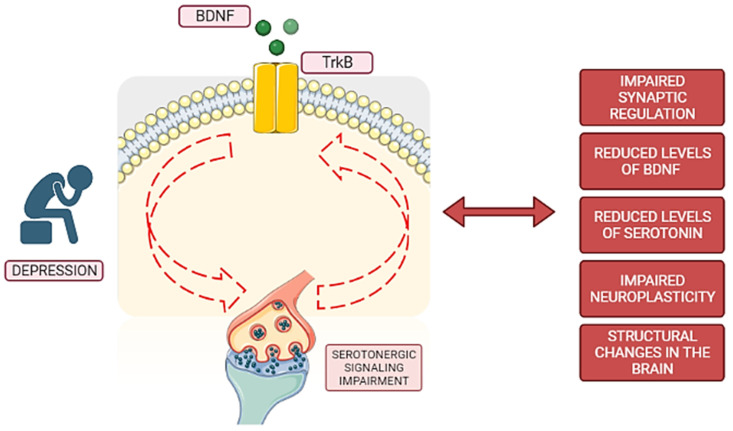
Brain-derived neurotrophic factor (BDNF) is a neurotrophin that plays a significant role in the survival and development of neurons, being involved in several diseases such as Alzheimer's disease and major depression disorder. The association between BDNF and major depressive disorder is the subject of extensive research. Indeed, numerous studies indicate that decreased levels of BDNF are linked to an increased occurrence of depressive symptoms, neuronal loss, and cortical atrophy. Moreover, it has been observed that antidepressive therapy can help restore BDNF levels. In this review, we will focus on the role of BDNF in major depression disorder serotonergic imbalance and associated stress conditions, particularly hypothalamic-pituitary-adrenal (HPA) axis dysregulation and oxidative stress. All of these features are highly connected to BDNF signaling pathways in the context of this disease, and exploring this topic will aim to advance our understanding of the disorder, improve diagnostic and treatment approaches, and potentially identify new therapeutic targets to alleviate the heavy burden of depression on society.
脑源性神经营养因子(BDNF)是一种神经营养因子,在神经元的存活和发育中起重要作用,涉及多种疾病,如阿尔茨海默病和重度抑郁症。BDNF与重度抑郁症之间的关联是广泛研究的主题。事实上,大量研究表明,BDNF水平降低与抑郁症状增加、神经元丢失和皮质萎缩有关。此外,据观察,抗抑郁治疗有助于恢复BDNF水平。在这篇综述中,我们将重点关注BDNF在重度抑郁症血清素失衡和相关应激条件中的作用,特别是下丘脑-垂体-肾上腺(HPA)轴失调和氧化应激。在这种疾病的背景下,所有这些特征都与BDNF信号通路高度相关,探索这一主题旨在增进我们对该疾病的理解,改善诊断和治疗方法,并有可能确定新的治疗靶点,以减轻抑郁症给社会带来的沉重负担。