Thomas Johann Seebeck Department of Electronics, Tallinn University of Technology, Ehitajate Tee 5, 19086 Tallinn, Estonia.
University Lille, CNRS, Centrale Lille, Junia, University Polytechnique Hauts-de-France, UMR 8520-IEMN, F-59000 Lille, France.
Sensors (Basel). 2023 Aug 11;23(16):7111. doi: 10.3390/s23167111.
Cardiovascular diseases (CVDs), being the culprit for one-third of deaths globally, constitute a challenge for biomedical instrumentation development, especially for early disease detection. Pulsating arterial blood flow, providing access to cardiac-related parameters, involves the whole body. Unobtrusive and continuous acquisition of electrical bioimpedance (EBI) and photoplethysmography (PPG) constitute important techniques for monitoring the peripheral arteries, requiring novel approaches and clever means.
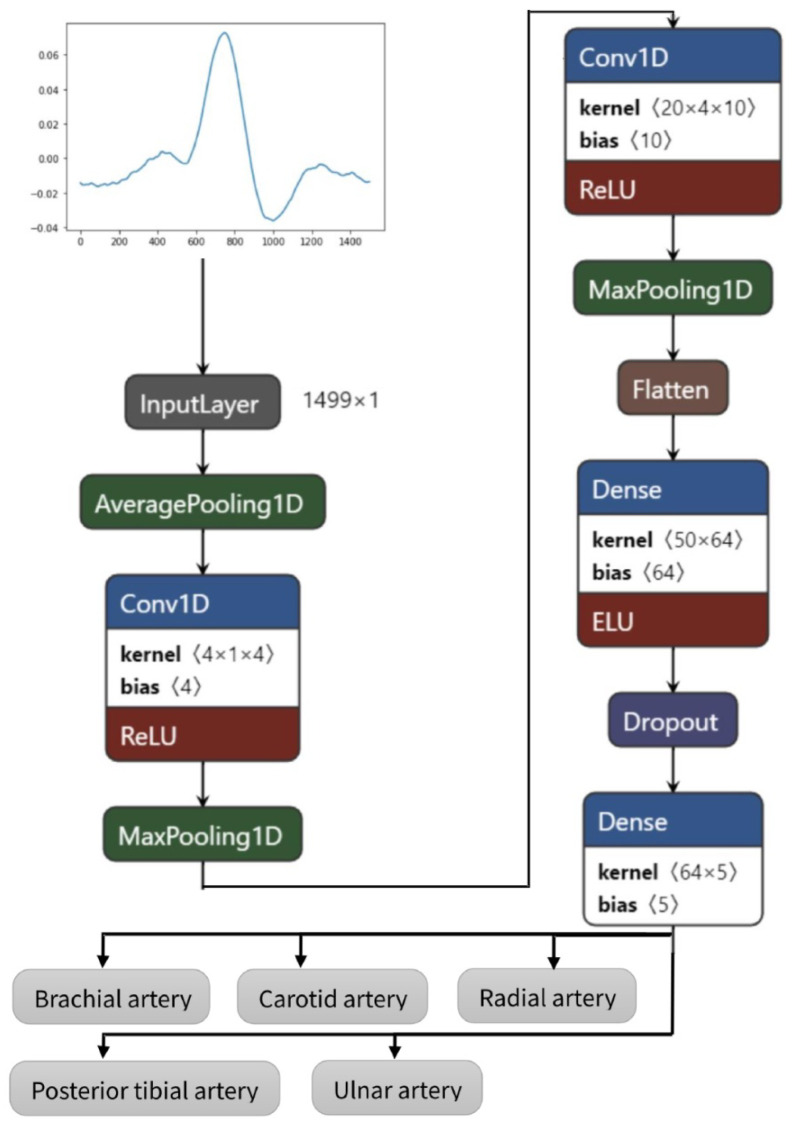
In this work, five peripheral arteries were selected for EBI and PPG signal acquisition. The acquisition sites were evaluated based on the signal morphological parameters. A small-data-based deep learning model, which increases the data by dividing them into cardiac periods, was proposed to evaluate the continuity of the signals.
The highest sensitivity of EBI was gained for the carotid artery (0.86%), three times higher than that for the next best, the posterior tibial artery (0.27%). The excitation signal parameters affect the measured EBI, confirming the suitability of classical 100 kHz frequency (average probability of 52.35%). The continuity evaluation of the EBI signals confirmed the advantage of the carotid artery (59.4%), while the posterior tibial artery (49.26%) surpasses the radial artery (48.17%). The PPG signal, conversely, commends the location of the posterior tibial artery (97.87%).
The peripheral arteries are highly suitable for non-invasive EBI and PPG signal acquisition. The posterior tibial artery constitutes a candidate for the joint acquisition of EBI and PPG signals in sensor-fusion-based wearable devices-an important finding of this research.
心血管疾病(CVDs)是全球三分之一死亡的罪魁祸首,这对生物医学仪器的发展构成了挑战,尤其是在早期疾病检测方面。脉动动脉血流提供了与心脏相关的参数,涉及全身。非侵入性和连续采集电生物阻抗(EBI)和光体积描记法(PPG)是监测外周动脉的重要技术,需要新的方法和巧妙的手段。
在这项工作中,选择了五条外周动脉进行 EBI 和 PPG 信号采集。根据信号形态参数评估采集部位。提出了一种基于小数据的深度学习模型,通过将数据分为心脏周期来增加数据,以评估信号的连续性。
EBI 的最高灵敏度为颈动脉(0.86%),比下一个最佳的后胫动脉(0.27%)高三倍。激励信号参数影响 EBI 的测量,证实了经典 100 kHz 频率的适用性(平均概率为 52.35%)。EBI 信号连续性评估证实了颈动脉的优势(59.4%),而后胫动脉(49.26%)超过了桡动脉(48.17%)。相反,PPG 信号推荐后胫动脉的位置(97.87%)。
外周动脉非常适合非侵入性 EBI 和 PPG 信号采集。后胫动脉是基于传感器融合的可穿戴设备中 EBI 和 PPG 信号联合采集的候选者,这是本研究的一个重要发现。