Metabolic Regulation Research Center, Korea Research Institute of Bioscience and Biotechnology (KRIBB), Daejeon, 34141, Republic of Korea.
Department of Functional Genomics, University of Science and Technology (UST), Daejeon, 34113, Republic of Korea.
Cell Death Dis. 2023 Aug 26;14(8):567. doi: 10.1038/s41419-023-06070-x.
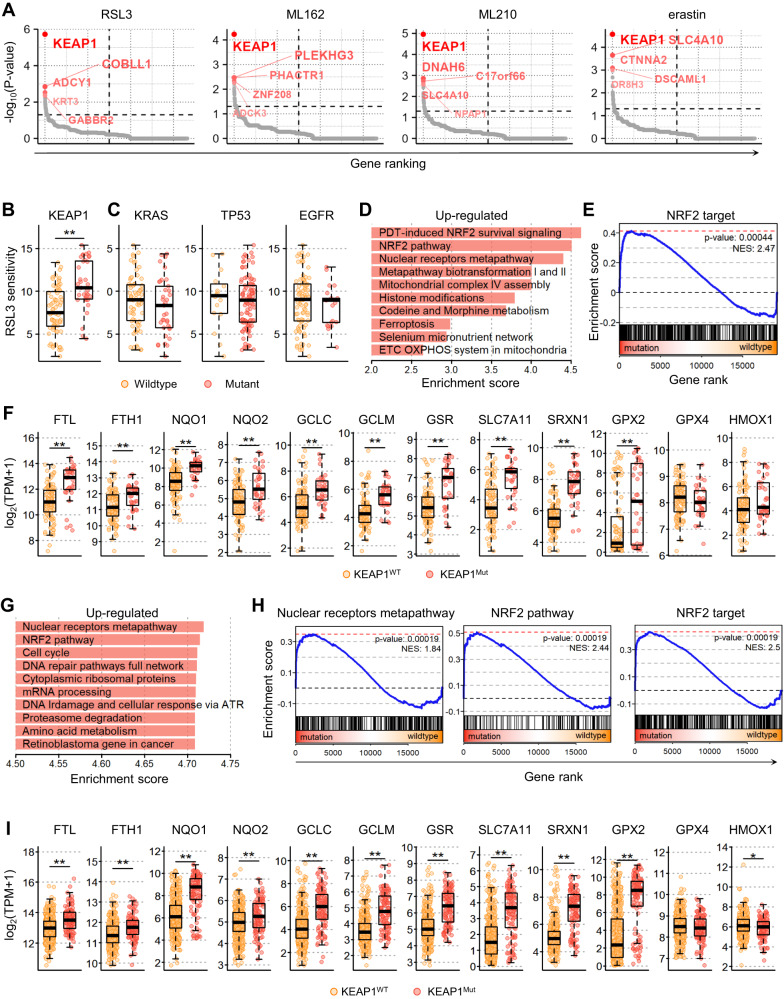
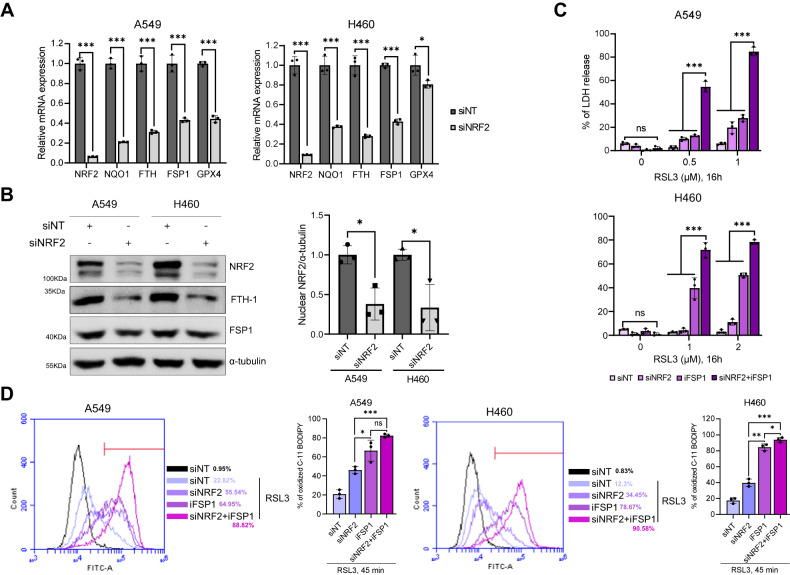
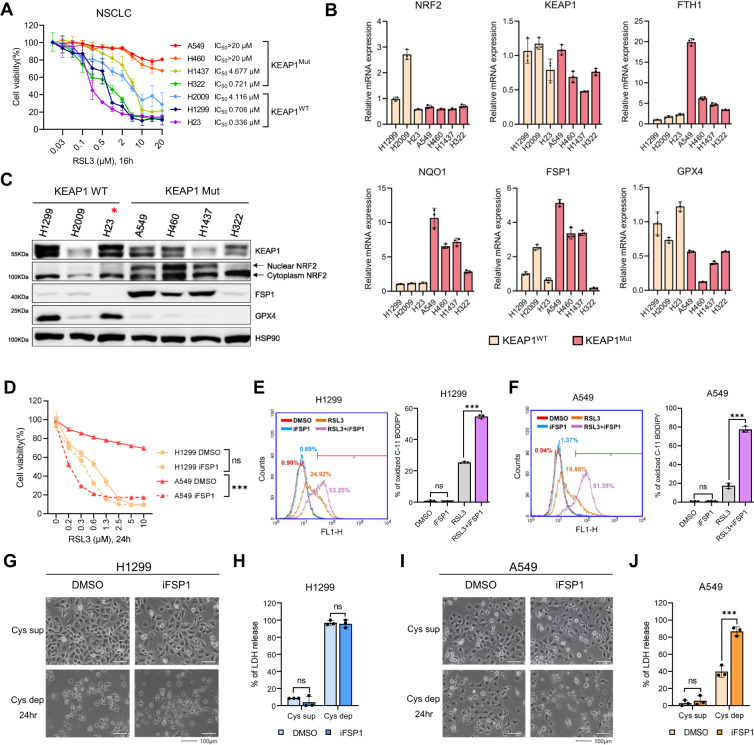
Ferroptosis, a type of cell death induced by lipid peroxidation, has emerged as a novel anti-cancer strategy. Cancer cells frequently acquire resistance to ferroptosis. However, the underlying mechanisms are poorly understood. To address this issue, we conducted a thorough investigation of the genomic and transcriptomic data derived from hundreds of human cancer cell lines and primary tissue samples, with a particular focus on non-small cell lung carcinoma (NSCLC). It was observed that mutations in Kelch-like ECH-associated protein 1 (KEAP1) and subsequent nuclear factor erythroid 2-related factor 2 (NRF2, also known as NFE2L2) activation are strongly associated with ferroptosis resistance in NSCLC. Additionally, AIFM2 gene, which encodes ferroptosis suppressor protein 1 (FSP1), was identified as the gene most significantly correlated with ferroptosis resistance, followed by multiple NRF2 targets. We found that inhibition of NRF2 alone was not sufficient to reduce FSP1 protein levels and promote ferroptosis, whereas FSP1 inhibition effectively sensitized KEAP1-mutant NSCLC cells to ferroptosis. Furthermore, we found that combined inhibition of FSP1 and NRF2 induced ferroptosis more intensely. Our findings imply that FSP1 is a crucial suppressor of ferroptosis whose expression is partially dependent on NRF2 and that synergistically targeting both FSP1 and NRF2 may be a promising strategy for overcoming ferroptosis resistance in cancer.
铁死亡是一种由脂质过氧化引起的细胞死亡方式,已成为一种新的抗癌策略。癌细胞经常对铁死亡产生耐药性。然而,其潜在的机制还不太清楚。为了解决这个问题,我们对数百个人类癌细胞系和原代组织样本的基因组和转录组数据进行了全面调查,特别关注非小细胞肺癌(NSCLC)。结果表明,Kelch-like ECH-associated protein 1(KEAP1)的突变和随后的核因子红细胞 2 相关因子 2(NRF2,也称为 NFE2L2)的激活与 NSCLC 中的铁死亡耐药性密切相关。此外,编码铁死亡抑制蛋白 1(FSP1)的 AIFM2 基因被确定为与铁死亡耐药性最显著相关的基因,其次是多个 NRF2 靶基因。我们发现,单独抑制 NRF2 不足以降低 FSP1 蛋白水平并促进铁死亡,而抑制 FSP1 可有效使 KEAP1 突变的 NSCLC 细胞对铁死亡敏感。此外,我们发现抑制 FSP1 和 NRF2 的联合作用可更强烈地诱导铁死亡。我们的研究结果表明,FSP1 是铁死亡的关键抑制因子,其表达部分依赖于 NRF2,而同时靶向 FSP1 和 NRF2 可能是克服癌症中铁死亡耐药性的一种有前途的策略。