Mansournia Mohammad Ali, Nazemipour Maryam, Etminan Mahyar
Department of Epidemiology and Biostatistics, School of Public Health, Tehran University of Medical Sciences, Tehran, Iran.
Department of Ophthalmology, Medicine and Pharmacology, University of British Columbia, Vancouver, Canada.
Glob Epidemiol. 2022 Sep 12;4:100085. doi: 10.1016/j.gloepi.2022.100085. eCollection 2022 Dec.
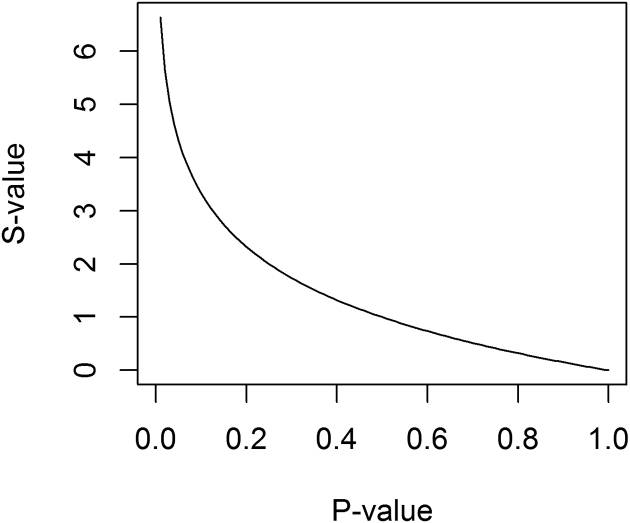
Misinterpretations of -values and 95% confidence intervals are ubiquitous in medical research. Specifically, the terms significance or confidence, extensively used in medical papers, ignore biases and violations of statistical assumptions and hence should be called overconfidence terms. In this paper, we present the compatibility view of -values and confidence intervals; the P-value is interpreted as an index of compatibility between data and the model, including the test hypothesis and background assumptions, whereas a confidence interval is interpreted as the range of parameter values that are compatible with the data under background assumptions. We also suggest the use of a surprisal measure, often referred to as the S-value, a novel metric that transforms the -value, for gauging compatibility in terms of an intuitive experiment of coin tossing.
在医学研究中,对P值和95%置信区间的误解无处不在。具体而言,医学论文中广泛使用的“显著性”或“置信度”等术语忽略了偏差和统计假设的违背,因此应被称为过度自信的术语。在本文中,我们提出了P值和置信区间的兼容性观点;P值被解释为数据与模型(包括检验假设和背景假设)之间的兼容性指标,而置信区间被解释为在背景假设下与数据兼容的参数值范围。我们还建议使用一种惊奇度量(通常称为S值),这是一种转换P值的新指标,用于通过抛硬币的直观实验来衡量兼容性。