Peng Kuan, Li Xue, Yang Deliang, Chan Shirley C W, Zhou Jiayi, Wan Eric Y F, Chui Celine S L, Lai Francisco T T, Wong Carlos K H, Chan Esther W Y, Leung Wai Keung, Lau Chak-Sing, Wong Ian C K
Department of Medicine, Li Ka Shing Faculty of Medicine, The University of Hong Kong, Hong Kong SAR, China.
Centre for Safe Medication Practice and Research, Department of Pharmacology and Pharmacy, Li Ka Shing Faculty of Medicine, The University of Hong Kong, Hong Kong SAR, China.
EClinicalMedicine. 2023 Aug 16;63:102154. doi: 10.1016/j.eclinm.2023.102154. eCollection 2023 Sep.
Case reports suggest that SARS-CoV-2 infection could lead to immune dysregulation and trigger autoimmunity while COVID-19 vaccination is effective against severe COVID-19 outcomes. We aim to examine the association between COVID-19 and development of autoimmune diseases (ADs), and the potential protective effect of COVID-19 vaccination on such an association.
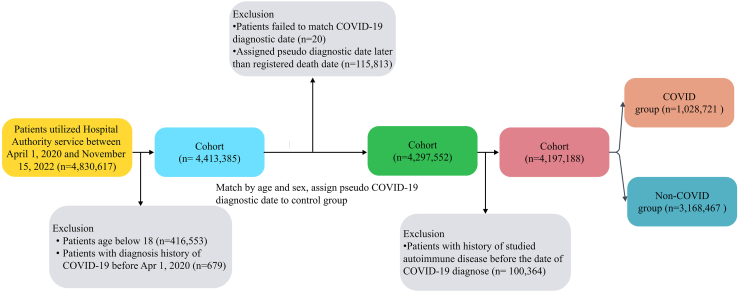
A retrospective cohort study was conducted in Hong Kong between 1 April 2020 and 15 November 2022. COVID-19 was confirmed by positive polymerase chain reaction or rapid antigen test. Cox proportional hazard regression with inverse probability of treatment weighting was applied to estimate the risk of incident ADs following COVID-19. COVID-19 vaccinated population was compared against COVID-19 unvaccinated population to examine the protective effect of COVID-19 vaccination on new ADs.
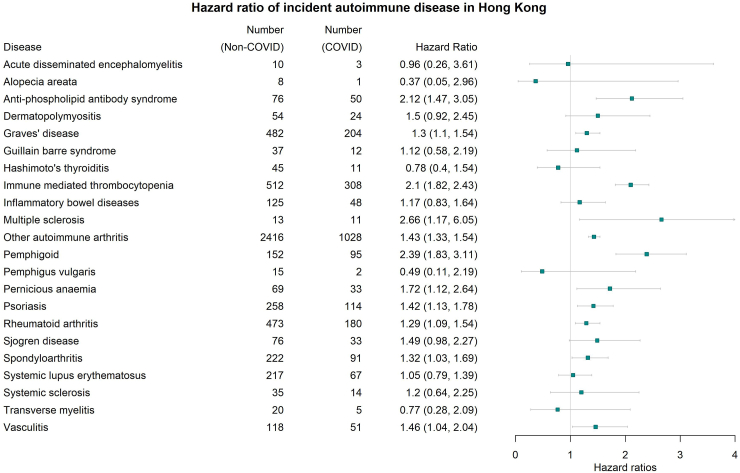
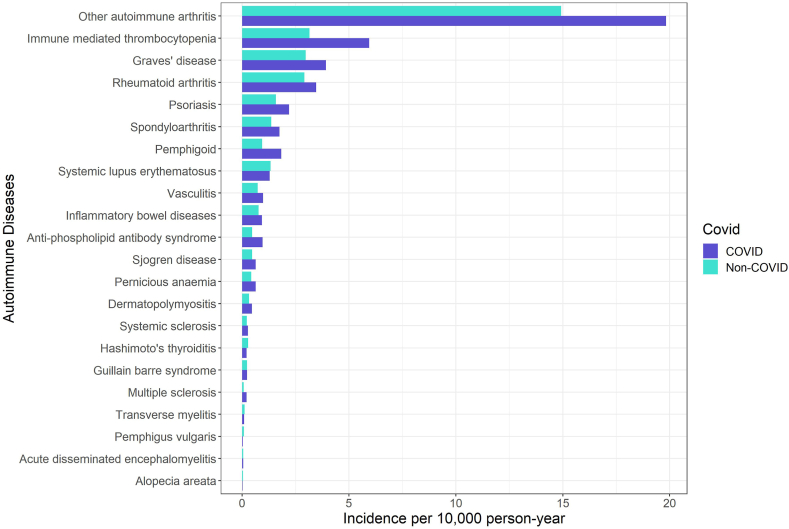
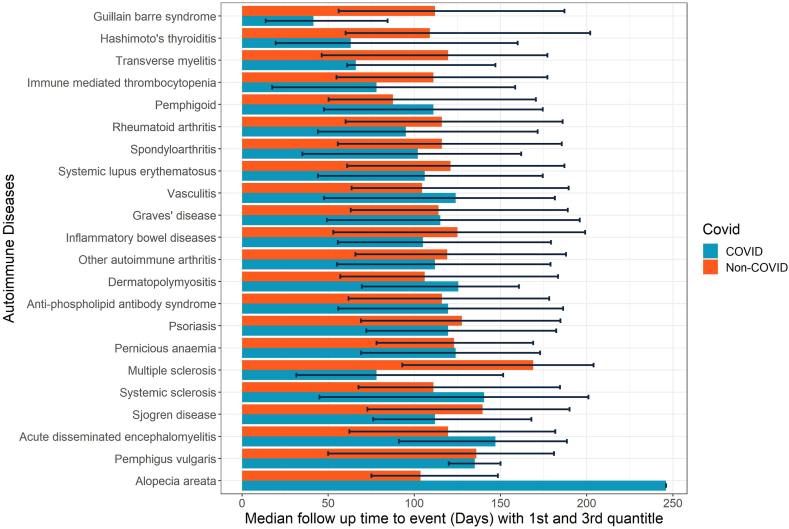
The study included 1,028,721 COVID-19 and 3,168,467 non-COVID individuals. Compared with non-COVID controls, patients with COVID-19 presented an increased risk of developing pernicious anaemia [adjusted Hazard Ratio (aHR): 1.72; 95% Confidence Interval (CI): 1.12-2.64]; spondyloarthritis [aHR: 1.32 (95% CI: 1.03-1.69)]; rheumatoid arthritis [aHR: 1.29 (95% CI: 1.09-1.54)]; other autoimmune arthritis [aHR: 1.43 (95% CI: 1.33-1.54)]; psoriasis [aHR: 1.42 (95% CI: 1.13-1.78)]; pemphigoid [aHR: 2.39 (95% CI: 1.83-3.11)]; Graves' disease [aHR: 1.30 (95% CI: 1.10-1.54)]; anti-phospholipid antibody syndrome [aHR: 2.12 (95% CI: 1.47-3.05)]; immune mediated thrombocytopenia [aHR: 2.1 (95% CI: 1.82-2.43)]; multiple sclerosis [aHR: 2.66 (95% CI: 1.17-6.05)]; vasculitis [aHR: 1.46 (95% CI: 1.04-2.04)]. Among COVID-19 patients, completion of two doses of COVID-19 vaccine shows a decreased risk of pemphigoid, Graves' disease, anti-phospholipid antibody syndrome, immune-mediated thrombocytopenia, systemic lupus erythematosus and other autoimmune arthritis.
Our findings suggested that COVID-19 is associated with an increased risk of developing various ADs and the risk could be attenuated by COVID-19 vaccination. Future studies investigating pathology and mechanisms would be valuable to interpreting our findings.
Supported by RGC Collaborative Research Fund (C7154-20GF).
病例报告表明,严重急性呼吸综合征冠状病毒2(SARS-CoV-2)感染可能导致免疫失调并引发自身免疫,而2019冠状病毒病(COVID-19)疫苗接种对预防严重COVID-19结局有效。我们旨在研究COVID-19与自身免疫性疾病(AD)发生之间的关联,以及COVID-19疫苗接种对这种关联的潜在保护作用。
于2020年4月1日至2022年11月15日在香港进行了一项回顾性队列研究。通过聚合酶链反应阳性或快速抗原检测确诊COVID-19。采用治疗权重逆概率的Cox比例风险回归来估计COVID-19后发生AD的风险。将接种COVID-19疫苗的人群与未接种COVID-19疫苗的人群进行比较,以研究COVID-19疫苗接种对新发AD的保护作用。
该研究纳入了1,028,721例COVID-19患者和3,168,467例非COVID个体。与非COVID对照组相比,COVID-19患者发生恶性贫血的风险增加[调整后风险比(aHR):1.72;95%置信区间(CI):1.12 - 2.64];脊柱关节炎[aHR:1.32(95%CI:1.03 - 1.69)];类风湿关节炎[aHR:1.29(95%CI:1.09 - 1.54)];其他自身免疫性关节炎[aHR:1.43(95%CI:1.33 - 1.54)];银屑病[aHR:1.42(95%CI:1.13 - 1.78)];类天疱疮[aHR:2.39(95%CI:1.83 - 3.11)];格雷夫斯病[aHR:1.30(95%CI:1.10 - 1.54)];抗磷脂抗体综合征[aHR:2.12(95%CI:1.47 - 3.05)];免疫介导的血小板减少症[aHR:2.1(95%CI:1.82 - 2.43)];多发性硬化症[aHR:2.66(95%CI:1.17 - 6.05)];血管炎[aHR:1.46(95%CI:1.04 - 2.04)]。在COVID-19患者中,完成两剂COVID-19疫苗接种可降低类天疱疮、格雷夫斯病、抗磷脂抗体综合征、免疫介导的血小板减少症、系统性红斑狼疮和其他自身免疫性关节炎的发病风险。
我们的研究结果表明,COVID-19与发生各种AD的风险增加相关,而COVID-19疫苗接种可能会降低这种风险。未来对病理和机制的研究将有助于解释我们的研究结果。
由研究资助局协作研究基金(C7154 - 20GF)资助。