National Primate Research Centre, Korea Research Institute of Bioscience and Biotechnology (KRIBB), Cheongju, Chungcheongbuk, Republic of Korea.
KRIBB School of Bioscience, Korea University of Science & Technology (UST), Daejeon, Republic of Korea.
Commun Biol. 2023 Aug 28;6(1):879. doi: 10.1038/s42003-023-05253-8.
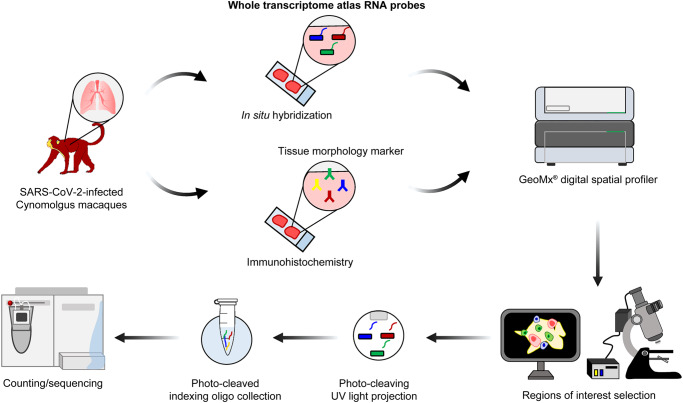
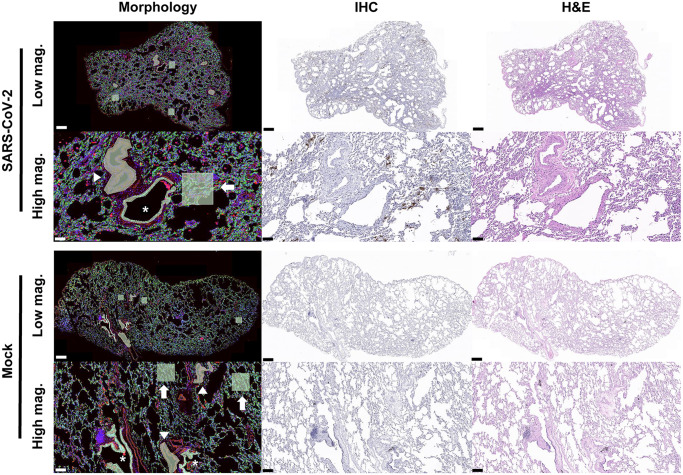
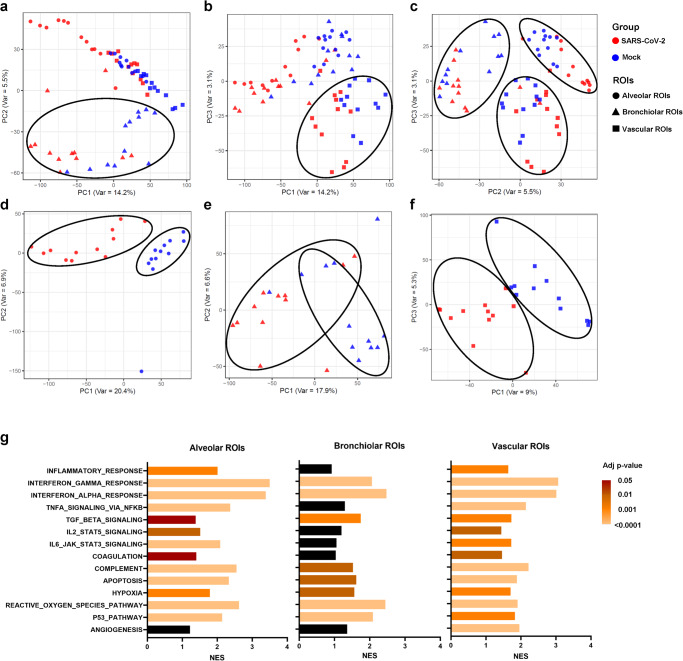
Characterizing the host response to severe acute respiratory syndrome coronavirus 2 (SARS-CoV-2) at the molecular level is necessary to understand viral pathogenesis and identify clinically relevant biomarkers. However, in humans, the pulmonary host response during disease onset remains poorly understood. Herein, we utilized a spatial transcriptome atlas to identify pulmonary microstructure-specific COVID-19 gene signatures during the acute phase of lung infection in cynomolgus macaques. The innate immune response to virus-induced cell death was primarily active in the alveolar regions involving activated macrophage infiltration. Inflamed vascular regions exhibited prominent upregulation of interferon and complement pathway genes that mediate antiviral activity and tissue damage response. Furthermore, known biomarker genes were significantly expressed in specific microstructures, and some of them were universally expressed across all microstructures. These findings underscore the importance of identifying key drivers of disease progression and clinically applicable biomarkers by focusing on pulmonary microstructures appearing during SARS-CoV-2 infection.
从分子水平上描述严重急性呼吸综合征冠状病毒 2(SARS-CoV-2)对宿主的反应对于理解病毒发病机制和确定有临床意义的生物标志物是必要的。然而,在人类中,疾病发病初期的肺部宿主反应仍知之甚少。在此,我们利用空间转录组图谱,在感染 SARS-CoV-2 的食蟹猴的肺部急性感染阶段,鉴定了与肺部微结构相关的 COVID-19 基因特征。病毒诱导的细胞死亡引起的固有免疫反应主要发生在涉及活化巨噬细胞浸润的肺泡区域。发炎的血管区域中干扰素和补体途径基因的表达显著上调,这些基因介导抗病毒活性和组织损伤反应。此外,已知的生物标志物基因在特定的微结构中显著表达,其中一些在所有微结构中都普遍表达。这些发现强调了通过关注 SARS-CoV-2 感染过程中出现的肺部微结构,确定疾病进展的关键驱动因素和具有临床应用价值的生物标志物的重要性。