CEUMA University, São Luís, Brazil.
State University of São Paulo, Marília, SP, Brazil.
BMC Oral Health. 2023 Aug 28;23(1):602. doi: 10.1186/s12903-023-03301-7.
Many orthodontic patients request dental bleaching during orthodontic treatment to achieve a faster aesthetic resolution, however, no attention has been paid to the inflammatory processes that can occur when both therapies are indicated together. So, this clinical trial evaluated the inflammatory parameters and color alterations associated with dental bleaching in patients wearing a fixed orthodontic appliance.
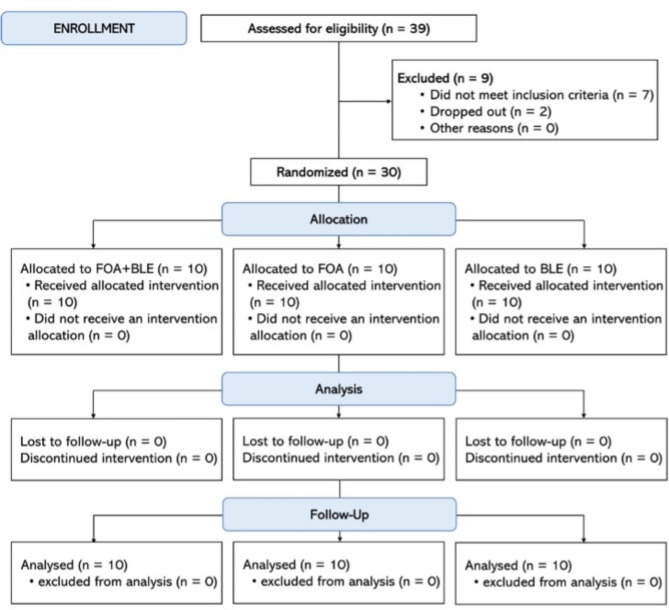
Thirty individuals aged between 18 and 40 years were equally and randomly allocated into three groups: FOA (fixed orthodontic appliance), BLE (dental bleaching), and FOA + BLE (fixed orthodontic appliance + dental bleaching). The orthodontic appliances and the bleaching procedures were performed in the maxillary premolars and molars. For dental bleaching a 35% hydrogen peroxide was used. The gingival crevicular fluid (GCF) and nitric oxide (NO) levels were evaluated at different time-points. Color evaluation was performed using an Easyshade spectrophotometer at baseline (FOA, FOA + BLE, BLE), one month after (FOA + BLE) and 21 days after appliance removing (FOA + BLE and FOA groups), in each tooth bleached. The ANOVA and Tukey's tests, with a significance level of 5%, were used for statistical analysis.
The GCF volume in the FOA + BLE and FOA groups significantly increased at the time points evaluated (p < 0.001); however, this did not occur in the BLE group (p > 0.05). On the other hand, NO levels significantly decreased during dental bleaching with or without fixed orthodontic appliances (FOA + BLE and BLE groups; p < 0.05), while no significant changes were observed in the FOA group (p > 0.05). Significant changes in color were observed in the FOA + BLE and BLE groups compared to in the FOA group (p < 0.01). However, the presence of fixed orthodontic appliance (FOA + BLE) negatively affected the bleaching efficacy compared to BLE group (p < 0.01).
Dental bleaching did not increase the inflammatory parameters in patients wearing fixed orthodontic appliance. However, in the presence of orthodontic appliances, the bleaching efficacy was lower than that of bleaching teeth without orthodontic appliances.
RBR-3sqsh8 (first trial registration: 09/07/2018).
许多正畸患者在正畸治疗期间要求进行牙齿漂白,以更快地达到美学效果,但对于同时进行这两种治疗可能引发的炎症过程,尚未引起关注。因此,本临床试验评估了佩戴固定正畸矫治器的患者牙齿漂白相关的炎症参数和颜色变化。
将 30 名年龄在 18 至 40 岁之间的个体等分为三组:FOA(固定正畸矫治器)、BLE(牙齿漂白)和 FOA+BLE(固定正畸矫治器+牙齿漂白)。正畸矫治器和漂白程序均在上颌前磨牙和磨牙进行。牙齿漂白使用 35%过氧化氢。在不同时间点评估龈沟液(GCF)和一氧化氮(NO)水平。使用 Easyshade 分光光度计在基线(FOA、FOA+BLE、BLE)、一个月后(FOA+BLE)和正畸矫治器去除后 21 天(FOA+BLE 和 FOA 组)对每个漂白牙进行颜色评估。采用方差分析和 Tukey 检验,显著性水平为 5%。
FOA+BLE 和 FOA 组的 GCF 体积在评估的时间点显著增加(p<0.001);然而,BLE 组未出现这种情况(p>0.05)。另一方面,在使用或不使用固定正畸矫治器进行牙齿漂白时,NO 水平显著降低(FOA+BLE 和 BLE 组;p<0.05),而 FOA 组无明显变化(p>0.05)。与 FOA 组相比,FOA+BLE 和 BLE 组的颜色变化显著(p<0.01)。然而,与 BLE 组相比,固定正畸矫治器的存在(FOA+BLE)降低了漂白效果(p<0.01)。
佩戴固定正畸矫治器的患者牙齿漂白不会增加炎症参数。然而,在存在正畸矫治器的情况下,漂白效果低于无正畸矫治器的牙齿漂白效果。
RBR-3sqsh8(首次试验注册:09/07/2018)。