Xue Yinting, Zhang Yunge, Huang Kun, Wang Xiuyan, Xing Mingzhen, Xu Qiaolin, Guo Yanbin
College of Resources and Environmental Sciences, China Agricultural University, Beijing, 100193, China.
Hebei Innovation Center of Biofertilizer Technology, Xingtai, Hebei, 054700, China.
AMB Express. 2023 Aug 29;13(1):91. doi: 10.1186/s13568-023-01596-x.
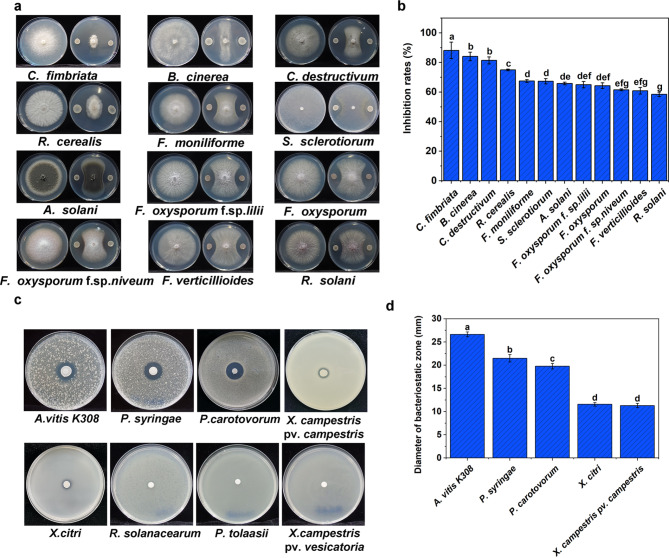
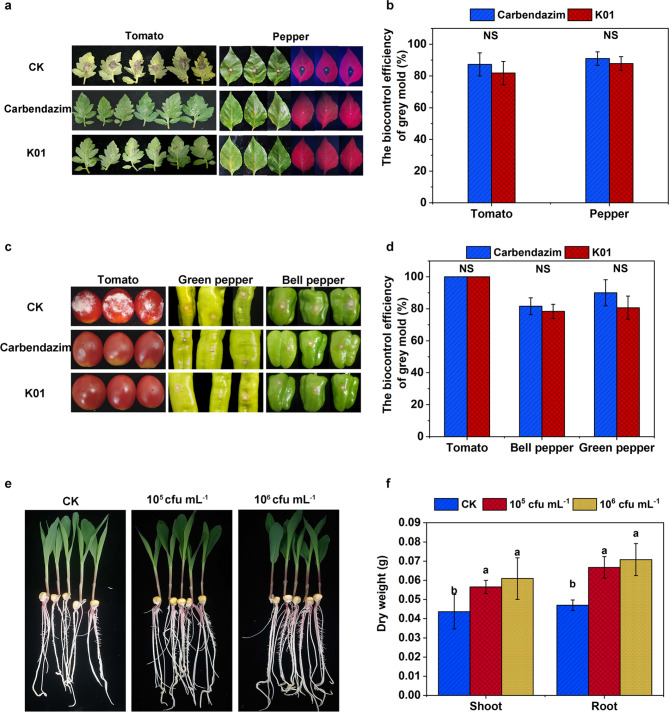
Gray mold is a destructive plant disease caused by a fungal pathogen Botrytis cinerea. The use of plant growth promoting rhizobacteria (PGPR) has proven to be a promising method to control this disease. Bacillus velezensis K01 was isolated from the rhizosphere of planting tomatoes. Strain K01 has a range of roles, including the ability to solubilize phytate phosphorus, stimulate resistant response, and produce indoleacetic acid (IAA), protease, cellulase, and antimicrobial substances. Strain K01 was found to inhibit 12 phytopathogenic fungi and 5 phytopathogenic bacteria. Specially, strain K01 demonstrated a biocontrol efficiency of over 78% against gray mold caused by B. cinerea on the leaves and fruits of tomato and pepper. Additionally, K01 was found to promote the growth of maize seedlings. Further genomic analysis revealed that K01 belongs to B. velezensis, which is consistent with phylogenetic analysis, average nucleotide polymorphism (ANI), and digital DNA-DNA hybridization (dDDH). The genome of strain K01 had a size of 3,927,799 bp and deduced 3866 predicted genes, with an average guanine-cytosine (GC) content of 46.5%. Based on the analyses of genomic secondary metabolites, over 18.4% of the genome was annotated to 12 gene clusters related to antimicrobial metabolite synthesis. Additionally, genome annotation and comparative genomics identified several genes associated with plant growth promotion and environmental adaption. These findings suggest that B. velezensis K01 has the potential to serve as a new biocontrol agent for management of gray mold on tomato and pepper.
灰霉病是一种由真菌病原体灰葡萄孢引起的具有破坏性的植物病害。事实证明,使用植物促生根际细菌(PGPR)是控制这种病害的一种很有前景的方法。贝莱斯芽孢杆菌K01是从种植番茄的根际分离出来的。菌株K01具有多种作用,包括溶解植酸磷、刺激抗性反应以及产生吲哚乙酸(IAA)、蛋白酶、纤维素酶和抗菌物质的能力。发现菌株K01能抑制12种植物病原真菌和5种植物病原细菌。特别地,菌株K01对番茄和辣椒叶片及果实上由灰葡萄孢引起的灰霉病表现出超过78%的生防效率。此外,发现K01能促进玉米幼苗的生长。进一步的基因组分析表明,K01属于贝莱斯芽孢杆菌,这与系统发育分析、平均核苷酸多态性(ANI)和数字DNA-DNA杂交(dDDH)结果一致。菌株K01的基因组大小为3,927,799 bp,推导有3866个预测基因,平均鸟嘌呤-胞嘧啶(GC)含量为46.5%。基于对基因组次生代谢产物的分析,超过18.4%的基因组被注释到与抗菌代谢产物合成相关的12个基因簇。此外,基因组注释和比较基因组学鉴定出了几个与植物生长促进和环境适应相关的基因。这些发现表明,贝莱斯芽孢杆菌K01有潜力作为一种新型生防菌用于防治番茄和辣椒上的灰霉病。