Department of Psychology and Speech-Language Pathology, University of Turku, Publicum building, 4th floor, 20014, Turku, Finland.
Department of Psychiatry, HUS Helsinki University Hospital and University of Helsinki, Adolescent Psychiatry, Finland.
BMC Psychiatry. 2023 Aug 29;23(1):632. doi: 10.1186/s12888-023-05127-7.
Early maladaptive schemas (EMSs) and self-harm have been firmly linked in adults, but research on these associations in adolescents remains scarce. Additionally, the links between EMSs and functions of self-injury has not been previously studied in this age group. Thus, the aim of the present study was to investigate the associations of EMSs with self-harm thoughts and behavior, as well as with self-harm functions, among adolescents in specialized health care.
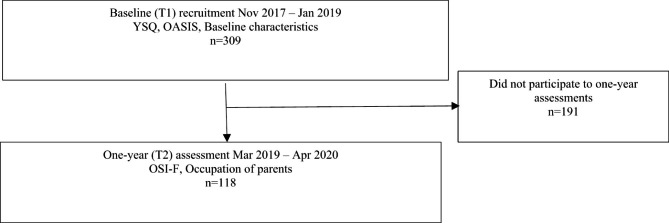
The participants were recruited from first-visit 12-22-year-old adolescent patients entering specialized mental health care or pediatric care. For 118 participants, complete data were available for the Young Schema Questionnaire Short Form 2-Extended (YSQ) when entering care and the Ottawa Self-Injury Inventory Functions scale (OSI-F) one year later. YSQ was used to measure the participants' EMSs and OSI-F their self-harm thoughts and behavior. The associations of EMSs and self-harm were investigated in three groups: no self-harm, self-harm thoughts only, and both self-harm thoughts and behavior. The associations of EMSs with self-injury behavior functions were assessed in four categories: Internal Emotional Regulation, External Emotional Regulation, Social Influence, and Sensation Seeking. Additionally, EMSs' associations with addictive features of self-injury behavior were assessed. The magnitudes of effect sizes of differences between the self-harm groups were evaluated with Cliff's Delta. The associations of EMSs with self-injury functions were analyzed with general linear modeling and with self-injury addictive features using logistic regression.
The differences between the self-harm groups were significant for the majority of the EMSs. The stronger the EMSs were, the more severe the manifestations of self-harm. The effect sizes ranged from small to large depending on the EMS. Considering self-injury functions, Internal Emotional Regulation was associated with Self-Sacrifice EMS (p = 0.021), and External Emotional Regulation both with Abandonment (p = 0.040) and Unrelenting Standards (p = 0.012) EMSs. Being addicted to self-injury was associated with Abandonment (p = 0.043) and Dependence (p = 0.025) EMSs.
The present study shows that significant associations between EMSs and both self-harm thoughts and behavior exist also in adolescents. Stronger EMSs are linked to more severe self-harm. Knowledge of these associations may help to improve the understanding and treatment of adolescents suffering from self-harm.
早期适应不良模式(EMSs)和自残在成年人中已被牢固地联系在一起,但关于青少年中这些关联的研究仍然很少。此外,EMSs 与自残功能之间的联系在该年龄段尚未被研究过。因此,本研究旨在调查在专门的医疗保健机构中,青少年的 EMSs 与自残思想和行为以及自残功能之间的关联。
从进入专门的心理健康护理或儿科护理的 12-22 岁的青少年患者中招募参与者。对于 118 名参与者,在进入护理时,他们有完整的 Young Schema Questionnaire Short Form 2-Extended(YSQ)数据,一年后有 Ottawa Self-Injury Inventory Functions scale(OSI-F)数据。YSQ 用于测量参与者的 EMSs,OSI-F 用于测量他们的自残思想和行为。研究了 EMSs 与以下三组之间的关联:无自残、只有自残思想、既有自残思想又有自残行为。使用一般线性建模分析了 EMSs 与内部情绪调节、外部情绪调节、社会影响和感觉寻求四个类别的自我伤害行为功能之间的关联。此外,还评估了 EMSs 与自我伤害行为成瘾特征之间的关联。使用 Cliff's Delta 评估了自我伤害组之间差异的效应大小的幅度。使用 logistic 回归分析了 EMSs 与自我伤害功能之间的关联。
自我伤害组之间的差异在大多数 EMSs 中均具有统计学意义。EMSs 越强,自残的表现越严重。根据 EMSs 的不同,效应大小从小到大不等。考虑到自我伤害功能,内部情绪调节与自我牺牲 EMS 相关(p=0.021),外部情绪调节与遗弃(p=0.040)和永不满足的标准(p=0.012)EMS 相关。对自我伤害行为的成瘾与遗弃(p=0.043)和依赖(p=0.025)EMS 相关。
本研究表明,EMSs 与自残思想和行为之间也存在显著关联,在青少年中也存在这种关联。EMSs 越强,自残越严重。了解这些关联可能有助于提高对自残青少年的理解和治疗。