Mukai Tomoyo, Tsukiyama Yoshi, Yamada Shinobu, Nishikawa Akinori, Hayami Shinya, Noguchi Rie, Yoshida Junko, Kashiwada Maki, Ohta Shigeru, Shimokawa Toshio, Yamaue Hiroki
Departments of Nursing, Wakayama Medical University Hospital, Wakayama, Japan.
Palliative Care Center, Oncology Center, Wakayama Medical University Hospital, Wakayama, Japan.
Palliat Med Rep. 2023 Aug 7;4(1):214-219. doi: 10.1089/pmr.2023.0017. eCollection 2023.
Malignancy patients who need long-term hospitalization can feel loneliness affecting their quality of life. The global COVID-19 pandemic has caused visiting restrictions that could mean patients who might be missing out on family support and palliative care, therefore, need to adapt and change. We used virtual reality (VR) technology with the aim of reducing feelings of loneliness among these patients.
In a small cohort setting, we aimed to clarify the usefulness of VR viewing for this purpose by text mining interviews with the patients in palliative care after their VR experience, and to clarify the feasibility of this program.
DESIGN AND SETTING/SUBJECTS: Four consecutive Japanese patients in the palliative care unit viewed personalized familiar persons or places through VR goggles, while communicating by telephone. After the VR experience, text mining of the patients' interviews was used to extract the words for the frequency count and co-occurrence analysis.
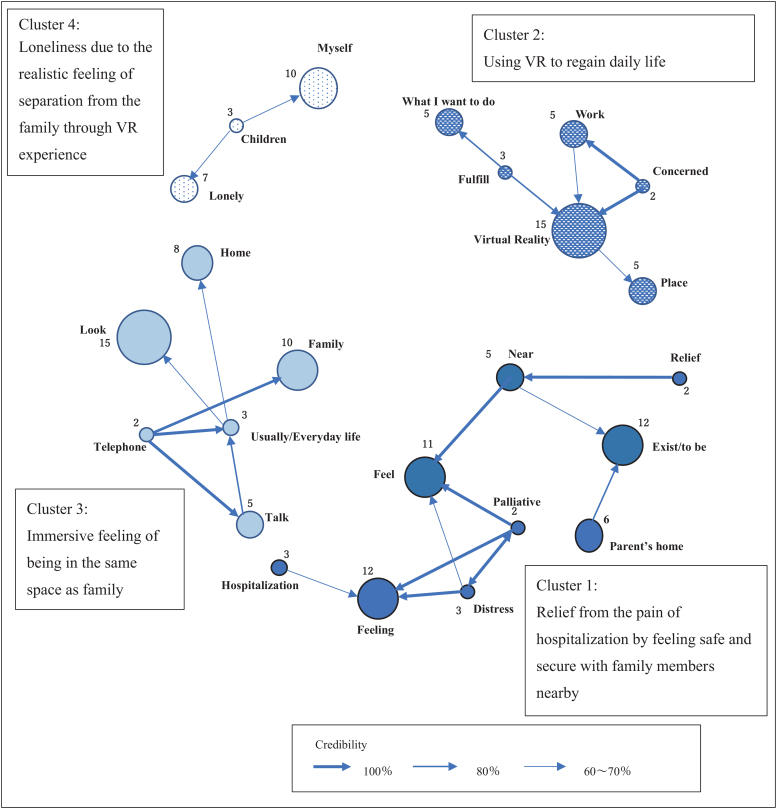
Four clusters were extracted: "relief from the pain of hospitalization by feeling safe and secure with family members nearby," "using VR to regain daily life," "immersive feeling of being in the same space as family," and "loneliness due to the realistic feeling of separation from the family through VR experience." There were no cases of VR sickness.
Our results attained by text mining suggest the promising potential of VR imaging of familiar surroundings for patients in palliative care.
需要长期住院的恶性肿瘤患者可能会感到孤独,这会影响他们的生活质量。全球新冠疫情导致了探视限制,这可能意味着患者可能会错过家庭支持和姑息治疗,因此,他们需要适应和改变。我们使用虚拟现实(VR)技术,旨在减少这些患者的孤独感。
在一个小队列研究中,我们旨在通过对姑息治疗患者VR体验后的访谈进行文本挖掘,以阐明VR观看在此方面的有用性,并阐明该方案的可行性。
设计与设置/研究对象:四名连续入住姑息治疗病房的日本患者通过VR护目镜观看个性化的熟悉人物或地点,同时通过电话进行交流。VR体验后,对患者访谈进行文本挖掘,以提取用于频率计数和共现分析的词汇。
提取了四个类别:“因家人在旁感到安全而缓解住院痛苦”、“利用VR恢复日常生活”、“与家人处于同一空间的沉浸式感受”以及“因VR体验中与家人分离的现实感而产生的孤独感”。没有出现VR不适的情况。
我们通过文本挖掘获得的结果表明,为姑息治疗患者进行熟悉环境的VR成像具有广阔的潜力。