Department of Neonatology, Hospital General Universitario Gregorio Marañón, Calle O'Donnel 48, Madrid, 28009, Spain.
Pediatric Infectious Disease Unit, Instituto de Investigación Sanitaria Gregorio Marañón, Madrid, Spain.
BMC Pregnancy Childbirth. 2023 Aug 30;23(1):623. doi: 10.1186/s12884-023-05926-6.
It is known that SARS-CoV-2 antibodies from pregnant women with SARS-CoV-2 infection during pregnancy cross the placenta but the duration and the protective effect of these antibodies in infants is scarce.
This prospective study included mothers with SARS-COV-2 infection during pregnancy and their infants from April 2020 to March 2021. IgG antibodies to SARS-CoV-2 spike protein were performed on women and infants at birth and at two and six months during follow-up. Anthropometrical measures and physical and neurological examinations and a clinical history of symptoms and COVID-19 diagnosis were collected. Simple linear regression was performed to compare categorical and continuous variables. To compare the mother's and infant's antibody titers evolution, a mixed linear regression model was used. A predictive model of newborn antibody titers at birth has been established by means of simple stepwise linear regression.
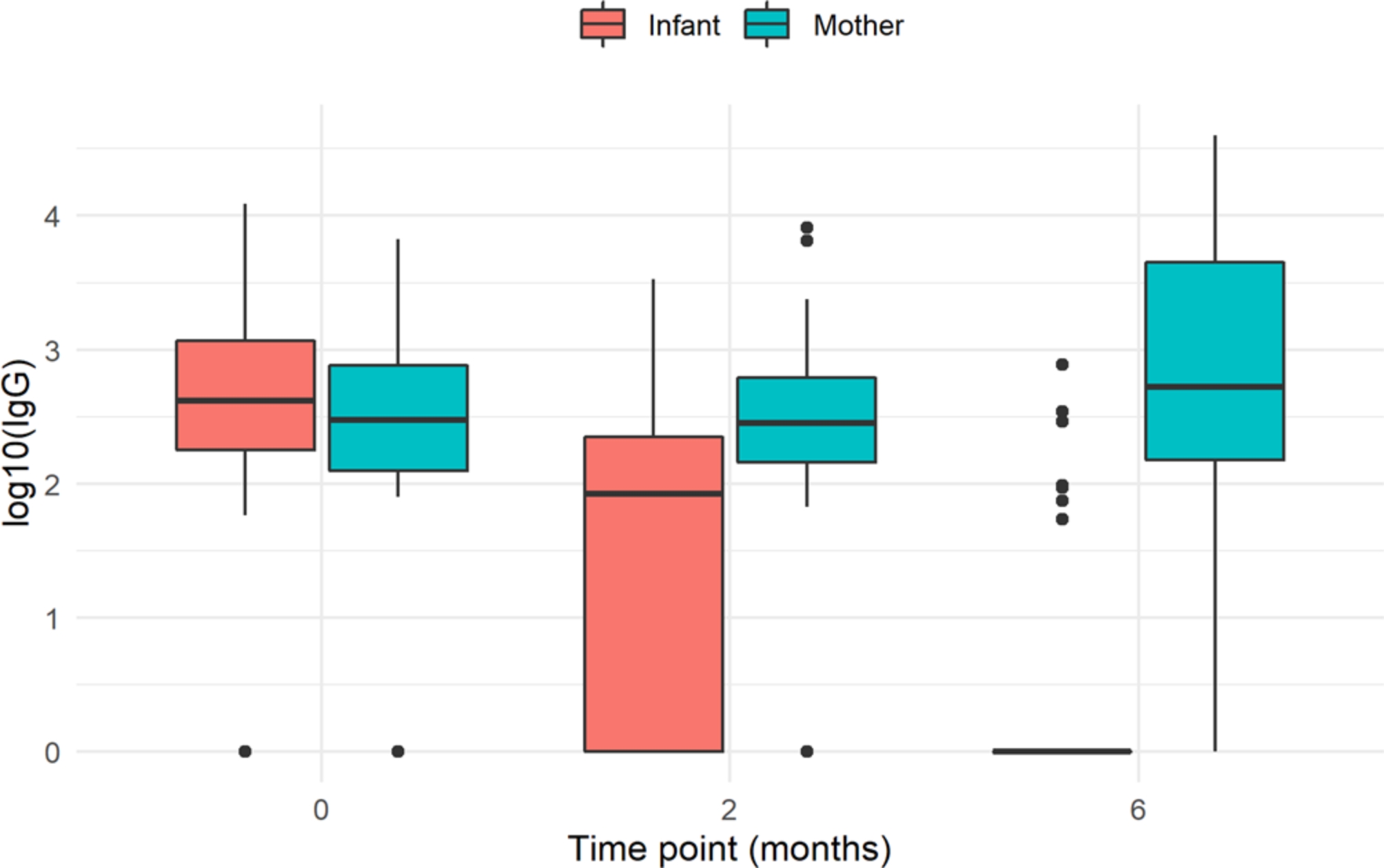
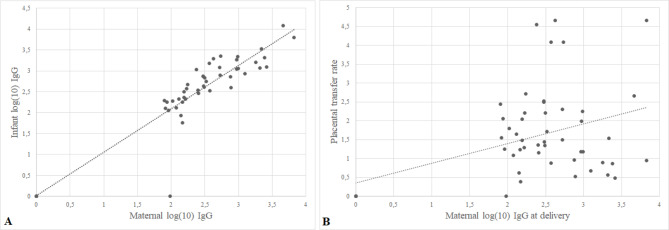
51 mother-infant couples were included. 45 (90%) of the mothers and 44 (86.3%) of the newborns had a positive serology al birth. These antibodies were progressively decreasing and were positive in 34 (66.7%) and 7 (13.7%) of infants at 2 and 6 months, respectively. IgG titers of newborns at birth were related to mothers' titers, with a positive moderate correlation (Pearson's correlation coefficient: 0.82, p < 0,001). Fetal/maternal antibodies placental transference rate was 1.3 (IQR: 0.7-2.2). The maternal IgG titers at delivery and the type of maternal infection (acute, recent, or past infection) was significantly related with infants' antibody titers at birth. No other epidemiological or clinical factors were related to antibodies titers. Neurodevelopment, psychomotor development, and growth were normal in 94.2% of infants in the third follow-up visit. No infants had a COVID-19 diagnosis during the follow-up period.
Transplacental transfer of maternal antibodies is high in newborns from mothers with recent or past infection at delivery, but these antibodies decrease after the first months of life. Infant's IgG titers were related to maternal IgG titers at delivery. Further studies are needed to learn about the protective role of maternal antibodies in infants.
已知感染 SARS-CoV-2 的孕妇体内的 SARS-CoV-2 抗体可穿过胎盘,但这些抗体在婴儿体内的持续时间和保护作用尚不清楚。
本前瞻性研究纳入了 2020 年 4 月至 2021 年 3 月期间感染 SARS-CoV-2 的孕妇及其婴儿。在女性和婴儿出生时以及随访期间的 2 个月和 6 个月时,检测针对 SARS-CoV-2 刺突蛋白的 IgG 抗体。收集人体测量学指标以及体格和神经检查和症状及 COVID-19 诊断的临床病史。采用简单线性回归比较分类和连续变量。为了比较母亲和婴儿抗体滴度的变化,采用混合线性回归模型。通过简单逐步线性回归建立了新生儿出生时抗体滴度的预测模型。
共纳入 51 对母婴。45 名(90%)母亲和 44 名(86.3%)新生儿出生时血清学检查呈阳性。这些抗体逐渐下降,2 个月和 6 个月时分别有 34 名(66.7%)和 7 名(13.7%)婴儿呈阳性。新生儿出生时的 IgG 滴度与母亲的滴度相关,呈正中度相关(Pearson 相关系数:0.82,p<0.001)。胎儿/母体抗体胎盘转移率为 1.3(IQR:0.7-2.2)。分娩时母体 IgG 滴度和母体感染类型(急性、近期或既往感染)与婴儿出生时的抗体滴度显著相关。其他流行病学或临床因素与抗体滴度无关。在第三次随访时,94.2%的婴儿神经发育、精神运动发育和生长正常。在随访期间,没有婴儿被诊断为 COVID-19。
来自分娩时近期或既往感染的母亲的新生儿体内有较高的母体抗体经胎盘转移,但这些抗体在生命的最初几个月后下降。婴儿的 IgG 滴度与分娩时母体 IgG 滴度相关。需要进一步的研究来了解母体抗体对婴儿的保护作用。