Peking University Fifth School of Clinical Medicine, Beijing Hospital, National Center of Gerontology, Beijing, China.
The Key Laboratory of Geriatrics, Beijing Institute of Geriatrics, Institute of Geriatric Medicine, Chinese Academy of Medical Sciences, Beijing Hospital, National Center of Gerontology of National Health Commission, Beijing, China.
Clin Transl Med. 2023 Sep;13(9):e1393. doi: 10.1002/ctm2.1393.
Small extrachromosomal circular DNAs (eccDNAs) have the potential to be cancer biomarkers. However, the formation mechanisms and functions of small eccDNAs selected in carcinogenesis are not clear, and whether the small eccDNA profile in the plasma of cancer patients represents that in cancer tissues remains to be elucidated.
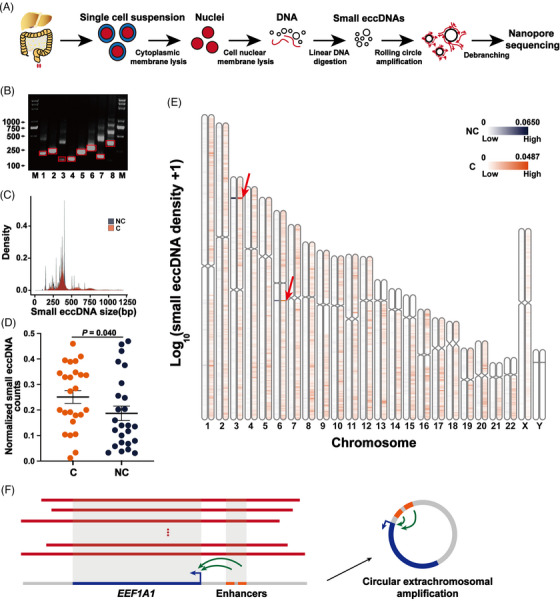
A novel sequencing workflow based on the nanopore sequencing platform was used to sequence naturally existing full-length small eccDNAs in tissues and plasma collected from 25 cancer patients (including prostate cancer, hepatocellular carcinoma and colorectal cancer), and from an independent validation cohort (including 7 cancer plasma and 14 healthy plasma).
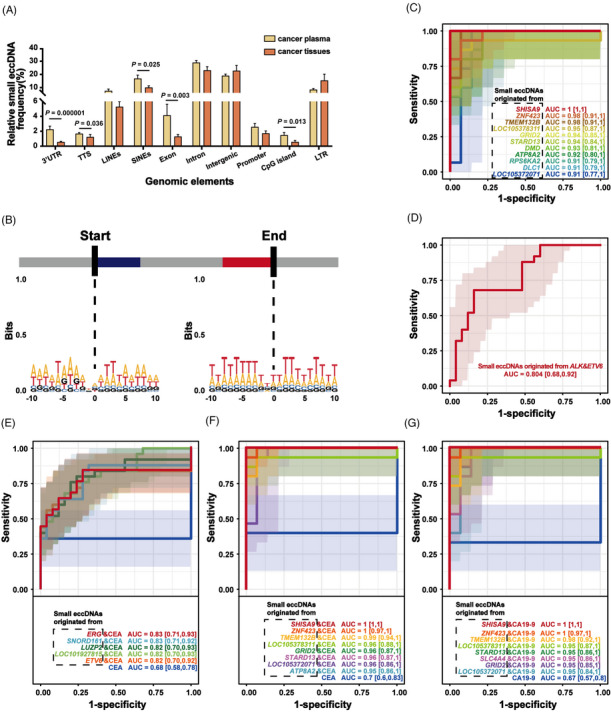
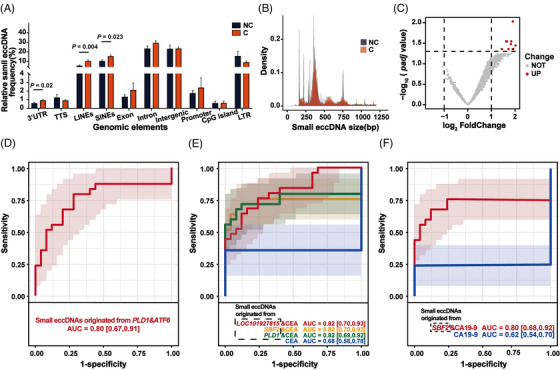
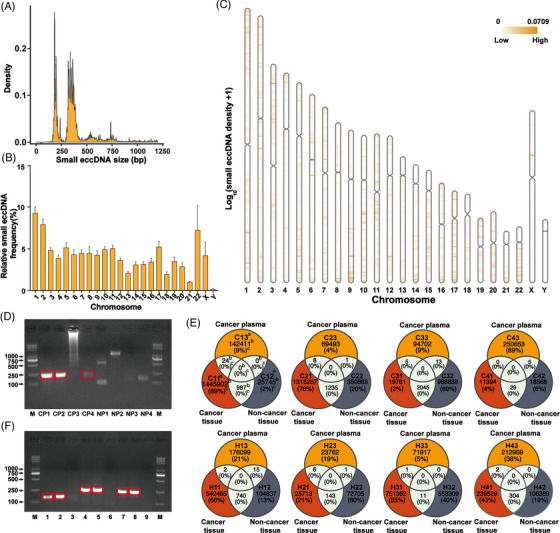
Compared with those in non-cancer tissues, small eccDNAs detected in cancer tissues had a significantly larger number and size (P = 0.040 and 2.2e-16, respectively), along with more even distribution and different formation mechanisms. Although small eccDNAs had different general characteristics and genomic annotation between cancer tissues and the paired plasma, they had similar formation mechanisms and cancer-related functions. Small eccDNAs originated from some specific genes had great multi-cancer diagnostic value in tissues (AUC ≥ 0.8) and plasma (AUC > 0.9), especially increasing the accuracy of multi-cancer prediction of CEA/CA19-9 levels. The high multi-cancer diagnostic value of small eccDNAs originated from ALK&ETV6 could be extrapolated from tissues (AUC = 0.804) to plasma and showed high positive predictive value (100%) and negative predictive value (82.35%) in a validation cohort.
As independent and stable circular DNA molecules, small eccDNAs in both tissues and plasma can be used as ideal biomarkers for cost-effective multi-cancer diagnosis and monitoring.
小的染色体外环状 DNA(eccDNA)有可能成为癌症生物标志物。然而,在癌变过程中选择的小 eccDNA 的形成机制和功能尚不清楚,并且癌症患者血浆中的小 eccDNA 谱是否代表癌症组织中的情况仍有待阐明。
使用基于纳米孔测序平台的新型测序工作流程,对 25 名癌症患者(包括前列腺癌、肝细胞癌和结直肠癌)以及独立验证队列(包括 7 份癌症血浆和 14 份健康血浆)中组织和血浆中自然存在的全长小 eccDNA 进行测序。
与非癌组织相比,在癌组织中检测到的小 eccDNA 的数量和大小显著更大(P=0.040 和 2.2e-16,分别),并且分布更加均匀,形成机制不同。尽管小 eccDNA 在癌组织和配对血浆之间具有不同的一般特征和基因组注释,但它们具有相似的形成机制和与癌症相关的功能。来自某些特定基因的小 eccDNA 在组织(AUC≥0.8)和血浆(AUC>0.9)中具有很好的多癌诊断价值,特别是提高了 CEA/CA19-9 水平的多癌预测准确性。ALK&ETV6 来源的小 eccDNA 的高多癌诊断价值可以从组织(AUC=0.804)推断到血浆,并在验证队列中表现出高阳性预测值(100%)和阴性预测值(82.35%)。
作为独立且稳定的环状 DNA 分子,组织和血浆中的小 eccDNA 均可作为具有成本效益的多癌诊断和监测的理想生物标志物。