He Qingliu, Su Qingfu, Wei Chengcheng, Zhang Pu, Liu Weihui, Chen Junyi, Su Xiaoping, Zhuang Wei
Department of Urology, The Second Affiliated Hospital of Fujian Medical University, Quanzhou, China.
Department of Urology, The First Affiliated Hospital of Chongqing Medical University, Chongqing, China.
Front Pharmacol. 2024 Sep 17;15:1464145. doi: 10.3389/fphar.2024.1464145. eCollection 2024.
The role of focal amplifications and extrachromosomal circular DNA (eccDNA) is still uncertain in prostate adenocarcinoma (PRAD). Here, we first mapped the global characterizations of eccDNA and then investigate the characterization of eccDNA-amplified key differentially expressed encoded genes (eKDEGs) in the progression, immune response and immunotherapy of PRAD.
Circular_seq was used in conjunction with the TCGA-PRAD transcriptome dataset to sequence, annotate, and filter for eccDNA-amplified differentially expressed coding genes (eDEGs) in PRAD and para-cancerous normal prostate tissues. Afterwards, risk models were created and eKDEGs linked to the PRAD prognosis were identified using Cox and Lasso regression analysis. The immune microenvironment of the risk model was quantified using a variety of immunological algorithms, which also identified its characteristics with regard to immunotherapy, immune response, and immune infiltration.
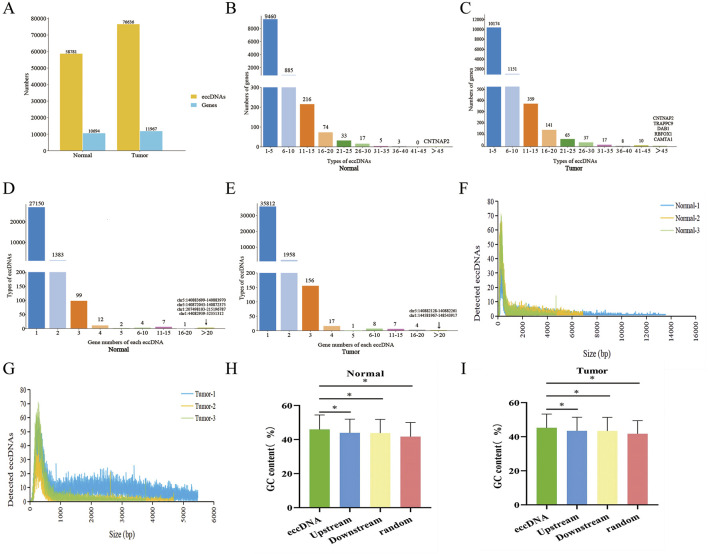
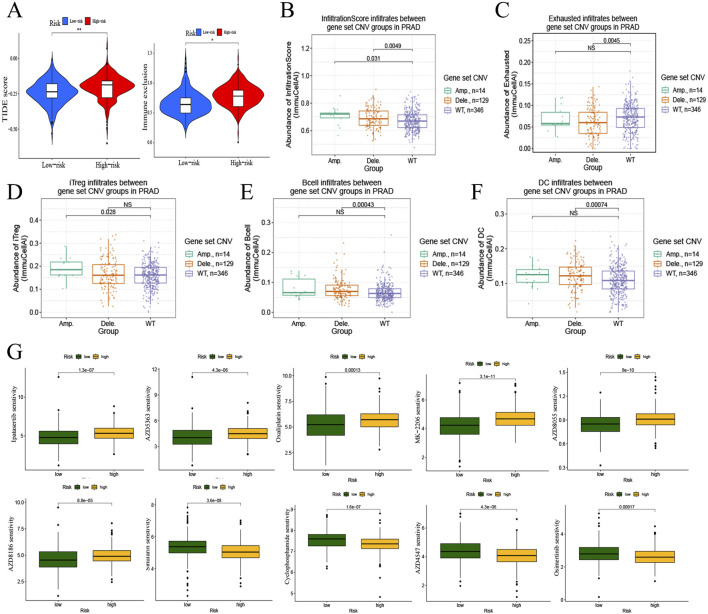
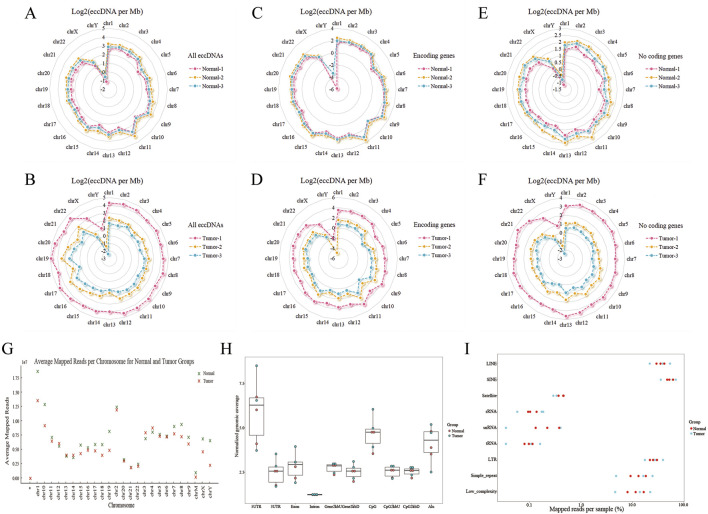
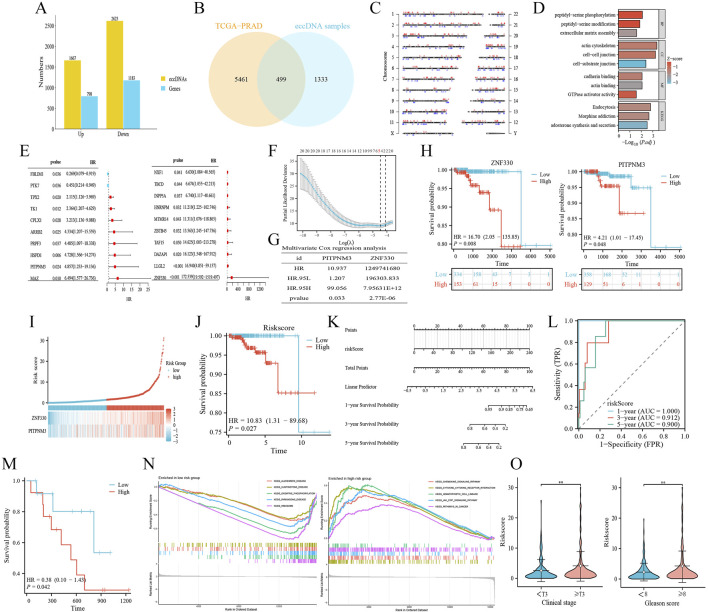
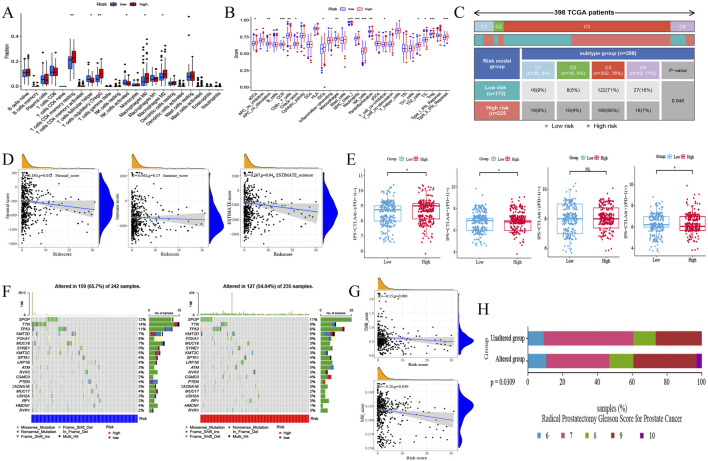
In this research, there was no significant difference in the size, type, and chromosomal distribution of eccDNA in PRAD and para-cancerous normal prostate tissues. However, 4,290 differentially expressed eccDNAs were identified and 1,981 coding genes were amplified. Following that, 499 eDEGs were tested in conjunction with the transcriptome dataset from TCGA-PRAD. By using Cox and Lasso regression techniques, ZNF330 and PITPNM3 were identified as eKDEGs of PRAD, and a new PRAD risk model was conducted based on this. Survival analysis showed that the high-risk group of this model was associated with poor prognosis and validated in external data. Immune infiltration analysis showed that the model risks affected immune cell infiltration in PRAD, not only mediating changes in immune cell function, but also correlating with immunophenotyping. Furthermore, the high-risk group was negatively associated with anti-/anti- response and mutational burden. In addition, Tumor Immune Dysfunction and Exclusion analyses showed that high-risk group was more prone to immune escape. Drug sensitivity analyses identified 10 drugs, which were instructive for PRAD treatment.
and are the eKDEGs for PRAD, which can be used as potential new prognostic markers. The two-factor combined risk model can effectively assess the survival and prognosis of PRAD patients, but also can predict the different responses of immunotherapy to PRAD patients, which may provide new ideas for PRAD immunotherapy.
在前列腺腺癌(PRAD)中,局灶性扩增和染色体外环状DNA(eccDNA)的作用仍不明确。在此,我们首先绘制了eccDNA的全局特征图谱,然后研究了eccDNA扩增的关键差异表达编码基因(eKDEGs)在PRAD进展、免疫反应和免疫治疗中的特征。
将Circular_seq与TCGA-PRAD转录组数据集结合使用,对PRAD和癌旁正常前列腺组织中的eccDNA扩增差异表达编码基因(eDEGs)进行测序、注释和筛选。之后,创建风险模型,并使用Cox和Lasso回归分析确定与PRAD预后相关的eKDEGs。使用多种免疫算法对风险模型的免疫微环境进行量化,同时确定其在免疫治疗、免疫反应和免疫浸润方面的特征。
在本研究中,PRAD和癌旁正常前列腺组织中eccDNA的大小、类型和染色体分布无显著差异。然而,共鉴定出4290个差异表达的eccDNA,1981个编码基因被扩增。随后,结合TCGA-PRAD的转录组数据集对499个eDEGs进行检测。通过Cox和Lasso回归技术,确定ZNF330和PITPNM3为PRAD的eKDEGs,并据此构建了一个新的PRAD风险模型。生存分析表明,该模型的高危组预后较差,并在外部数据中得到验证。免疫浸润分析表明,模型风险影响PRAD中的免疫细胞浸润,不仅介导免疫细胞功能的变化,还与免疫表型相关。此外,高危组与抗/抗肿瘤反应和突变负担呈负相关。此外,肿瘤免疫功能障碍和排除分析表明,高危组更容易发生免疫逃逸。药物敏感性分析确定了10种药物,对PRAD治疗具有指导意义。
ZNF330和PITPNM3是PRAD的eKDEGs,可作为潜在的新预后标志物。双因素联合风险模型可有效评估PRAD患者的生存和预后,还可预测PRAD患者对免疫治疗的不同反应,可能为PRAD免疫治疗提供新思路。