Department of Behavioral Neuroscience, Oregon Health & Science University, Portland, Oregon, USA.
Department of Psychology, Michigan State University, East Lansing, Michigan, USA.
Psychol Med. 2023 Aug;53(11):5167-5176. doi: 10.1017/S0033291722002185. Epub 2022 Aug 1.
Stress is associated with binge eating and emotional eating (EE) cross-sectionally. However, few studies have examined stress longitudinally, limiting understanding of how within-person fluctuations in stress influence EE over time and whether stress is a risk factor or consequence of EE. Additionally, little is known regarding how the biological stress response relates to EE.
We used an intensive, longitudinal design to examine and effects of major life stress, daily stress, and cortisol on EE in a population-based sample of women ( = 477; ages 15-30; = 21.8; s.d. = 3.0) from the Michigan State University Twin Registry. Participants reported past year major life stress, then provided daily ratings of EE and stress for 49 consecutive days. Hair cortisol concentration (HCC) was collected as a longitudinal biological stress measure.
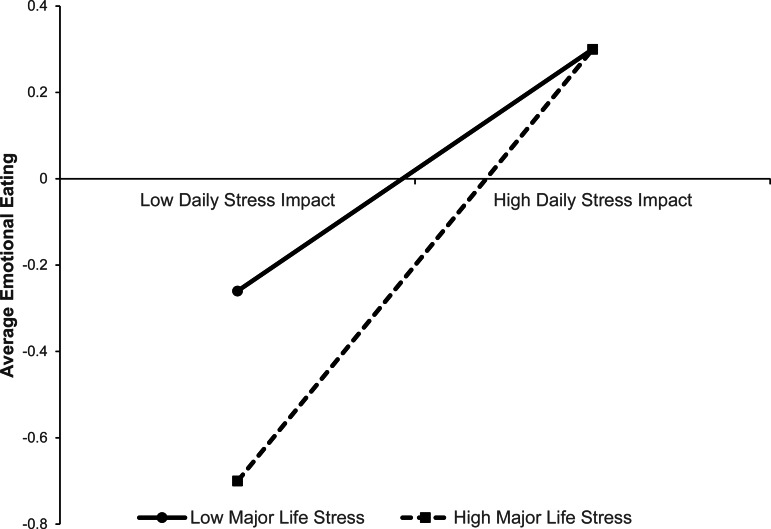
Women reported greater EE when they experienced greater mean stress across days (between-person effects) or greater stress relative to their own average on a given day (within-person effects). Daily stress was more strongly associated with EE than major life stress. However, the impact of daily stress on EE was amplified in women with greater past year major life stress. Finally, participants with lower HCC had increased EE.
Findings confirm longitudinal associations between stress and EE in women, and highlight the importance of shifts in stress in EE risk. Results also highlight HCC as a novel biological stress measure that is significantly associated with EE and may overcome limitations of prior physiological stress response indicators.
压力与暴饮暴食和情绪性进食(EE)存在横断面关联。然而,很少有研究从纵向角度研究压力,这限制了我们对个体内部压力波动如何随时间影响 EE 以及压力是 EE 的风险因素还是后果的理解。此外,关于生物应激反应与 EE 的关系,我们知之甚少。
我们使用密集的纵向设计,在密歇根州立大学双胞胎登记处的基于人群的女性样本(n = 477;年龄 15-30 岁;M = 21.8;SD = 3.0)中,考察重大生活压力、日常压力和皮质醇对 EE 的 和 效应。参与者报告了过去一年的重大生活压力,然后连续 49 天每天报告 EE 和压力的评分。头发皮质醇浓度(HCC)被作为一种纵向生物应激测量方法收集。
女性报告的 EE 更高,当她们经历的平均日压力较大(个体间效应)或与给定日的平均压力相比,压力更大(个体内效应)时。日常压力与 EE 的关联比重大生活压力更强。然而,在过去一年中经历更大生活压力的女性中,日常压力对 EE 的影响更大。最后,HCC 较低的参与者 EE 增加。
研究结果证实了女性中压力与 EE 之间存在纵向关联,并强调了 EE 风险中压力变化的重要性。结果还突出了 HCC 作为一种新型生物应激测量方法的重要性,它与 EE 显著相关,并且可能克服了先前生理应激反应指标的局限性。