China-New Zealand Joint Laboratory on Biomedicine and Health, CAS Key Laboratory of Regenerative Biology, Guangdong Provincial Key Laboratory of Stem Cell and Regenerative Medicine, Guangzhou Institutes of Biomedicine and Health, Chinese Academy of Sciences, Guangzhou 510530, China.
Sanya Institute of Swine Resource, Hainan Provincial Research Centre of Laboratory Animals, Sanya 572000, China.
Nucleic Acids Res. 2023 Oct 13;51(18):10075-10093. doi: 10.1093/nar/gkad687.
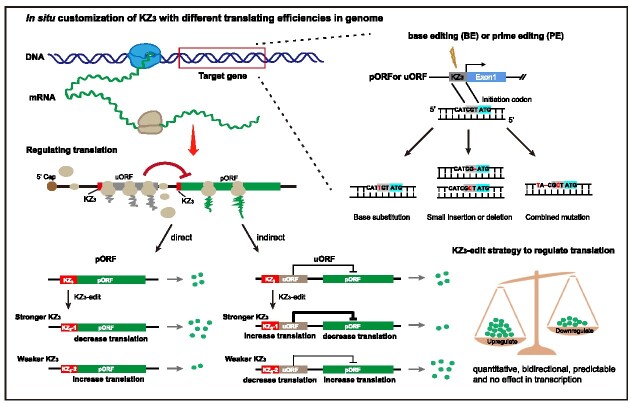
None of the existing approaches for regulating gene expression can bidirectionally and quantitatively fine-tune gene expression to desired levels. Here, on the basis of precise manipulations of the Kozak sequence, which has a remarkable influence on translation initiation, we proposed and validated a novel strategy to directly modify the upstream nucleotides of the translation initiation codon of a given gene to flexibly alter the gene translation level by using base editors and prime editors. When the three nucleotides upstream of the translation initiation codon (named KZ3, part of the Kozak sequence), which exhibits the most significant base preference of the Kozak sequence, were selected as the editing region to alter the translation levels of proteins, we confirmed that each of the 64 KZ3 variants had a different translation efficiency, but all had similar transcription levels. Using the ranked KZ3 variants with different translation efficiencies as predictors, base editor- and prime editor-mediated mutations of KZ3 in the local genome could bidirectionally and quantitatively fine-tune gene translation to the anticipated levels without affecting transcription in vitro and in vivo. Notably, this strategy can be extended to the whole Kozak sequence and applied to all protein-coding genes in all eukaryotes.
目前尚无任何调控基因表达的方法能够对基因表达进行双向、定量地精细调控至预期水平。在这里,基于对 Kozak 序列的精确操作,该序列对翻译起始有显著影响,我们提出并验证了一种新策略,通过碱基编辑器和先导编辑器直接修饰给定基因翻译起始密码子的上游核苷酸,从而灵活改变基因翻译水平。当翻译起始密码子上游的三个核苷酸(称为 KZ3,Kozak 序列的一部分)被选为编辑区域以改变蛋白质的翻译水平时,我们证实,Kozak 序列中最显著的碱基偏好的 KZ3 的 64 种变体中的每一种都具有不同的翻译效率,但转录水平相似。使用具有不同翻译效率的排序 KZ3 变体作为预测因子,在体外和体内,碱基编辑器和先导编辑器介导的 KZ3 在局部基因组中的突变可以双向、定量地将基因翻译精细调节至预期水平,而不影响转录。值得注意的是,该策略可以扩展到整个 Kozak 序列,并应用于所有真核生物中的所有蛋白质编码基因。