National Institute of Public Health NIH-National Research Institute (NIPH NIH-NRI), Warsaw, Poland.
Department of Public Health, Medical University of Warsaw, Warsaw, Poland.
Euro Surveill. 2023 Aug;28(35). doi: 10.2807/1560-7917.ES.2023.28.35.2200745.
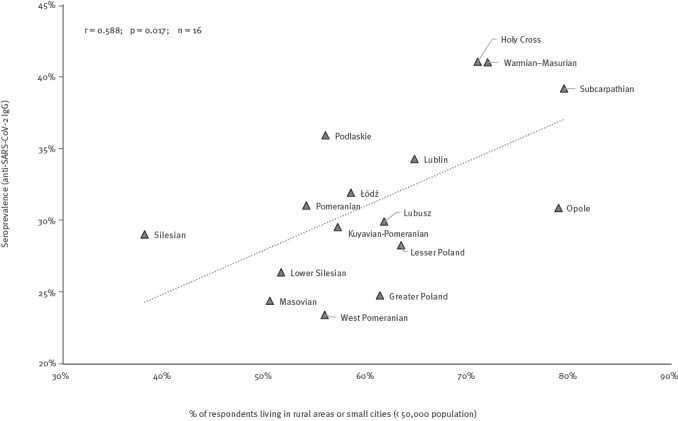
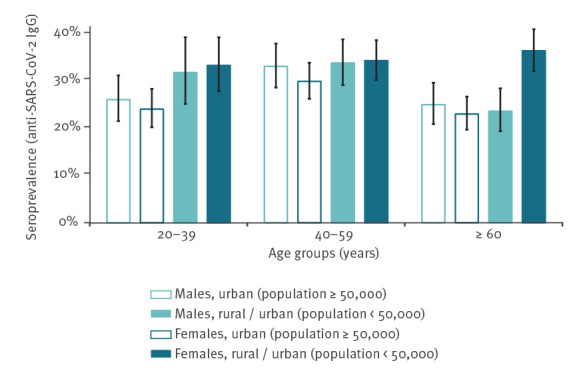
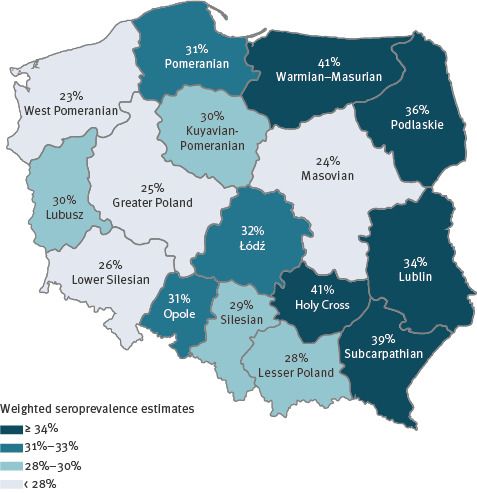
BackgroundWe anticipated that people in rural areas and small towns with lower population density, lower connectivity and jobs less dependent on social interaction will be less exposed to COVID-19. Still, other variables correlated with socioeconomic inequalities may have a greater impact on transmission.AimWe investigated how COVID-19 affected rural and urban communities in Poland, focussing on the most exposed groups and disparities in SARS-CoV-2 transmission.MethodsA random digit dial sample of Polish adults stratified by region and age was drawn from 29 March to 14 May 2021. Serum samples were tested for anti-S1 and anti-N IgG antibodies, and positive results in both assays were considered indicative of past infection. Seroprevalence estimates were weighted to account for non-response. Adjusted odds ratios (AORs) were calculated using multivariable logistic regression.ResultsThere was serological evidence of infection in 32.2% (95% CI: 30.2-34.4) of adults in rural areas/small towns (< 50,000 population) and 26.6% (95% CI: 24.9-28.3) in larger cities. Regional SARS-CoV-2 seroprevalence ranged from 23.4% (95% CI: 18.3-29.5) to 41.0% (95% CI: 33.5-49.0) and was moderately positively correlated (R = 0.588; p = 0.017; n = 16) with the proportion of respondents living in rural areas or small cities. Upon multivariable adjustment, both men (AOR = 1.60; 95% CI: 1.09-2.35) and women (AOR = 2.26; 95% CI: 1.58-3.21) from these areas were more likely to be seropositive than residents of larger cities.ConclusionsWe found an inverse urban-rural gradient of SARS-CoV-2 infections during early stages of the COVID-19 pandemic in Poland and suggest that vulnerabilities of populations living in rural areas need to be addressed.
背景
我们预计,人口密度较低、连通性较低且工作较少依赖社交互动的农村地区和小城镇的人们将较少接触 COVID-19。然而,其他与社会经济不平等相关的变量可能对传播有更大的影响。
目的
我们调查了 COVID-19 如何影响波兰的农村和城市社区,重点关注受感染风险最高的群体以及 SARS-CoV-2 传播方面的差异。
方法
我们于 2021 年 3 月 29 日至 5 月 14 日,对波兰成年人进行了一项基于地区和年龄分层的随机数字拨号抽样。对血清样本进行了针对 S1 和 N 抗体 IgG 的检测,两种检测方法均呈阳性的结果被认为表明过去有过感染。采用加权方法对血清流行率估计值进行了调整,以考虑到无应答情况。采用多变量逻辑回归计算了调整后的优势比(AOR)。
结果
农村地区/小镇(人口<50000)和较大城市中成年人的血清学感染证据分别为 32.2%(95%CI:30.2-34.4)和 26.6%(95%CI:24.9-28.3)。区域 SARS-CoV-2 血清流行率范围为 23.4%(95%CI:18.3-29.5)至 41.0%(95%CI:33.5-49.0),与报告生活在农村地区或小镇的受访者比例呈中度正相关(R=0.588;p=0.017;n=16)。经多变量调整后,与来自较大城市的居民相比,这些地区的男性(AOR=1.60;95%CI:1.09-2.35)和女性(AOR=2.26;95%CI:1.58-3.21)更有可能呈血清阳性。
结论
我们发现,在波兰 COVID-19 大流行的早期阶段,SARS-CoV-2 感染存在城乡反比梯度,这表明需要解决居住在农村地区的人群的脆弱性问题。