National Perinatal Epidemiology Unit, Nuffield Department of Population Health, University of Oxford, Oxford, UK.
Department of Obstetrics and Gynaecology, Gauhati Medical College and Hospital, Guwahati, India.
Am J Hematol. 2023 Nov;98(11):1721-1731. doi: 10.1002/ajh.27059. Epub 2023 Aug 31.
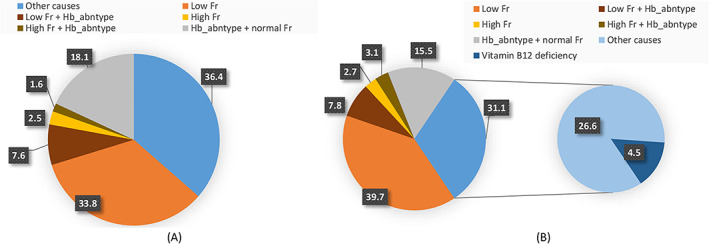
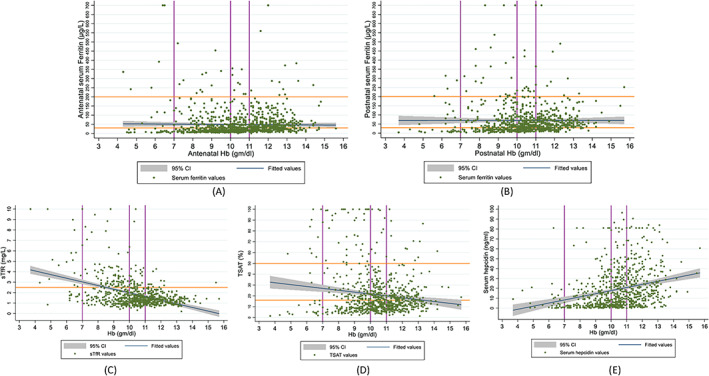
Low hemoglobin is widely used as an indicator of iron deficiency anemia in India and other low-and-middle income counties, but anemia need not accurately reflect iron deficiency. We examined the relationship between hemoglobin and biomarkers of iron status in antenatal and postnatal period. Secondary analysis of uncomplicated singleton pregnancies in two Indian study cohorts: 1132 antenatal women in third trimester and 837 postnatal women 12-72 h after childbirth. Associations of hemoglobin with ferritin in both data sets, and with sTfR, TSAT, and hepcidin in the postnatal cohort were examined using multivariable linear regression. Multinomial logistic regression was used to examine the association between severity of anemia and iron status. Regression models were adjusted for potential confounders. Over 55% of the women were anemic; 34% of antenatal and 40% of postnatal women had low ferritin, but 4% antenatal and 6% postnatal women had high ferritin. No evidence of association between hemoglobin and ferritin was observed (antenatal: adjusted coefficient [aCoef] -0.0004, 95% confidence interval [CI] -0.001, 0.001; postnatal: aCoef -0.0001, 95% CI -0.001, 0.001). We found a significant linear association of hemoglobin with sTfR (aCoef -0.04, 95% CI -0.07, -0.01), TSAT (aCoef -0.005, 95% CI -0.008, -0.002), and hepcidin (aCoef 0.02, 95% CI 0.02, 0.03) in postnatal women. Likelihood of low ferritin was more common in anemic than non-anemic women, but high ferritin was also more common in women with severe anemia in both cohorts. Causes of anemia in pregnant and postpartum women in India are multifactorial; low hemoglobin alone is not be a useful marker of iron deficiency.
血红蛋白在印度和其他中低收入国家被广泛用作缺铁性贫血的指标,但贫血不一定能准确反映缺铁情况。我们研究了产前和产后期间血红蛋白与铁状态生物标志物之间的关系。对两个印度研究队列中的简单单胎妊娠进行二次分析:1132 名妊娠晚期妇女和 837 名产后 12-72 小时的妇女。使用多元线性回归分析了两个数据集中心血红蛋白与铁蛋白的关系,以及产后队列中 sTfR、TSAT 和血红素的关系。使用多项逻辑回归分析了贫血严重程度与铁状态的关系。回归模型调整了潜在混杂因素。超过 55%的女性贫血;34%的产前和 40%的产后女性铁蛋白低,但 4%的产前和 6%的产后女性铁蛋白高。未观察到血红蛋白与铁蛋白之间存在关联(产前:调整系数[aCoef]-0.0004,95%置信区间[CI]-0.001,0.001;产后:aCoef-0.0001,95%CI-0.001,0.001)。我们发现血红蛋白与 sTfR(aCoef-0.04,95%CI-0.07,-0.01)、TSAT(aCoef-0.005,95%CI-0.008,-0.002)和血红素(aCoef 0.02,95%CI 0.02,0.03)呈显著线性相关在产后妇女中。与非贫血妇女相比,贫血妇女铁蛋白低的可能性更大,但在两个队列中,严重贫血妇女铁蛋白高的情况也更为常见。印度孕妇和产后妇女贫血的原因是多因素的;单纯低血红蛋白不能作为缺铁的有用标志物。