Department of Health Sciences (DISSAL), University of Genoa, Genoa, Italy.
Clinica Malattie Infettive, IRCCS Ospedale Policlinico San Martino, Genoa, Italy.
Infection. 2024 Feb;52(1):197-208. doi: 10.1007/s15010-023-02084-x. Epub 2023 Sep 1.
We assessed the laboratory diagnosis and treatment of invasive fungal disease (IFD) in Italy to detect limitations and potential for improvement.
The survey was available online at www.clinicalsurveys.net/uc/IFI management capacity/, and collected variables such as (a) institution profile, (b) perceptions of IFD in the respective institution, (c) microscopy, (d) culture and fungal identification, (e) serology, (f) antigen detection, (g) molecular tests, (h) susceptibility testing and (i) therapeutic drug monitoring (TDM).
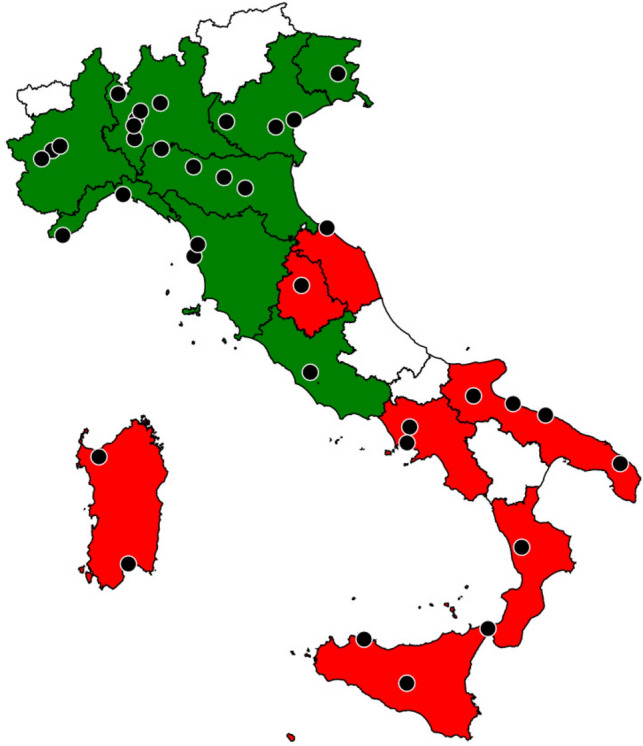
The laboratory capacity study received responses from 49 Italian centres, with an equitable geographical distribution of locations. The majority of respondents (n = 36, 73%) assessed the occurrence of IFD as moderate-high, with Aspergillus spp. being the pathogen of highest concern, followed by Candida spp. and Mucorales. Although 46 (94%) of the institutions had access to microscopy, less than half of them performed direct microscopy on clinical specimens always when IFD was suspected. Cultures were available in all assessed laboratories, while molecular testing and serology were available in 41 (83%), each. Antigen detection tests and antifungal drugs were also generally accessible (> 90%) among the participating institutions. Nevertheless, access to TDM was limited (n = 31, 63%), with a significant association established between therapeutic drug monitoring availability and higher gross domestic product per capita.
Apart from TDM, Italy is adequately prepared for the diagnosis and treatment of IFD, with no significant disparities depending on gross domestic product. Future efforts may need to focus on enhancing the availability and application of direct microscopic methods, as well as TDM, to promote optimal treatment and better patient outcomes.
我们评估了意大利侵袭性真菌病(IFD)的实验室诊断和治疗情况,以发现其中的局限性和改进潜力。
该调查可在 www.clinicalsurveys.net/uc/IFI management capacity/ 网站上在线填写,收集的变量包括(a)机构概况、(b)各机构对 IFD 的认识、(c)显微镜检查、(d)培养和真菌鉴定、(e)血清学、(f)抗原检测、(g)分子检测、(h)药敏试验和(i)治疗药物监测(TDM)。
该实验室能力研究收到了来自意大利 49 个中心的回应,地理位置分布均衡。大多数受访者(n=36,73%)认为 IFD 的发生率为中高,曲霉属是最受关注的病原体,其次是念珠菌属和毛霉目真菌。尽管 46 个(94%)机构可以进行显微镜检查,但不到一半的机构在怀疑 IFD 时始终对临床标本进行直接显微镜检查。所有评估的实验室均提供培养,而分子检测和血清学分别在 41 个(83%)实验室中提供。抗原检测试验和抗真菌药物也在参与机构中普遍可用(>90%)。尽管如此,TDM 的可及性有限(n=31,63%),TDM 的可及性与人均国内生产总值之间存在显著关联。
除 TDM 外,意大利在 IFD 的诊断和治疗方面准备充分,与人均国内生产总值无关。未来的工作可能需要侧重于提高直接显微镜方法和 TDM 的可用性和应用,以促进最佳治疗和更好的患者结局。